From Kibbutz to the global stage
The MBS–Al Thani Meeting Accelerates IMEC: The Rail Line Redraws the Area Map
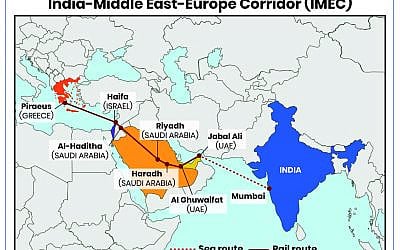
Most of the land bridge — from Doha and Riyadh through NEOM, Aqaba, Jordan and Israel to Europe — already exists.
The newly signed Doha–Riyadh rail line completes the key eastern section.
(Image: Public domain / Free-to-use map)
The MBS–Al Thani Meeting Accelerates IMEC: The Doha–Riyadh Rail Line Redraws the Regional Map.
A surprise Qatar–Saudi alignment, sealed in Riyadh, signals a new phase in the emerging Middle Eastern economic corridor — just days before expected announcements from Washington.
Qatar’s Emir Visits Riyadh: Not a Ceremonial Gesture — but a Move in a New Regional Architecture
Qatar’s Emir visited Riyadh on Monday, in the middle of the second day of the Doha Forum, even as Doha publicly warned that it “will not fund the destruction in Gaza caused by Israel.”
The implicit message was aimed — almost certainly — at Saudi Arabia: Qatar will not stand alone, and the region must now make collective decisions.
Despite friction in recent days between Riyadh and Abu Dhabi — over Yemen, Sudan, and broader strategic disagreements — Saudi Arabia invited the Emir precisely now, with the highest level of protocol.
MBS personally welcomed him at the airport and at the palace, with full media coverage and ceremonial honors.
The reasons are clear:
- Full regional coordination ahead of a major political–economic realignment.
- Bringing Qatar into the new architecture — not necessarily as a leader, but as a critical bridge.
- Neutralizing Qatar’s potential to disrupt the process, just as Washington moves toward announcing Phase Two and the Peace Council.
Qatar has always been a central actor in Gaza. The fact that it is now drawing closer to Saudi Arabia at this specific moment of American diplomatic momentum points to something larger.
Saudi Arabia’s Message: “We are unifying the Sunni camp before the big move.”
What is unfolding in Riyadh amounts to:
- A Saudi attempt to dominate the regional narrative,
- A Qatar–Saudi–UAE alignment,
- Building a consolidated Sunni bloc opposite Iran,
- And a signal to Israel: The train is leaving the station. You are welcome on board — but the 20-point Trump plan and the UN Security Council framework must be implemented.
This is also one of the clearest indications yet that Saudi Arabia intends to play a central role in Trump’s emerging Peace Council.
The Agreements Signed: Technology, Infrastructure — and Above All, the Doha–Riyadh Rail Line.
The visit produced a series of agreements in:
- Technology
- Infrastructure
- Economy
- Political coordination
- Media policy — Qatar agreed to address hostility in some media outlets and restrict indirect channels of funding to extremist groups, a long-standing Saudi demand.
But the most consequential agreement was economic:
The Doha–Riyadh High-Speed Rail (735 km): The Physical Backbone of IMEC:
The two states signed an agreement to build a 735 km high-speed electric rail line for passengers and freight, linking both capitals and their major airports — a central pillar of the Gulf region’s future infrastructure grid.
This is the key missing piece in the land corridor that connects the Gulf to Europe — known as IMEC, the India–Middle East–Europe Corridor envisioned in the Abraham Accords and later frameworks.
The timing strongly suggests Saudi Arabia is preparing to join Trump’s Peace Council.
The signing comes just days before expected announcements in Washington.
Existing Rail Segments Show the Land Bridge Is Nearly Complete
1. Saudi Arabia: Riyadh → Al-Jawf → Tabuk → NEOM.
This section already exists as part of the North–South Railway (since 2018):
- Freight lines
- Passenger lines
- Upgradable to high-speed standards
The route reaches almost to the Red Sea coast opposite Aqaba.
2. NEOM as a Global Junction.
The current railway will:
- Connect to NEOM’s port
- Connect to the Tabuk–Jordan line
- Turn NEOM into the strategic hinge between the Gulf and the Mediterranean
A core component of IMEC.
3. Jordan: The Aqaba Line Already Exists.
Jordan already operates:
- Freight lines across the country
- The Port of Aqaba
- A north–south rail spine capable of expansion
4. Israel: Only 4–12 km Are Missing (!) for Full Connectivity.
- The Beit She’an line exists
- Extensions toward Tiberias and Kiryat Shmona are planned
- Jordan’s line reaches the border
The gap is only a few kilometers.
The result:
Doha → Riyadh → NEOM → Aqaba → Northern Jordan → Beit She’an → Haifa → Europe
The land bridge is almost complete — even before political announcements.
The Only Missing Piece: The Maritime Segment from Mumbai to Oman.
IMEC’s original design featured:
- A land corridor — nearly complete
- A maritime corridor — from Mumbai to Oman/UAE
But the maritime section:
- Lacks viable technology
- Is economically questionable
- Has no official engineering progress
- Relies on unproven subsea infrastructure
It has barely advanced since 2023.
This means the Gulf states do not actually need India to complete IMEC 2.0.
IMEC Without India: The Arabs Are Already Building a New Version.
This is the major shift:
The Arab–European IMEC ≠ the original India–Middle East–Europe IMEC.
The new version progresses without dependence on India, using two alternative extensions:
Route 1 — North:
Saudi Arabia → Jordan → Syria → Turkey → Europe
Route 2 — East:
Jordan → Iraq → Iran → Pakistan → India / China
Thus:
The Arab–European corridor could integrate with China’s Belt & Road — even without India.
Strategic Meaning: The Gulf Is Moving Ahead — Partners May Join Later.
The signing of the Doha–Riyadh rail line sends a simple message:
“We are building our land bridge. Anyone who wants to join is welcome — but we will not wait.”
This demonstrates:
- Saudi Arabia’s rise to one of the most strategic logistical positions in the world
- Qatar’s integration into the regional corridor
- The UAE’s gain in freight volumes
- Israel’s role as a gateway to Europe
- Gaza reconstruction becoming feasible within the corridor
- India free to join later — but no longer indispensable
Related Topics
Related Posts