
The Mecca Agreement and Europe’s New Southern Front
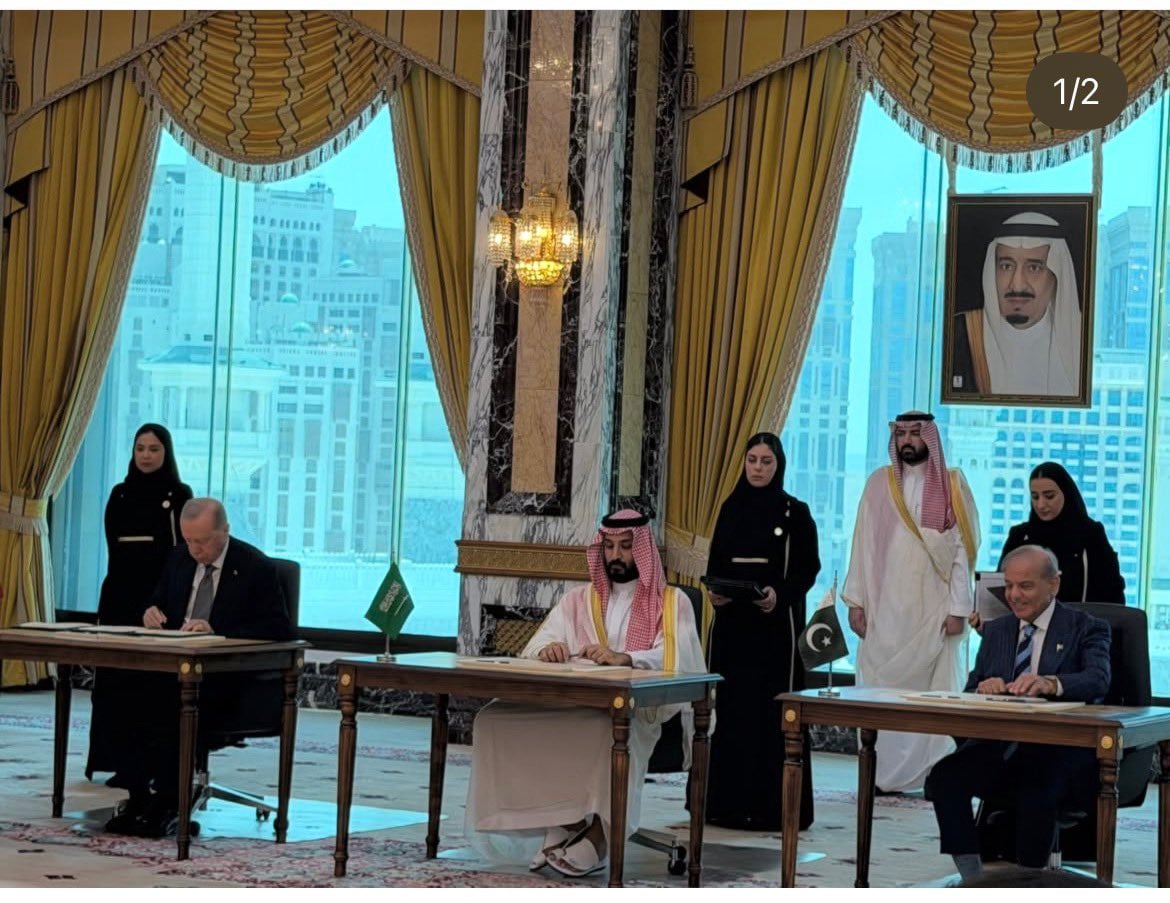
Europe has spent the last four years almost entirely focused on its eastern frontier. Russia’s invasion of Ukraine brought NATO back to its original purpose, increased defence expenditure across the continent and forced European governments to think seriously about military security after decades of relative complacency. While Europe continues to look east, however, a very different strategic architecture is developing to its south.
The Mecca Joint Defence Agreement (Mecca Pact) signed on 7th August by Saudi Arabia, Turkey and Pakistan deserves considerably more European attention and concern than it has received. The agreement establishes that an attack against one of the three countries will be considered an attack against all. Turkish Foreign Minister Hakan Fidan has himself compared the principle to NATO’s Article 5. The agreement also provides for regular meetings between foreign and defence ministers and a permanent secretariat in Saudi Arabia as well as efforts to get Egypt to join the alliance.
The three countries bring very different strengths to the alliance. Saudi Arabia has enormous financial resources and influence across the Islamic world. Pakistan has one of the largest armed forces in Asia and is the only Muslim nuclear power. Turkey has the second-largest army in NATO, an increasingly sophisticated defence industry and, most importantly for Europe, geography.
Turkey is not a distant Middle Eastern power. It borders Greece and Bulgaria, controls the Bosphorus and Dardanelles and has established an increasingly important military presence in Syria and Libya. It is also involved in a long-running dispute with Greece and Cyprus over maritime boundaries, territorial waters and economic zones in the Eastern Mediterranean.
The Mecca Pact therefore cannot be viewed only in the context of the Middle East or the recent war with Iran. Its importance for Europe comes principally from Turkey.
For President Recep Tayyip Erdoğan, the agreement fits into a foreign policy pursued consistently for more than a decade. Turkey does not want to abandon NATO, but neither does it want its foreign policy determined by NATO. It wants to remain inside the Western alliance while simultaneously building an independent sphere of political, economic and military influence.
This policy has often appeared contradictory to Europeans. Turkey purchased the Russian S-400 air defence system while remaining a member of NATO. It has supported Ukraine while keeping channels with Moscow open. It has negotiated migration agreements with the European Union while repeatedly confronting Greece and Cyprus. It intervened militarily in Libya and Syria without waiting for a European or American consensus.
There is little contradiction in any of this from Ankara’s perspective. Turkey follows Turkish interests.
The Mecca Pact considerably expands the possibilities available to Erdoğan. Saudi Arabia has money but remains dependent on foreign military technology. Pakistan has military manpower, considerable defence experience and nuclear weapons, but faces serious economic limitations. Turkey has developed a large indigenous defence industry producing drones, missiles, warships, armoured vehicles and electronic warfare systems and has become an important exporter of military technology.
There is therefore the possibility of the agreement developing beyond a conventional mutual-defence pact into a defence-industrial partnership. Saudi capital, Turkish technology and Pakistani military capacity are complementary in a way that should not be underestimated.
This becomes particularly relevant in the Eastern Mediterranean. Greece and Turkey remain NATO allies, but their fundamental disputes have never been resolved. The Aegean, Cyprus, territorial waters, airspace and maritime economic zones continue to produce regular tensions. Turkey’s Blue Homeland doctrine also challenges the maritime order which Greece and Cyprus consider established.
Ankara’s maritime agreement with Libya already attempted to redraw the strategic map of the Eastern Mediterranean by creating a Turkish-Libyan maritime corridor cutting across claims made by Greece.
The immediate danger is not that Pakistan will suddenly send soldiers to the Aegean or Saudi Arabia will confront Greece. That would be an absurd interpretation of the Mecca agreement. The more important question is whether a wider alliance gives Turkey greater strategic confidence and resources in pursuing policies which already bring it into disagreement with European states.
Libya is even more important for Italy. Turkey’s military intervention in 2020 prevented the collapse of the Tripoli government during Khalifa Haftar’s offensive. Turkish troops, advisers, drones and military infrastructure subsequently became part of Libya’s security environment.
Ankara has now begun developing relations with Haftar as well. Turkey entered Libya as the military supporter of one side. If it can maintain its position in Tripoli while simultaneously building relations with eastern Libya, it becomes a power capable of dealing with both principal centres of Libyan authority.
For Italy and Europe this has direct consequences. Libya is one of Europe’s principal sources of migration pressure, an important energy supplier and a country sitting immediately opposite the Italian coast. Whoever exercises influence in Libya consequently has influence over the Central Mediterranean.
Europe has already discovered how migration can become an instrument of foreign policy in its relations with Turkey. During the Syrian refugee crisis Erdoğan repeatedly demonstrated that Ankara understood the political importance of Europe’s dependence on Turkey to control migration flows.
Syria represents another area where the regional balance is changing rapidly.The fall of Bashar al-Assad dramatically weakened Iran’s position in the Levant. For decades Tehran had constructed a corridor running through Iraq and Syria towards Hezbollah in Lebanon. The loss of Assad disrupted this architecture and created space for Turkey.
Ankara today has considerable influence over the new Syrian political and security establishment. Syria and Libya both participated in Turkey’s EFES-2026 military exercise this year, demonstrating the extent to which Turkey is attempting to place itself at the centre of new regional security relationships.
Israel is already watching this development carefully. Israeli strikes on Syria’s Abu al-Duhur airbase have been linked to concerns that the facility could eventually host Turkish forces. Ankara has denied that such a deployment is planned, but the incident itself is significant. Israel now considers the possibility of a greater Turkish military presence in Syria important enough to include in its strategic calculations.
Lebanon may eventually become the next arena. Iranian influence in Lebanon has traditionally depended on Hezbollah and its access through Syria. A weaker Iran and a transformed Syria inevitably change the Lebanese balance. Turkey does not need to replace Iran or attempt to reproduce Tehran’s relationship with Hezbollah. It has other instruments available, particularly among Sunni communities, and can combine political influence with economic assistance and its historical relationship with the Levant.
Saudi Arabia’s involvement through the Mecca Pact makes this considerably more interesting. Riyadh has historically had substantial influence in Lebanon and particularly among Lebanese Sunnis. A Turkey-Saudi strategic understanding therefore has implications extending beyond the immediate members of the pact.
This emerging Sunni axis should not be exaggerated into a religious alliance preparing for confrontation with Europe. Saudi Arabia and Turkey remain important European partners and Pakistan has extensive relations with Britain and the European Union. The agreement itself is presented as defensive.
But it would be equally mistaken to ignore the religious and geopolitical circumstances in which it has emerged.
Iran, the principal Shia power in the Middle East, has been considerably weakened. Israel has demonstrated unprecedented military reach across the region. Confidence in unconditional American security guarantees has declined. Three of the most important Sunni states have responded by creating a collective security arrangement.
Egypt has already been mentioned in discussions surrounding a possible expansion of the grouping. Were Cairo eventually to join, the geography of the alliance would change significantly. It would connect the Eastern Mediterranean, Red Sea, Gulf and South Asia within a single security framework.
Europe would then have this new architecture directly across the Mediterranean. There is also a peculiar problem created by Turkey’s membership of NATO. Turkey would simultaneously belong to two collective security systems. This is not necessarily incompatible, but it raises questions when the interests of the two organisations diverge, particularly because Turkey has unresolved disputes with another NATO member, Greece.
Europe needs to consider what would happen during a serious Greek-Turkish crisis if Ankara sought political, economic or military support from its Mecca Pact partners. Even without direct military intervention, Saudi financing, Pakistani military cooperation or greater defence-industrial integration could alter the balance of power in the Eastern Mediterranean.
Pakistan’s nuclear status adds another dimension. There is currently no evidence that Islamabad has extended a nuclear guarantee to Turkey or Saudi Arabia and it would be wrong to suggest otherwise. Nevertheless, Pakistan is a nuclear weapons state entering a collective defence arrangement. That fact inevitably changes the strategic weight of the organisation.
For Europe, and particularly for Italy, the wider problem is that the Mediterranean is once again becoming an area of serious geopolitical competition.
Russia retains important interests in the region. China has developed ports, infrastructure and commercial relationships across the Mediterranean. Gulf countries are increasingly important investors and political actors. Israel has demonstrated its willingness to use military force across a very wide geographical area. Turkey now has military or political influence stretching from the Caucasus through Syria to Libya. Russia is engaging in Libya, on Italy’s shores after having settled its use of ports and airports in Syria.
Europe, despite being the largest economic power bordering the Mediterranean, often remains reactive.
The Mecca Pact does not represent an immediate military threat to Europe and treating it as one would obscure the real issue. It represents the emergence of a new strategic bloc whose most powerful conventional military member sits directly on Europe’s frontier and is already involved in several of the regions most important to European security.
Turkey is present opposite Greece, in Syria, in Libya and increasingly in the wider Levant. Saudi Arabia can provide the financial depth required to sustain a much larger regional role, while Pakistan brings military capacity and the political weight of nuclear weapons.
For decades Europe could assume that the Mediterranean security order was ultimately guaranteed by the United States and NATO. That assumption is becoming increasingly difficult to sustain.
Europe has spent billions preparing its eastern frontier for the Russian threat. It now needs to look south.
The Mecca Pact may have been signed in Saudi Arabia, but its western frontier is already at Europe’s doorstep.