
Reading Between Borders and Battlefields
The Mecca Pact: What Does It Mean for Israel’s Intelligence
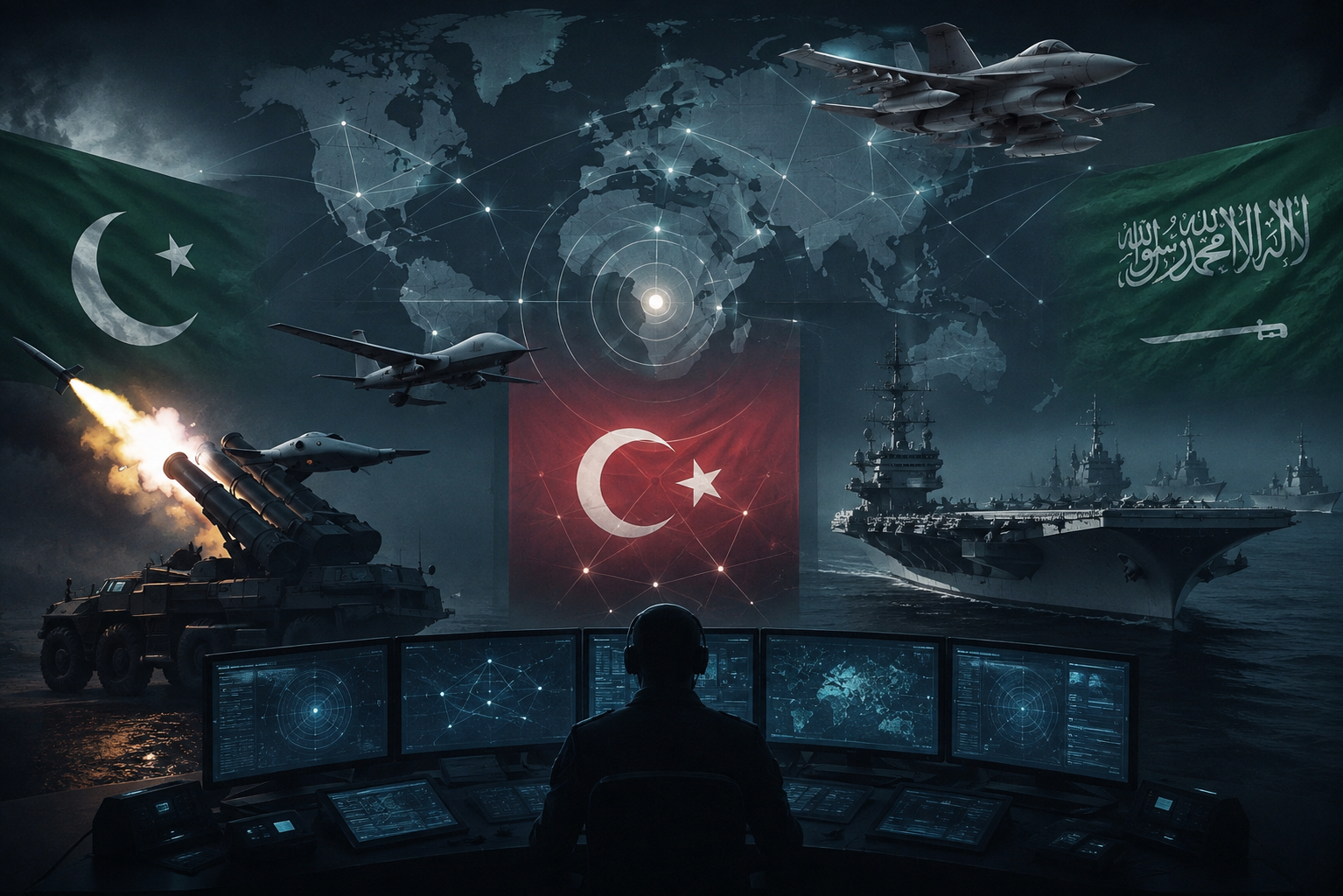
AI-generated illustration depicting an emerging security and defence architecture linking Türkiye, Pakistan and Saudi Arabia through the lens of intelligence, military capability and strategic coordination.
On August 7, Saudi Arabia, Pakistan and Türkiye signed the Mecca Joint Defence Agreement, declaring that an armed attack against one member would be regarded as an attack against all three. Turkish Foreign Minister Hakan Fidan has compared its mutual-defence principle to NATO’s Article 5, while also stressing that the pact is not directed against Iran or any other country.
The immediate debate has focused on military power. For Israel, the more consequential question may be what happens behind the military hardware.
What information will these three states share? What threats will they monitor together? And could a defence partnership gradually develop into a regional intelligence architecture?
That is where the Mecca Pact deserves closer attention. The Pact Is More Than Three Militaries. The three members bring very different strategic capabilities.
Pakistan contributes a nuclear deterrent, a large military and decades of defence cooperation with Saudi Arabia. Türkiye brings NATO membership, substantial military capabilities and an increasingly sophisticated defence industry. Saudi Arabia brings enormous economic resources, strategic geography and a growing network of security partnerships.
But these capabilities do not automatically form an integrated military bloc.
The real test will be whether the agreement produces interoperability: joint exercises, common procedures, air and missile-defence coordination, cyber cooperation, maritime surveillance and most importantly intelligence-sharing.
The agreement itself does not publicly establish a trilateral intelligence service or a mechanism directed against Israel. Its precise implementation also remains unclear. That distinction matters. Analysts should distinguish between what the treaty establishes and what it could eventually enable.
The Intelligence Question
For Israel, the critical issue is therefore not simply:
Is this an anti-Israel alliance? That is too narrow.
The more useful intelligence questions are:
What capabilities are being integrated?
What information is being exchanged?
Which threats are being jointly assessed?
What military technologies and operational practices are moving between them?
And finally: Under what circumstances would the collective-defence commitment actually be activated?
These are the questions that transform treaty analysis into intelligence analysis. A defence agreement becomes strategically significant when political commitments are translated into institutional habits shared exercises, common threat assessments, liaison relationships and information flows.
Why Saudi Arabia Is the Critical Variable
Saudi Arabia makes this development particularly important for Israel.
Riyadh has been diversifying its security relationships rather than relying exclusively on one external guarantor. Its defence relationship with Pakistan was already elevated by the September 2025 Strategic Mutual Defence Agreement, which created a new security linkage between South Asia and the Gulf. The International Institute for Strategic Studies has described that relationship as part of wider shifts in the security dynamics connecting the two regions.
The Mecca Pact adds Türkiye to that equation. This does not mean Saudi Arabia has abandoned its existing relationships with Washington or that Riyadh has chosen a permanently anti-Israel alignment. Saudi strategic interests remain broader than any single regional rivalry.
But from an Israeli perspective, diversification itself matters.
A regional actor with multiple security partners possesses more options.
And intelligence agencies pay close attention to options.
Türkiye Changes the Equation
Türkiye’s participation gives the arrangement another dimension.
Ankara is a NATO member with extensive defence-industrial capabilities and established military ties with Pakistan. The three countries had also been deepening defence-industrial cooperation before the agreement was signed.
For Israeli intelligence analysts, this creates a broader question about technology and doctrine.
Weapons are only one component of military power.
Training, electronic warfare, unmanned systems, cyber capabilities, command-and-control procedures and operational experience can travel through defence relationships just as effectively as physical equipment.
The movement of those capabilities will therefore be worth watching.
The Iran Factor
There is another reason Israel should resist simplistic interpretations.
The pact’s members do not share identical relationships with Iran.
Saudi Arabia has sought to manage its rivalry with Tehran. Pakistan has historically maintained a delicate relationship with Iran while deepening its strategic partnership with Riyadh. Türkiye likewise has its own interests in maintaining a workable relationship with Tehran.
Indeed, Turkish and Pakistani officials have explicitly rejected the idea that the new agreement is directed against Iran.
That makes the pact more interesting—not less.
A sophisticated intelligence assessment should not assume that three states will behave as one.
It should identify where their interests converge and where they diverge.
Those points of divergence may ultimately matter as much as the agreement itself.
What Should Israel Watch?
Israel does not need to wait for the pact to become a fully integrated alliance before assessing its implications.
The indicators will appear gradually.
Israeli intelligence and policymakers should watch for:
- increasingly sophisticated trilateral military exercises;
- institutionalised intelligence liaison;
- integrated air and missile-defence arrangements;
- cyber and electronic-warfare cooperation;
- defence-industrial joint ventures;
- movement of military technology and training;
- shared maritime and air-surveillance capabilities;
- and the emergence of common threat assessments.
These indicators would tell Israel far more than political rhetoric.
A treaty can announce an intention.
Military institutions reveal whether that intention has become capability.
The Bigger Strategic Picture
The Mecca Pact should also be viewed within a broader regional movement toward strategic autonomy.
The Middle East is no longer organised exclusively around a single external security architecture. Regional powers are increasingly building overlapping partnerships to reduce dependence on any one major power.
The International Institute for Strategic Studies has described the emerging Saudi-Pakistani-Turkish alignment as part of a wider transformation in the regional security landscape.
For Israel, this creates a different strategic environment.
The challenge is no longer simply to understand individual adversaries.
It is to understand networks.
A networked security environment can transfer information, technology, training and strategic influence across borders without requiring a formal military command structure.
That is precisely why intelligence becomes more important.
The Mossad Question
For Mossad, this does not necessarily mean that a new adversarial bloc has emerged.
It means that a new intelligence problem has appeared.
Mossad, Aman and Israel’s wider intelligence community will need to distinguish between political symbolism and operational integration.
The central question is not whether Saudi Arabia, Pakistan and Türkiye can put large numbers of troops, aircraft or missiles on a map.
It is whether they can develop the information advantage necessary to employ those capabilities collectively.
That distinction is fundamental.
Modern strategic competition is increasingly determined not only by who possesses the most weapons, but by who can detect a threat first, interpret it correctly and coordinate a response faster.
The Intelligence Takeaway
The Mecca Pact may eventually become a significant regional defence arrangement. It may also remain more limited than its rhetoric suggests.
It is too early to know.
But that uncertainty is precisely why intelligence matters.
For Israel, the task is not to predict the alliance from its opening ceremony. It is to monitor what develops afterward.
Watch the exercises.
Watch the technology.
Watch the officers who meet.
Watch the information that moves.
Because the real power of an alliance is rarely written in the treaty.
It is built in the intelligence networks beneath it.
Related Topics