
The Meeting Netanyahu Cannot Fully Control
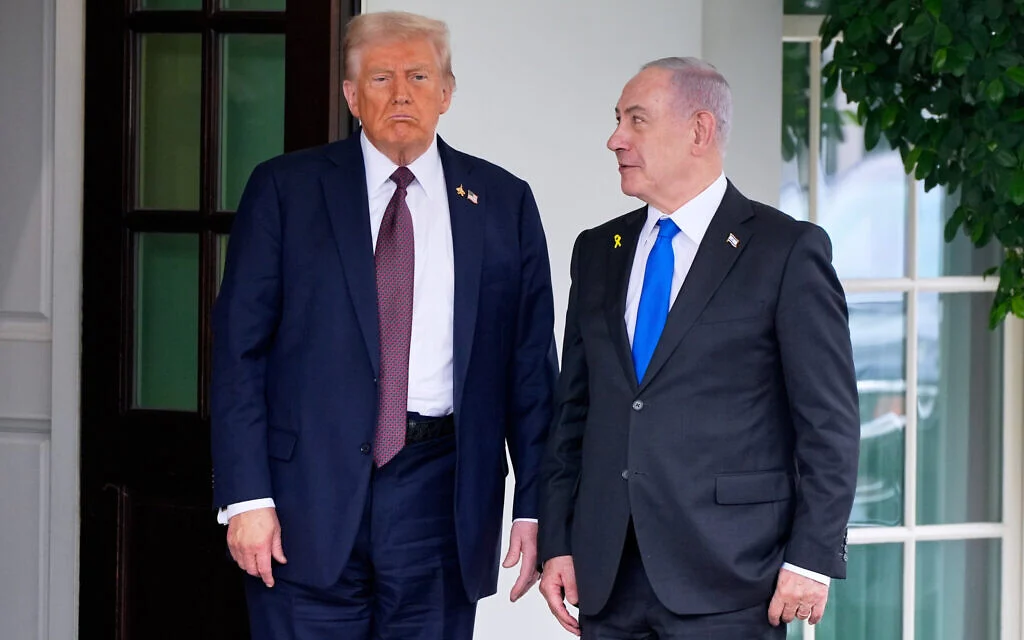
Benjamin Netanyahu has flown to Washington this week to discuss Iran with a president whose calculus on Iran no longer runs through Jerusalem. That is the plain reading of the last ten days. Donald Trump halted the bombing campaign not because Israeli threat assessments changed, but because the Pentagon’s target list in the Strait of Hormuz was exhausted and its stock of interceptors was running low. Mediators from Qatar, Pakistan, Egypt, and Oman moved into the resulting space, and by the time Netanyahu boarded his plane from Nevatim rather than Ben Gurion, a Hormuz transit proposal already had Iranian and Omani sign-off and awaited only Trump’s word. Netanyahu’s stated goal for the trip, to secure Israel’s future, described an outcome. It said nothing about who now holds the pen.
This is worth naming directly, because it inverts the assumption built into most commentary on the US-Israel relationship: that the senior partner’s Iran policy tracks the junior partner’s threat perception, with disagreements settled by persuasion in Washington. Neoclassical realism offers a more useful lens here than either the crude power-politics account (Washington does what serves its interests, full stop) or the values-based account (allies converge because they share a threat). The theory’s contribution is to insist that systemic pressure, in this case Iranian retaliatory capacity and the broader question of who controls the world’s most important oil chokepoint, gets refracted through unit-level variables before it becomes policy. Those variables, this month, are an exhausted interceptor inventory, a set of Gulf and South Asian mediators with their own incentives to end a war disrupting shipping through their waters, and a president fourteen months from a midterm election who has already told Axios that talks should move fast or not happen at all. None of those pressures originate in Jerusalem, and none of them are subject to Israeli veto.
The historical analogy that comes to mind is 1956, when Eisenhower forced Israel, Britain, and France out of Sinai over Suez regardless of the military logic Ben-Gurion had constructed for the operation. The comparison illuminates something real: an American president willing to let his own operational and political constraints override an ally’s argument about the shape of victory. But the analogy also breaks under its own weight. Eisenhower applied direct coercion, including a currency crisis engineered through the IMF. Trump has applied no comparable pressure on Israel; he has simply stopped acting on Israel’s preferred timeline while Israel remains, notably, absent from the current round of fighting altogether. The 2026 case is a story of divergence by omission rather than confrontation by design, and Netanyahu retains tools Ben-Gurion did not, chiefly a nuclear posture Ben-Gurion never possessed, and a domestic American political coalition that no single president relishes crossing publicly. The instrument is different even where the structural position, arriving in Washington to discover the timetable has already moved without you, rhymes.
None of this means Netanyahu leaves the meeting empty-handed. The report that Trump initially declined to meet him at all, relenting only after an Israeli concession on Gaza, suggests the leverage runs in both directions, however lopsided the balance. And Netanyahu’s own domestic position, an election year, a primary process consolidating his control over the Likud slate, a coalition partner threatening to declare Qatar an enemy state days before Doha’s mediators broker the deal Israel will have to live with, gives him reasons to extract something visible from Tuesday’s session even if the Hormuz arrangement proceeds largely on Washington’s terms. Small and middle powers inside asymmetric alliances rarely get to set the agenda; they get to shape the margins, attach conditions, and occasionally veto the parts that touch their own territory directly. Israel’s position this week resembles that pattern more than it resembles the language, on both sides, of a partnership managing a shared threat in lockstep.
The deeper lesson travels beyond this particular war. Alliance theory that treats patron and client preferences as pre-aligned by shared interest will consistently miss moments like this one, where the patron’s own bureaucratic and electoral constraints do the deciding and the client’s argument, however well constructed, arrives after the fact. Bibi is right that Iran will top the agenda in that Oval Office conversation. He is on weaker ground insisting that Iran policy will be decided there.