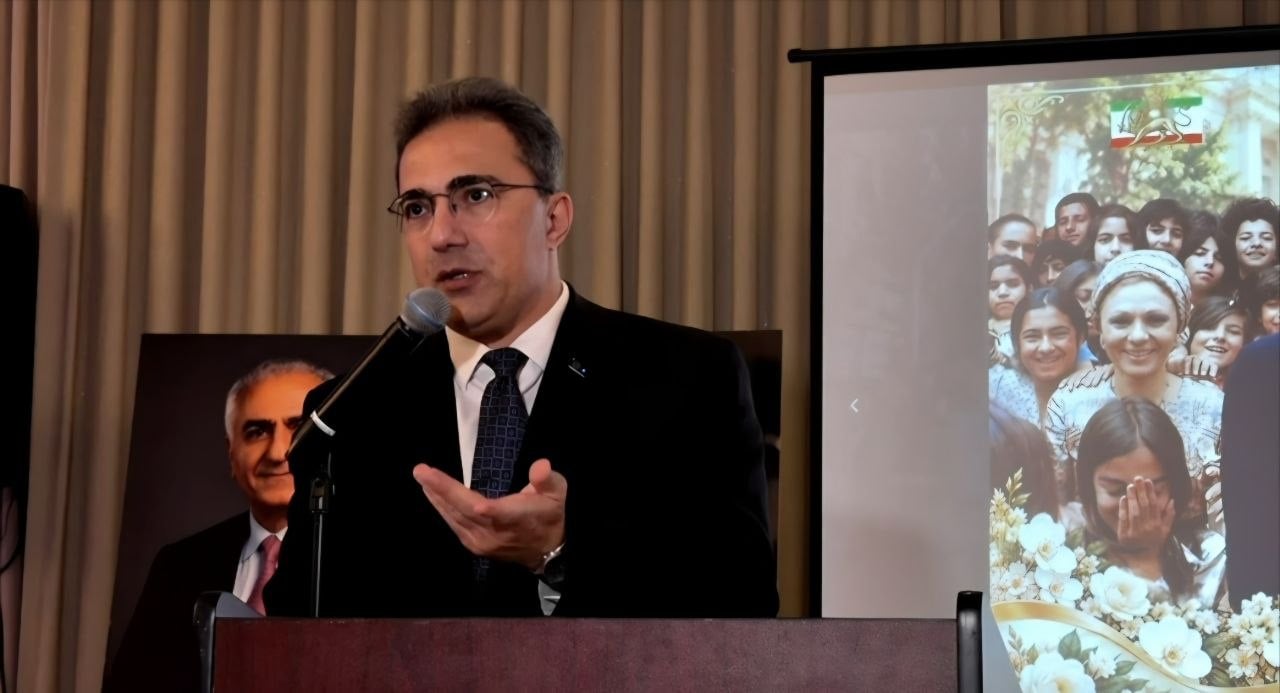
Erfan Fard , The 88th birthday of Empress farah Pahlavi , NY 11 Oct 2026 - Picture : https://erfan-fard.com/
The MEK’s filthy campaign of character assassination, aided by separatist factions and the Barzani political machine, is yet another desperate attempt to bury the truth beneath fabricated dossiers, mutilated photographs, and the poisonous propaganda of the revolutionary forces that helped destroy Iran in 1979.
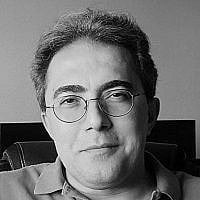
There is something profoundly rotten about a political organization that cannot confront its critics without digging through their past, mutilating photographs, recycling unsubstantiated accusations, and dressing character assassination in the respectable clothing of investigative journalism. (My professional photo album)
The latest article attacking me, published under the title “Erfan Ghanei-Fard’s Defense of SAVAK and His Campaign Against Iran’s Opposition,” is a textbook example of this intellectual dishonesty. It is not a serious examination of my research, political positions, or professional record. It is a crude political indictment constructed from insinuations, selective quotations, historical distortions, and an almost desperate determination to discredit anyone who challenges the revolutionary mythology of the terrorist thugs of People’s Mojahedin Organization of Iran (MEK).
The timing is particularly revealing. At a moment when the Islamic Republic faces profound political instability and the question of Iran’s future has become increasingly urgent, certain opposition factions appear more interested in attacking their ideological competitors than confronting the clerical dictatorship itself. The MEK’s hostility toward Crown Prince Reza Pahlavi is hardly a secret. Neither is its resentment toward researchers who challenge the violent legacy of the 1979 revolution. I have spent decades examining the political forces that helped destroy Iran’s constitutional monarchy, including revolutionary Islamists, Marxist-Leninist guerrillas, and armed organizations that subsequently attempted to disguise their own histories beneath the language of democracy and human rights. I have no intention of surrendering that historical inquiry to the self-appointed guardians of revolutionary innocence.
The central exhibit in this latest exercise in political mudslinging is a photograph of me with Mohsen Rezaee, the former commander of the Islamic Revolutionary Guard Corps. I am 50 years old today. The photograph was taken when I was approximately 23. Two other individuals were present, yet the image has repeatedly circulated in cropped form, stripping away its original context and inviting audiences to imagine a clandestine relationship that never existed. I met Rezaee solely in connection with research and interviews for a book concerning the memoirs of Jalal Talabani. That is the entire explanation. There was no intelligence relationship, no organizational affiliation, no political allegiance, and no secret arrangement. A researcher meeting a controversial figure is not evidence of complicity. Only an intellectually bankrupt propagandist could pretend otherwise.
For years, political adversaries associated with the Barzani leadership and certain armed Kurdish factions have also circulated this photograph against me. I regard the repeated manipulation of this image as part of a wider campaign to undermine my credibility because of my criticism of political tribalism, separatist militancy, and the exploitation of Kurdish identity by armed organizations. I have also raised serious questions about the political relationships between elements of these networks and interests connected to the Islamic Republic’s security establishment.
Such matters deserve documentary investigation, not another exchange of unsupported allegations. What cannot be justified is the deliberate transformation of a decades-old research encounter into an imaginary intelligence dossier. If my accusers possess evidence of an illicit relationship, they should publish it. A contract, a financial record, authenticated correspondence, or credible firsthand testimony would at least constitute material worth examining. A cropped photograph and a collection of recycled accusations constitute nothing of the sort.
The article invokes the Jamestown Foundation as though mentioning a respected research institution automatically converts an allegation into a verified fact. It does not. An allegation reported in an analytical publication remains an allegation unless substantiated by independent evidence. Quoting that allegation in another article does not strengthen it, and repeating it across multiple websites does not transform it into proof. This is the oldest trick in the political smear merchant’s handbook: one writer introduces a suspicion, another cites the first writer, a third cites both, and eventually the resulting circle of references is presented as an established record. I categorically reject the allegation that I have ever served as a member, operative, employee, collaborator, or intelligence asset of the IRGC, the Quds Force, Iran’s Ministry of Intelligence, or any other security institution of the Islamic Republic. Those who claim otherwise bear the burden of producing evidence.
My professional record is publicly accessible. My books, interviews, research, articles, and public appearances document years of criticism of the Islamic Republic, its intelligence operations, its support for terrorist organizations, and its systematic destruction of Iranian political and civil liberties. My accusers would rather their audience contemplate a single image from my youth than examine the enormous volume of material I have published since then. I invite readers to consult my photographic and professional archive, covering my life and research activities across five decades: [INSERT ARCHIVE LINK]. Compare that record with the carefully selected fragment my adversaries circulate. The contrast exposes the poverty of their argument.
The second component of this political attack concerns my research on Parviz Sabeti, the former senior official of SAVAK, and my extensive interviews with him for the Persian-language oral-history book Dar Damgahe Hadeseh. I make no apology for conducting those interviews. Historical research is not a loyalty test administered by revolutionary factions. The purpose of interviewing individuals who participated in consequential political events is to document their testimony, examine their claims, compare competing accounts, and contribute to a more accurate understanding of history. Interviewing Sabeti does not mean endorsing every action undertaken by SAVAK, just as interviewing a former revolutionary militant would not mean endorsing assassinations, bombings, or armed attacks. This distinction should be obvious to anyone possessing even a rudimentary understanding of historical scholarship.
The political violence preceding the 1979 revolution cannot simply be airbrushed from Iran’s history. Armed revolutionary organizations carried out assassinations, bank robberies, attacks on security personnel, and other violent operations while claiming to fight for liberation. Their ideological successors cannot reasonably demand that these activities be forgotten while insisting that every allegation against their adversaries be accepted without scrutiny. I do not defend torture or unlawful repression, whether committed under the monarchy, the Islamic Republic, or any other government. But I equally reject the absurd proposition that revolutionary violence becomes morally untouchable merely because its perpetrators subsequently describe themselves as victims or freedom fighters. Historical truth is not a privilege reserved for the victors of 1979.
The civil litigation involving Sabeti is another example of the article’s tendentious presentation. Allegations brought before a court deserve examination, and plaintiffs have the right to seek legal remedies. But the refusal to dismiss a lawsuit at an early procedural stage is not a judicial finding that the allegations are true.
It is certainly not a conviction. The distinction between allowing a case to proceed and establishing legal responsibility is elementary. I have challenged particular allegations, questioned the credibility of certain accounts, and criticized what I consider the political exploitation of historical grievances. My critics are entitled to disagree with my assessment. They are not entitled to replace my actual position with the false assertion that I believe torture is acceptable whenever the alleged victim belonged to a revolutionary organization.
The MEK, meanwhile, is in no position to lecture the Iranian public about historical innocence. Its revolutionary Islamist origins, history of armed violence, participation in the struggle against the Shah, and later military alliance with Saddam Hussein during the Iran-Iraq War are not inventions of monarchist propaganda. They are chapters of its own history. The organization was designated a foreign terrorist organization by the United States before its removal from that list in 2012. That removal is a legal fact, but it does not erase the historical record. Nor does it absolve the organization of scrutiny concerning its internal practices, political ideology, or conduct toward critics. The MEK’s historical anti-American violence and revolutionary hostility toward Israel also deserve examination, particularly when its representatives seek to reinvent the organization as a natural champion of Western democratic values.
The organization’s historical connections with Palestinian revolutionary militancy form another uncomfortable chapter of that record. Its early ideological and operational environment cannot be separated from the broader revolutionary networks of the Middle East. Today, its representatives may employ a different political vocabulary, but political rebranding does not constitute historical absolution.
My opposition to the MEK is grounded in its documented history, its political conduct, and my rejection of ideological organizations that claim an exclusive right to speak for an entire nation. I regard its political model as fundamentally incompatible with the pluralistic, secular, democratic Iran I support. It is particularly grotesque for an organization with such a controversial history to appoint itself prosecutor, judge, and jury over the professional integrity of independent researchers.
My criticism extends to Komala, the Kurdistan Democratic Party, and the political apparatus surrounding the Barzani leadership wherever their conduct warrants scrutiny. I am Kurdish by background, and I refuse to accept the poisonous suggestion that criticizing an armed Kurdish faction amounts to hostility toward the Kurdish people. No political party owns Kurdish identity. No tribal dynasty possesses a hereditary right to represent Kurdish society. And no armed organization should be permitted to hide its political failures, factional interests, or relationships with regional powers behind the suffering of ordinary Kurds. Kurdish citizens deserve the same freedoms, dignity, security, and democratic rights as every other Iranian. They do not deserve to become permanent political hostages of organizations that confuse ethnic representation with ideological obedience.
The article’s most transparent political maneuver, however, is its attempt to portray my support for Crown Prince Reza Pahlavi as evidence of some disreputable conspiracy. I support Reza Pahlavi openly, deliberately, and without embarrassment. I consider him the strongest available national figure for helping unite Iranians around a transition beyond the Islamic Republic. That is a political assessment, not a concealed affiliation. I support a secular, democratic, territorially united Iran in which the people ultimately determine their constitutional future. The MEK is free to oppose that vision, but it cannot reasonably expect its competitors to disappear simply because their growing political relevance threatens its ambitions.
Indeed, the central contradiction of the MEK’s political posture deserves far more attention than my photograph with a former IRGC commander. An organization that claims to seek the overthrow of the Islamic Republic devotes remarkable energy to attacking rival opponents of that same regime. Its opposition to Reza Pahlavi appears, at times, almost more urgent than its struggle to establish a credible democratic alternative. I question whether its leadership fears the continued existence of the Islamic Republic more than it fears a post-Islamic Republic Iran in which the MEK possesses no meaningful popular mandate. That is a legitimate political question, and no amount of character assassination will make it disappear.
What the author describes as my campaign against Iran’s opposition is, in reality, my refusal to accept that every organization calling itself an opposition movement deserves democratic legitimacy. Opposition to a dictatorship is not, by itself, proof of democratic principles. Revolutionary organizations can oppose one authoritarian system while aspiring to construct another. Armed factions can invoke national liberation while suppressing dissent within their own ranks. Political movements can speak endlessly about human rights while refusing to confront the darker chapters of their own history. I will continue to scrutinize these contradictions, whether they involve the MEK, Marxist-Leninist factions, armed separatist organizations, or the clerical establishment in Tehran.
The latest article is particularly contemptible because it mistakes personal insinuation for political argument. It offers no authenticated evidence establishing the intelligence relationships it insinuates. Instead, it places unrelated facts beside one another and invites the reader to manufacture the connection. I interviewed Parviz Sabeti; therefore, I must be part of a sinister monarchist campaign. I met Mohsen Rezaee in my early twenties; therefore, I must have connections to the Islamic Republic. I support Reza Pahlavi; therefore, my historical research must be politically illegitimate. This is not reasoning. It is a parade of logical frauds assembled for readers whom the author apparently assumes will never demand proof.
I have spent too many years studying the machinery of authoritarianism and political extremism to be intimidated by such primitive tactics. My research, my political opinions, and my public record are open to criticism. They are not open to fabrication. I welcome serious disagreement, documentary challenges, and rigorous examination of my published arguments. What I reject is the cowardly practice of inventing an intelligence relationship from a photograph, laundering allegations through secondary citations, and presenting ideological hostility as an investigative discovery.
Let the MEK and every other organization offended by my research answer a few simple questions. Where is the evidence of the intelligence collaboration they insinuate? Why circulate a cropped photograph instead of presenting its full context? Why treat historical interviews as political allegiance? Why condemn the security apparatus of the monarchy while evading serious discussion of revolutionary violence? And why does support for Reza Pahlavi provoke such extraordinary hostility among organizations that claim their principal objective is the liberation of Iran?
The answers will not be found in another anonymous dossier, another recycled accusation, or another photograph stripped of its history. They will be found in the uncomfortable political realities these factions have spent decades trying to escape. The Islamic Republic has already inflicted catastrophic damage upon Iran. The country does not need another generation of ideological inquisitors, armed political sects, or revolutionary organizations determined to monopolize the future in the name of freedom.
I will not apologize for my research, my interviews, my criticism of the MEK, my opposition to separatist militancy, or my support for Reza Pahlavi. My accusers may continue their campaign of political mudslinging, but they should understand one thing: a photograph is not an intelligence file, an allegation is not evidence, and a political smear is not history. Those who cannot confront my arguments should at least have the courage to stop hiding their intellectual emptiness behind a mutilated image from my youth.
Iran’s future belongs to its people, not to the self-appointed revolutionary guardians of 1979. And the history of my life will not be rewritten by the political heirs of a revolution whose destructive legacy I have spent decades investigating.
Let the MEK, the armed separatists of Komala and the Kurdish Democratic Party, and the Barzani political clan understand one thing: I will never surrender to their lies, never apologize for exposing their history, and never allow the political heirs of the disastrous 1979 revolution to rewrite my life, silence my voice, or steal Iran’s future from its people.
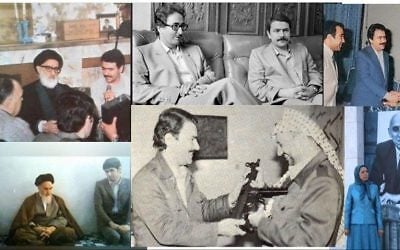
Masoud Rajavi and Abolhassan Banisadr were among Khomeini’s entourage and Islamic terrorists who supported Yasser Arafat — as reported in Iranian newspapers in 1979.
About the Author
Erfan Fard is a counter-terrorism analyst and Middle East Studies researcher based in Washington, DC. He is in Middle Eastern regional security affairs with a particular focus on Iran, Counter terrorism, IRGC, MOIS and Ethnic conflicts in MENA. \He graduated in International Security Studies (London M. University, UK), and in International Relations (CSU-LA), and is fluent in Persian, Kurdish, Arabic and English. Follow him in this twitter account @EQFARD