
The Middle East’s Enlightenment: Why Secularism is the Only Path to Salvation
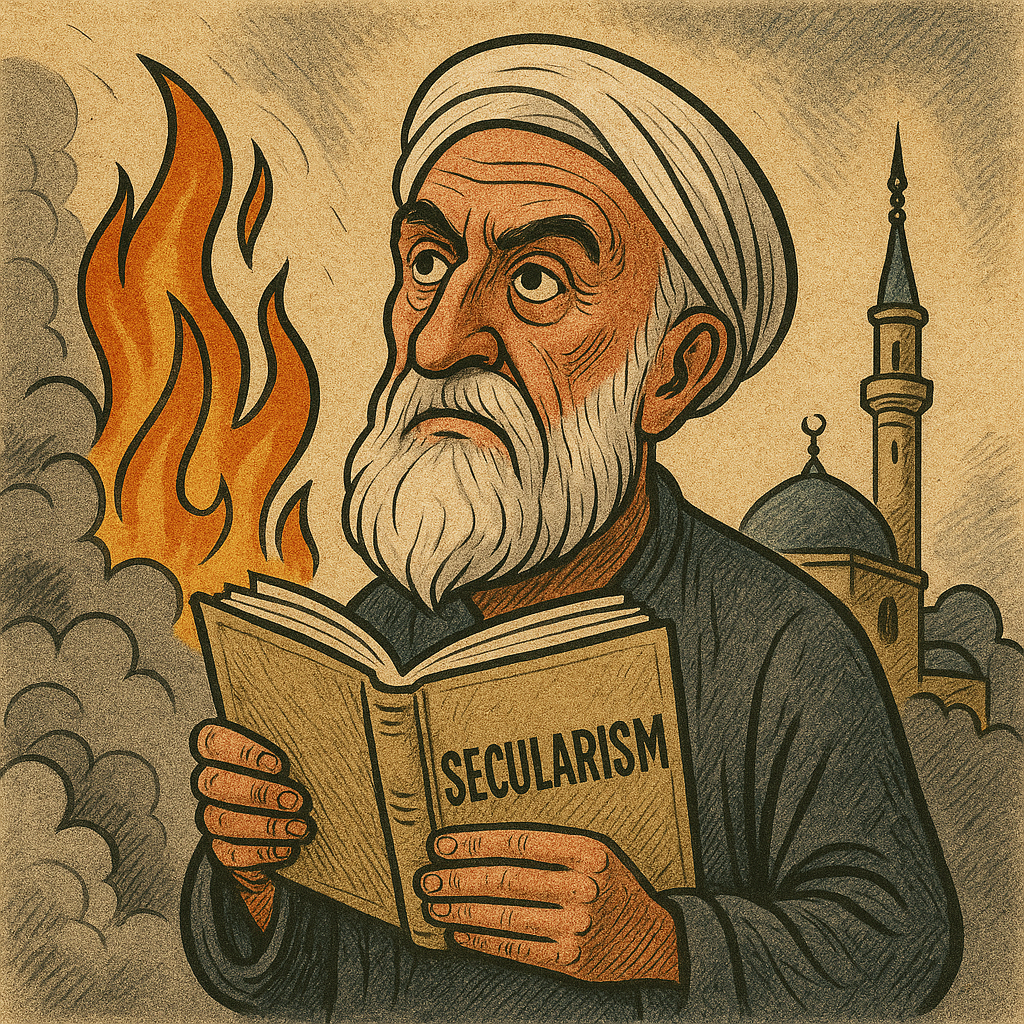
We must begin with an uncomfortable truth: civilization, for all its cathedrals, minarets, pyramids, and pagodas, is not built on faith. It is built on the tempering of faith — that subtle, marvelous ability to hold our gods and our reason in separate hands without crushing either. When we fail at this, when religion takes command of the state and claims the totality of human experience, it leads not to heavenly bliss but to earthly carnage. History, which is nothing if not a patient tutor, has demonstrated this over and over again.
Nowhere is this more evident than in the Middle East today. A region that once birthed mathematics, medicine, astronomy, and literature now languishes under the suffocating grip of clerical authoritarianism. This is not the faith of ordinary believers going quietly about their prayers, but the weaponization of belief into a form of political tyranny. It is a tyranny that turns holy texts into instruments of fear, that thrives on the persecution of minorities, and that chokes the very intellectual freedom that once made the Islamic world a beacon of learning.
The truth, which we all know but dare not speak, is that the Middle East needs an Enlightenment. Not a superficial nod to Western ideas, but a genuine, internal revolution of reason — one that will allow its people to separate the altar from the throne, the mosque from the state, the pulpit from the seat of power. Until this happens, no amount of foreign policy, oil revenue, or diplomacy will save the region from the cycles of fanaticism that have rendered its politics so poisonous.
Europe was not always the confident, secular powerhouse it is today. We tend to forget that, for centuries, the continent was a bloody chessboard of religious wars, inquisitions, and witch burnings. One must only recall the Thirty Years’ War (1618–1648), which left much of Central Europe a smoldering ruin, its fields soaked with the blood of millions, all in the name of which variety of Christianity would dominate. When kings ruled by “divine right” and priests dictated law, Europe’s progress was paralyzed.
It was only through the long, agonizing journey into the Enlightenment — that marvelous age of reason — that Europe broke free. Think of Voltaire railing against the absurdities of dogma, or John Locke arguing for the rights of the individual. Think of Spinoza, Kant, and Rousseau. Theirs was a rebellion not against faith itself, but against its tyranny. They knew that belief is most dignified when it is voluntary, not imposed, and that a society thrives when its citizens are free to speak, question, and doubt.
The Enlightenment allowed Europe to rise from a feudal wasteland to a continent of innovation, democracy, and, eventually, tolerance. Science flourished when it was liberated from the pulpit. Philosophy thrived when it no longer had to genuflect to dogma. Art, literature, and music bloomed when freed from ecclesiastical micromanagement. This is the inheritance of secularism: a society where religion is a matter of personal conscience, and the state is accountable to reason, not revelation.
The Islamic world, too, has had its moments of brilliance. There was a time — let us not forget it — when Baghdad, Damascus, Cairo, and Córdoba were centres of intellectual light while Europe languished in the Dark Ages. Scholars like Avicenna (Ibn Sina) and Averroes (Ibn Rushd) preserved and expanded the knowledge of the ancient Greeks. Algebra, astronomy, medicine — these were the fruits of a civilisation that valued reason as a companion to faith, not its adversary.
But somewhere along the way, the light dimmed. The intellectual openness of the Abbasid caliphate gave way to rigidity. The Ottoman Empire, which once embodied pluralism and cosmopolitanism, became sclerotic and suspicious of modernity. In the 20th century, when many nations of the Middle East won independence, there was a moment — a fleeting one — when secular republics and constitutional monarchies might have set the tone for the future. Instead, nationalism, oil wealth, and the rise of political Islam conspired to drag the region back towards authoritarianism. Religion became the language of the state, and the state became an instrument of religious enforcement.
The consequences are written across the headlines: the persecution of Christians and Yazidis in Iraq and Syria, the suffocation of women’s rights in Iran, the Taliban’s medieval grip on Afghanistan. The problem is not faith itself but the refusal to separate faith from governance. Without this separation, there is no room for minorities, no protection for freedom of conscience, and no platform for intellectual growth.
To argue for secularism in the Middle East is not to argue against Islam, Christianity, Judaism, or any other faith. On the contrary, it is to argue for their survival. When religion is fused with the state, it becomes corrupted — turned from a source of spiritual guidance into a weapon of control. Secularism is what ensures that every believer — and every non-believer — can live without fear of persecution.
Consider Israel’s Druze population, or the Christians of Lebanon: their ability to live with dignity is dependent on civic protections that transcend sectarian rule. Compare this to the fate of the Yazidis under ISIS, or the Bahá’ís under Iran’s theocracy — their suffering is what happens when there is no secular shield.
Secularism does not diminish faith; it dignifies it by making belief a personal choice, not a political mandate. It prevents clerics from becoming kings and kings from becoming gods. Without it, the Middle East will continue to fracture along sectarian lines, as Sunni and Shia, Christian and Muslim, Jew and Druze are pitted against one another in the endless zero-sum game of theological supremacy.
What the Middle East needs is not a copy of Europe’s Enlightenment, but its own. An awakening that draws on the region’s rich intellectual history, reclaiming the spirit of inquiry that once made Islamic civilization great. Education, science, and philosophy must again be valued over censorship and dogma. Women, half the population, must be freed from legal and cultural subjugation. Young people must be taught to think critically, not merely to recite.
Countries like Morocco and the UAE, which have made cautious steps towards moderating religious influence in public life, offer a glimpse of what is possible. But these are exceptions, not the rule. Across much of the Middle East, clerics and autocrats have created a symbiosis of fear, where challenging religious authority is tantamount to treason.
This is not merely an academic debate; it is a matter of life and death. Theocratic rule stifles economies, drives innovation abroad, and fuels cycles of violence that spill far beyond the region. The refugee crises, the endless conflicts, the radicalization — these are not the products of faith, but of faith wielded as a political bludgeon.
Secularism, by contrast, offers a way out. It promises governance based on reason, equality before the law, and protection for all citizens regardless of creed. It allows religion to flourish in its rightful place — as a matter of private conviction, not state coercion.
To call for secularism in the Middle East is to call for a revolution of the mind — a revolution every bit as radical, and necessary, as Europe’s Enlightenment was centuries ago. It will not be easy. Clerical power is deeply entrenched, and the forces of extremism will not go quietly. But history offers a simple lesson: no civilization has ever achieved lasting peace, prosperity, or progress while chained to theocratic rule.
The choice is stark. The Middle East can continue to wander in the wilderness of fanaticism, or it can step into the light of reason — not by abandoning faith, but by liberating it. As the Enlightenment saved the West from its own dark centuries, so too can a new age of secular thought save the Islamic world from the tyranny of its self-appointed guardians of truth.
If there is to be a future of peace, science, art, and human flourishing in the Middle East, it will be written not by imams or mullahs, but by those who dare to say, with courage and clarity: let reason rule, and let faith be free.