The Mitzvah of the Dropped Plan
What our canceled summer vacation taught me about catching unexpected light.
We had the passports sitting on the counter, the itineraries printed out, and that sweet daydream of a family summer in Europe. We were ready to wander down cobblestone alleys with no schedule, buy gelato on every corner, and turn off our news alerts for two whole weeks.
Life decided to change our coordinates overnight.
No boarding passes. No airport terminal coffee. Within forty-eight hours, our home in Pardes Hanna turned into an unofficial orthopedic clinic. Our flight tickets were swapped for ice packs and a stack of medical prescriptions.
My husband got injured during reserve service. For an active man, a business owner, and a father of four, a serious back injury brings life to a dead stop. Our summer plan turned into a painful class on domestic vulnerability. We were back to the most basic human movements, helping him walk from the bed to the shower, and learning how to measure a morning’s success by whether he could sit by himself without immense pain.
Our living room became an obstacle course. We progressed from a walker to crutches, and from crutches to a rigid metal brace he will wear for months. Watching my teenagers take shifts to help their dad out of an armchair and watching our eight-year-old realize our vacation was going to happen entirely at home, taught me more about real grit than any keynote speech ever could.
I know this forced detour is not unique to our living room.
I talk to friends across the globe who feel the ground shaking under their feet. Some are blown away by the speed of an AI wave rewriting careers overnight. Others are dealing with sudden medical calls, financial strains, or the heavy baseline fatigue of three years of continuous regional instability.
When the floor starts wobbling, our natural reflex is to grab the nearest solid object and brace for impact. We build tighter spreadsheets, double down on control, and convince ourselves that once we fix every broken piece, once life is predictable again, we will finally be ready to show up and enjoy the world.
The Torah reading in the weeks leading into Rosh Hashanah dismantles that illusion.
Tucked inside Parshat Ki Teitzei is Shichachah, the precept of the forgotten sheaf. When you harvest your field and accidentally drop a bundle of wheat, you are forbidden from turning back to get it. You leave it behind for the stranger, the orphan, and the widow.
It is the only commandment in our entire tradition that is impossible to fulfill on purpose. The moment you plan to leave that grain behind to feel generous, the mitzvah disappears. The sanctity lives inside the accident. It exists in the gap where your attention slipped while you were trying to get through the workday. It is a reminder that grace makes space for itself in the exact spots where our plans fall apart.
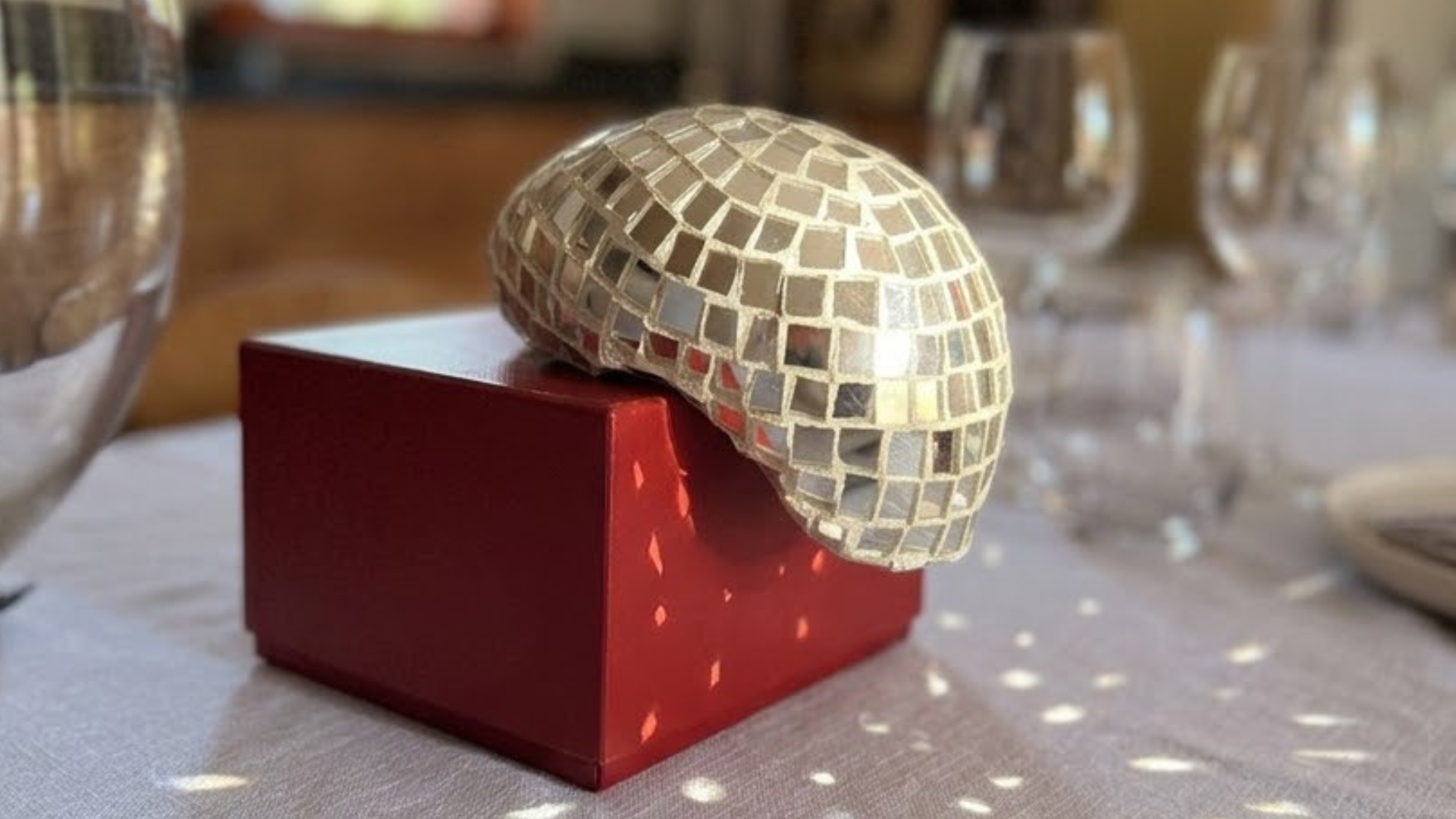
Whenever I need a physical reminder of that truth, I look at the strange object perched on the edge of a red box in my dressing room.
It looks like an ’80s disco ball that took a punch to the jaw and decided to melt. Eighty-five percent of its mass sits on the surface. The remaining fifteen percent hangs down. It defies neat balance, but somehow it works.
I sculpted it years ago during a weekend of experimenting with wet paper pulp and scrap mirrors. My thumbs were raw from snapping glass shards into jagged squares. The studio was a gray disaster of wet grout and dirty rags. I jammed my knuckles into the wet pulp, forcing it to cave inward and slouch over the table ledge until it dried crooked. For three days, it looked like a clump of mortar ready for the dumpster.
The piece holds a peculiar habit: in the glare of midday, you barely notice it. It needs transition. Like the moon waiting for dusk, this crooked shell only shows what it can do when the room dims.
When the low morning sun hits the window, those hand-cut mirrors catch the beam. The dented surface scatters light, splattering bright flecks across the arched ceiling, down the floor tiles, and onto the puff where I tie my shoes. Most of the tiles sit in the shadow, but the few that catch the sun throw an unscripted party across the whole room.
Our tradition asks us to light Shabbat and holiday candles on the windowsill facing the street for a clear reason. Light was never meant to stay hoarded in the center of an empty room. It belongs on the sill, right at the border where our private aches meet the dark road, reminding whoever is walking outside that warmth is still alive.
We do not need perfect vacation itineraries, predictable economies, or a life without bruises to illuminate our corner of the world.
Nobody is operating in total control right now. We are all wearing our invisible braces, coping with dropped plans, and carrying half-finished recoveries. Real life happens in the forgotten sheaves, in the fifteen percent that hangs over the edge, and in the accidental rays of light that bounce off our dents.
As we stand at the threshold of Rosh Hashanah and step into 5787, the birthday of our messy, complicated world, my wish for us is to let go of the script.
Leave the window open. Let your dropped plans make room for serendipity, for unexpected kindness, and allow your imperfect edges to throw a little light onto whoever is standing in the room with you.