The Mosaic of Judaism: A Testament to Beauty and Complexity
There is a curious paradox at the heart of Jewish identity. We are at once one of the world’s oldest peoples and one of its most diverse. We are both ancient and perpetually renewing, bound by a covenant that stretches across millennia yet constantly reshaped by exile, migration, and return. To be Jewish is to embody contradiction — and in that contradiction lies a profound beauty.
One of the most common misconceptions about Jews is that we are a single, uniform people. It is a fiction that has sustained antisemitic caricatures for centuries, from medieval depictions of Jews as an alien race to modern conspiracy theories about global uniformity and control. Yet the lived reality of Jewish identity could not be further removed from this stereotype. Jews are black, white, and brown. We are Mizrahi, Ashkenazi, Sephardi, Beta Israel, Bnei Menashe, and everything in between. Our faces carry the marks of countless lands: the Levant, North Africa, Eastern Europe, South America, India, Ethiopia, and beyond.
This extraordinary diversity is no accident. It is the product of a history unlike any other: a people dispersed and scattered across the globe, exiled from their homeland yet determined never to vanish. Wherever Jews have found themselves, they absorbed the flavours, languages, and melodies of their surroundings — not as replacements for their identity, but as enrichments of it. That is why a Shabbat table in Casablanca might feature couscous and tagines, while in Kraków it offered gefilte fish and borscht; why Ladino songs carry the lilt of Iberia, while Yiddish ones echo the cadences of the Rhineland and the steppe. Judaism does not erase the particularity of place. It sanctifies it, weaving local traditions into the fabric of the universal.
To be Jewish, then, is to live in plurality. We are simultaneously particular and universal: deeply protective of our covenant and yet compelled to engage the world. The Torah commands us to remember Egypt, to recall that we were strangers, and from that memory springs an enduring ethic of empathy. It is why Jewish communities have so often stood at the forefront of movements for justice, from the struggle for civil rights in America to campaigns for refugees in Europe. And yet that same memory insists upon our distinctiveness, reminding us that the preservation of our identity is itself a sacred duty.
The beauty of Judaism lies precisely in this tension. It resists reduction to a single category. It is not merely a religion, though faith and ritual are at its core. It is not merely an ethnicity, though shared ancestry binds us together. It is not merely a culture, though Jewish literature, art, and humour are among the richest in the world. Judaism is, rather, all these things at once: a civilisation, a people, a faith, and a destiny.
This complexity is often difficult for outsiders to grasp. Modern political debates, particularly around Israel, demand simplicity. They crave binary narratives: oppressor and victim, coloniser and colonised. But Jewish identity stubbornly refuses to fit these boxes. Israel itself is a microcosm of Jewish diversity: Jews of Iraqi, Polish, Ethiopian, Yemeni, Russian, Moroccan, and Indian descent live side by side, their cuisines, accents, and traditions colliding in a constant dance. Arab Israelis, Druze, Circassians, and others are woven into the fabric of its society. Israel is messy, imperfect, vibrant, and alive — as any living culture must be.
The insistence on complexity is itself a moral act. In an age where slogans and hashtags dominate public discourse, Judaism demands nuance. It insists that we acknowledge the coexistence of joy and suffering, of exile and homecoming, of covenant and rebellion. The Book of Psalms can move from lamentation to praise in a single breath, and Jewish history mirrors that rhythm: devastation followed by renewal, persecution answered by creativity. It is this capacity for holding contradictions — for refusing to allow one truth to erase another — that gives Judaism its extraordinary resilience.
Consider the way Jews have carried their traditions across continents. In Ethiopia, the Beta Israel preserved a form of Judaism untouched by rabbinic interpretation for centuries, maintaining rituals that predate the Talmud. In Yemen, Jews developed haunting melodies for prayer that echo the cadence of Arabic maqamat. In Spain, before the expulsion of 1492, Jews wrote poetry in Hebrew that rivalled the finest of the Islamic Golden Age. In Eastern Europe, Hasidic masters taught that joy itself is a form of worship, even in the shadow of pogroms. Each strand is different, yet each is recognisably Jewish — part of a shared tapestry that stretches back to Sinai.
This diversity is not weakness. It is strength. It demonstrates that Jewish identity is not brittle but elastic, capable of adapting to circumstances without losing its essence. Indeed, the Jewish people are perhaps the ultimate refutation of the notion that identity must be fixed or homogenous. We are living proof that a people can endure while embracing plurality, that difference can exist within unity, and that survival need not come at the expense of openness.
And so Judaism becomes a gift not only to Jews but to the world. In our multiplicity lies a lesson for humanity: that identity is not a box to tick, but a mosaic to cherish. That exile need not erase belonging, and that memory can coexist with renewal. In an era increasingly plagued by identity politics that seek to flatten and essentialise, Judaism offers a richer vision: one where complexity is embraced as truth rather than rejected as inconvenience.
Perhaps this is why antisemitism has so persistently sought to deny Jewish diversity. Hatred thrives on caricature. It requires Jews to be one thing: the eternal outsider, the puppet master, the colonialist, the rootless cosmopolitan. To acknowledge the reality — that Jews are as varied as humanity itself, and yet bound by an ancient covenant — is to shatter the stereotype. That is why defending the truth of Jewish identity is not only an act of self-preservation, but also an act of resistance against simplification and hatred.
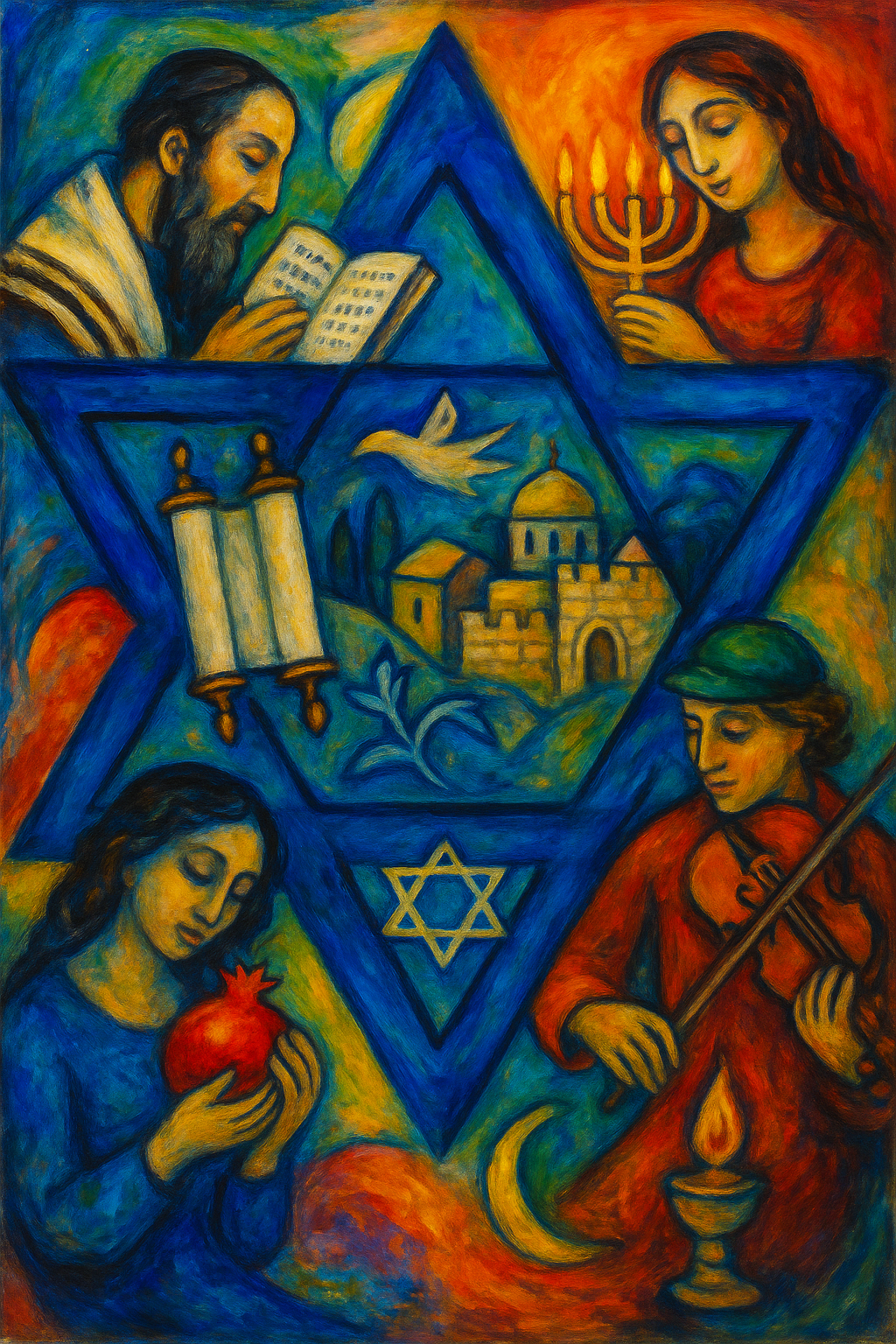
Marc Chagall once painted dreamlike visions of floating figures, fiddlers, brides, and rabbis, suspended in a swirl of colour. His art captured something essential about Jewish identity: its surreal ability to float above history’s cruelties while remaining rooted in memory and faith. The painting becomes a metaphor for the Jewish people themselves — never quite at rest, never entirely assimilated, always carrying within them a universe of stories, traumas, and hopes.
To be Jewish is to live in this space of paradox. It is to carry exile and homecoming in the same heart. It is to belong everywhere and nowhere, to be both ancient and modern, to pray in Hebrew and laugh in a dozen tongues. It is to light a menorah in Jerusalem, Paris, Addis Ababa, or São Paulo, and know that the flame connects you to every Jew who has ever lit one before.
And so Judaism stands as a testament — not only to Jewish survival, but to the complexity and beauty of humanity itself. For if a people so scattered, so diverse, so contradictory can endure and thrive, then perhaps humanity too can learn to embrace its own complexity. The Jewish story reminds us that identity is not diminished by diversity. It is deepened by it.
That is why Judaism matters: not only as the inheritance of one people, but as a living example of how contradiction can be beauty, how plurality can be strength, and how survival can be sanctified into meaning. In a world that craves simple narratives, the Jewish people remain gloriously, stubbornly complex. And that complexity is, quite simply, beautiful.