English Professor; Executive Director, Writing on the Wall
The Scandal of the Infinite – and of Teshuvah
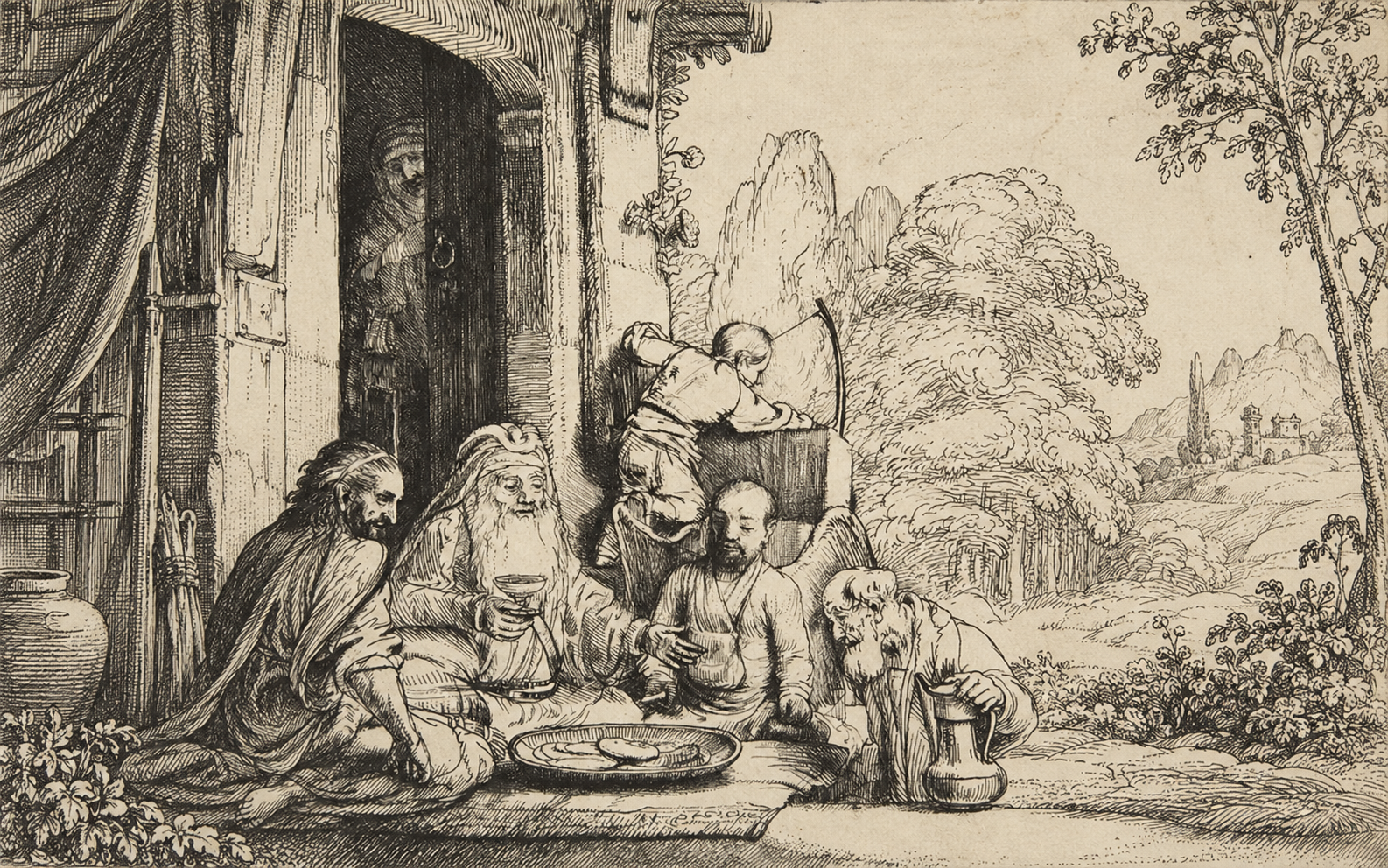
Rembrandt van Rijn, Abraham Entertaining the Angels, 1656 (Wikimedia Commons)
On Rosh Hashanah, we remember a human sacrifice that did not happen: the binding of Isaac. In the final hours of the Yom Kippur fast, we plead: Recall in our favor the binding of Isaac, and accept us with mercy.
But the life of the most underrated patriarch begins in laughter. God tells Abraham, “I’m going to give you a son,” and Abraham laughs – וַיִּצְחָק. It is astonished joy. God takes that laughter and gives it to the child as his name: יִצְחָק, Isaac.
But the promise is not Abraham’s alone.
God has already told Abraham that Sarah will have a son. Yet three men – angels – arrive for a meal. The scene is domestic: Sarah bakes bread; Yishmael prepares a tender calf; Abraham brings curds, milk, and the meat. The visitors sit beneath a tree and eat. Then they ask Abraham, “Where is Sarah?”
“Inside the tent.”
They are there for her.
Sarah listens from inside the tent. Upon hearing she will bear a child, she laughs too. Not the laughter of joy, but of surprise, disbelief, incredulity: Seriously? The Infinite is entering my house, my bedroom, my body?
Sarah’s laughter exposes the scandal at the heart of Judaism: the Infinite God enters into a relationship with human beings. Sarah’s tent, like every Jewish home after hers, becomes a home for the Infinite.
God then asks Abraham why Sarah laughed. Sarah had thought, “Both my husband and I are too old.” But God omits what she said about Abraham, reporting her as saying only, “I am old.” In this, Sarah discovers that the Infinite God is not merely a Knower of Secrets, privy to her most intimate thoughts. He is also an ethical God: He cares about the human, about relationships, about love.
When Isaac is born, Sarah’s private laughter of disbelief transforms: “God has made laughter for me; everyone who hears will laugh with me.” Her laughter travels throughout the world and throughout history. We, too, are among those laughing with Sarah.
Then Abraham takes that child – the child named Laughter – to Mount Moriah and binds him upon an altar.
At the Akedah, no one laughs.
Isaac’s birth had already reversed barrenness into continuity. Now that promised future is brought to the edge of annihilation. If Isaac dies, the covenantal promise dies. Then the story reverses once more: at the decisive moment, God stops Abraham’s hand – “Do not stretch out your hand against the boy.”
Isaac is not killed.
In Christian satisfaction theology, the death of Jesus stands at the center of redemption: humanity’s sins require a death, and the Son’s death pays the debt. An early-fifteenth-century Austrian painting of the Trinity makes the contrast vivid.
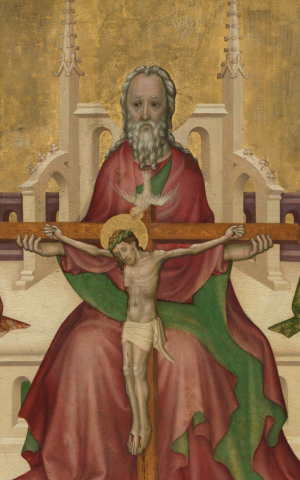
God the Father, a reluctant puppeteer, holds the cross upon which the diminutive Son hangs dead. The human sacrifice has occurred; redemption has been accomplished within the divine drama. Jesus’ human life serves the drama’s necessary ending.
But long before that theology, Genesis gives us the God who stops the knife. The ram is sacrificed; the son is returned to history. Isaac lives so that he can father Jacob, so that Jacob can become Israel, so that the Jewish people can exist.
Isaac is not a failed version of the son who dies. His survival is the promise, the revelation, the future: a history of responsibility.
Yom Kippur extends that principle to each of us: redemption returns us to history, where we must take responsibility for what happens next.
A Religion for Adults
Where redemption is placed entirely in divine hands, it is performed for the human being. Teshuvah, however, makes the astonishingly different claim that human beings participate in their own redemption: we are responsible not only for what we have done, but for who we may yet become.
The facts of the past are immutable. The “somehow” of teshuvah is that, without changing what happened, it transforms what the past becomes. The Talmud makes the extraordinary claim that teshuvah performed from love can transform deliberate sins into merits – not because evil becomes good, but because teshuvah changes the role that the past plays in a person’s future.
The Author of the world gives us the authority to become authors of ourselves.
God says: Speak. Name what you have done. Take responsibility for it. Tell your story again.
The divine gift of teshuvah is the gift of agency. The Akedah can be invoked on our behalf, but it cannot repent for us. God’s love does not erase the human actor; it restores our voice and asks us to use it.
These are the two scandals: the Infinite enters human life and, rather than extinguishing human agency, calls it into being.
The scandal of teshuvah is that God entrusts the future to us.
Related Topics