
The MOU That Forgot to Ask Iran to Stop
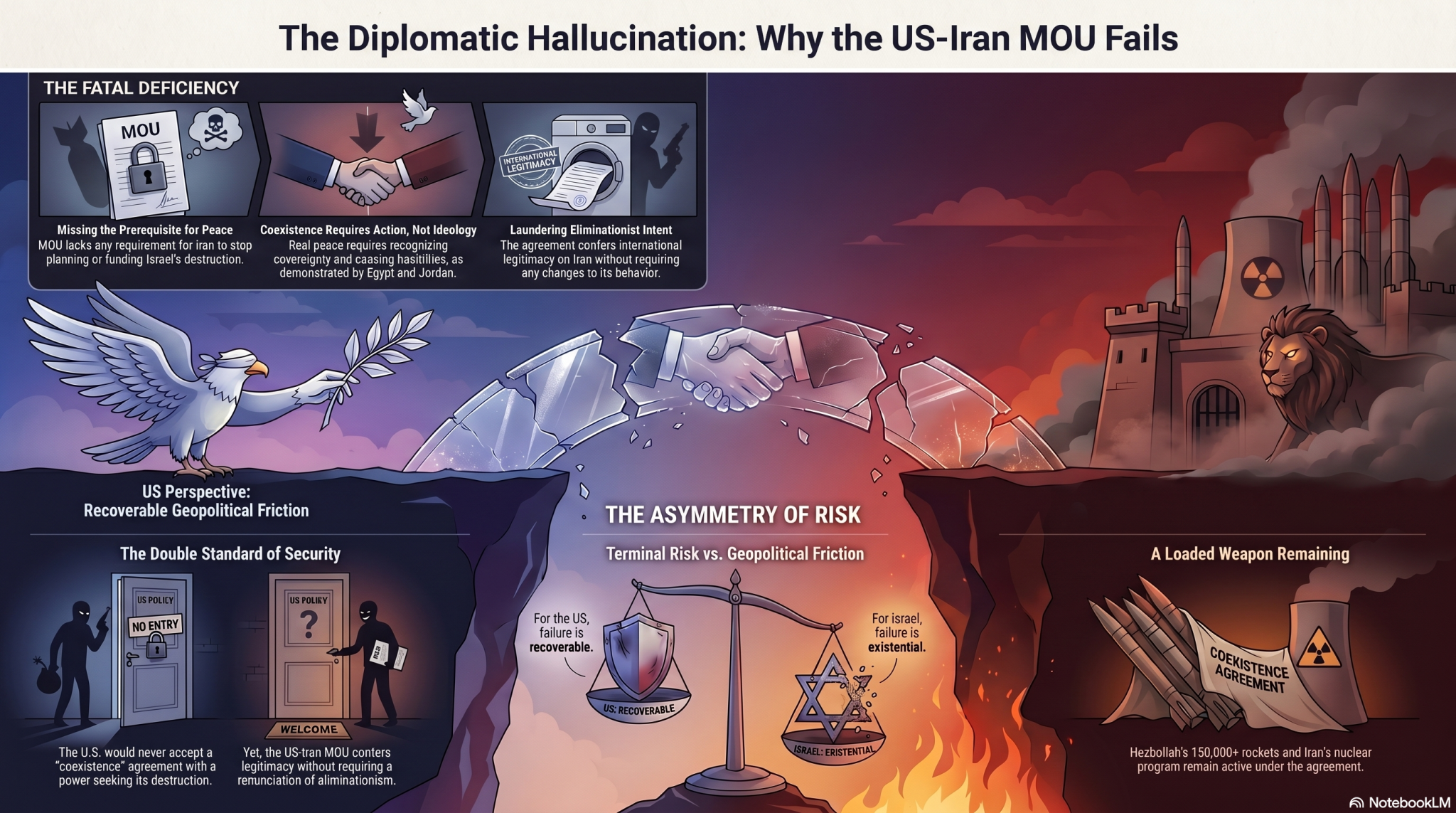
The memorandum of understanding on peaceful coexistence between the United States and Iran is not a diplomatic achievement. It is a diplomatic hallucination — a document that uses the language of peace to describe an arrangement in which none of the parties committed to peace are required to stop planning, funding, or executing war. It is a logical impossibility: a coexistence agreement with parties whose founding charters, operational budgets, and active military commands are organized around the elimination of one of the parties to the agreement.
That party is Israel. And Israel was not asked whether it consented to being coexisted with under these terms.
The MOU’s fatal deficiency is not procedural — not that the instrument is non-binding, though it is, or that verification mechanisms are weak, though they are. The deficiency is categorical. Peaceful coexistence has a logical prerequisite this document did not meet and did not attempt to meet: the operational renunciation of eliminationism. A commitment, however cold and minimal, that the parties will cease to plan, fund, and direct forces whose explicit mission is the other party’s destruction.
No such commitment was extracted. No such commitment was sought. The MOU forgot to ask Iran to stop.
What Coexistence Actually Requires
Coexistence does not require ideological conversion. Egypt made cold peace with Israel in 1979 without theological realignment. Jordan followed in 1994. Neither was asked to love Israel or abandon Arab solidarity. They were asked to do something far more limited: recognize Israeli sovereignty, cease cross-border hostilities, and commit — operationally, not rhetorically — to not destroying the state they were making peace with.
That minimum standard is precisely what the current MOU does not require of Iran, Hamas, or Hezbollah.
Hamas’s charter does not treat Israel’s destruction as a political preference — it treats it as a religious obligation. Hezbollah’s founding doctrine is an organizational constitution whose animating purpose is Israel’s elimination. The IRGC’s proxy network across Gaza, Lebanon, Yemen, Syria, and Iraq operates under current instructions, not historical artifacts. An MOU that does not require even the suspension of these commitments is not a coexistence agreement. It is a press release issued over a live battlefield.
The Asymmetry the MOU Conceals
For the United States, a failed Iran agreement means regional disruption, elevated energy prices, and geopolitical friction — serious consequences, not existential ones. America has absorbed failed Middle East diplomacy before. Its cities are not within range of Hezbollah’s arsenal. Its population has not recently survived a massacre organized and celebrated by the party with whom it is now coexisting.
For Israel, the calculus differs in kind, not merely degree. October 7 is proof of both intent and capability. Hezbollah’s 150,000-plus rockets pointed at Israeli population centers are not a deterrent posture — they are a loaded weapon. Iran’s nuclear program places an eliminationist regime within reach of the instrument required to act on its eliminationist theology.
The MOU was negotiated by a party for whom failure is recoverable, on behalf of a party for whom failure is terminal. That substitution of risk tolerance should have disqualified the framework before the first draft was written.
The Laundering of Eliminationist Intent
What the MOU operatively achieves is the conferral of behavioral legitimacy on Iran without requiring behavioral change. Iran enters the agreement funding eliminationist proxies. It exits as a signatory to a coexistence framework. The international community registers this as progress. Pressure eases. Isolation lifts.
Meanwhile, nothing changes on the ground. Hamas retains its command structure. Hezbollah retains its arsenal. The IRGC continues its funding flows. The centrifuges continue rotating. This is not diplomacy. It is the laundering of eliminationist intent through the alchemy of signed paper.
The Question America Must Answer
There is a simple test. Imagine a neighboring power with armed proxies on American borders, an active weapons program, and a founding ideological commitment to American destruction proposed a coexistence agreement — one containing no requirement to disarm its proxies, suspend its weapons program, or renounce its eliminationist doctrine. Would the United States sign?
The question answers itself. The only remaining question is why the answer becomes less obvious when Israel is the party being asked to accept what America would never accept for itself.
What Was Forgotten Cannot Be Papered Over
A coexistence agreement that does not require parties to stop planning each other’s destruction is not a peace framework. It is a void given a name.
The MOU forgot to ask Iran to stop. It forgot to ask Hamas to stop. It forgot to ask Hezbollah to stop. Until that omission is corrected, there is no coexistence agreement — only a document that allows its signatories to speak of peace while the machinery of elimination continues to run.
Israel cannot afford American-calibrated risk tolerance applied to Israeli-scale stakes. And the United States cannot credibly champion a coexistence it would never consent to living under itself.