Stuffed with feelings, like a good kishka should be.
The Names History Forgot: Why I Won’t Let My Ancestors Die a Third Time
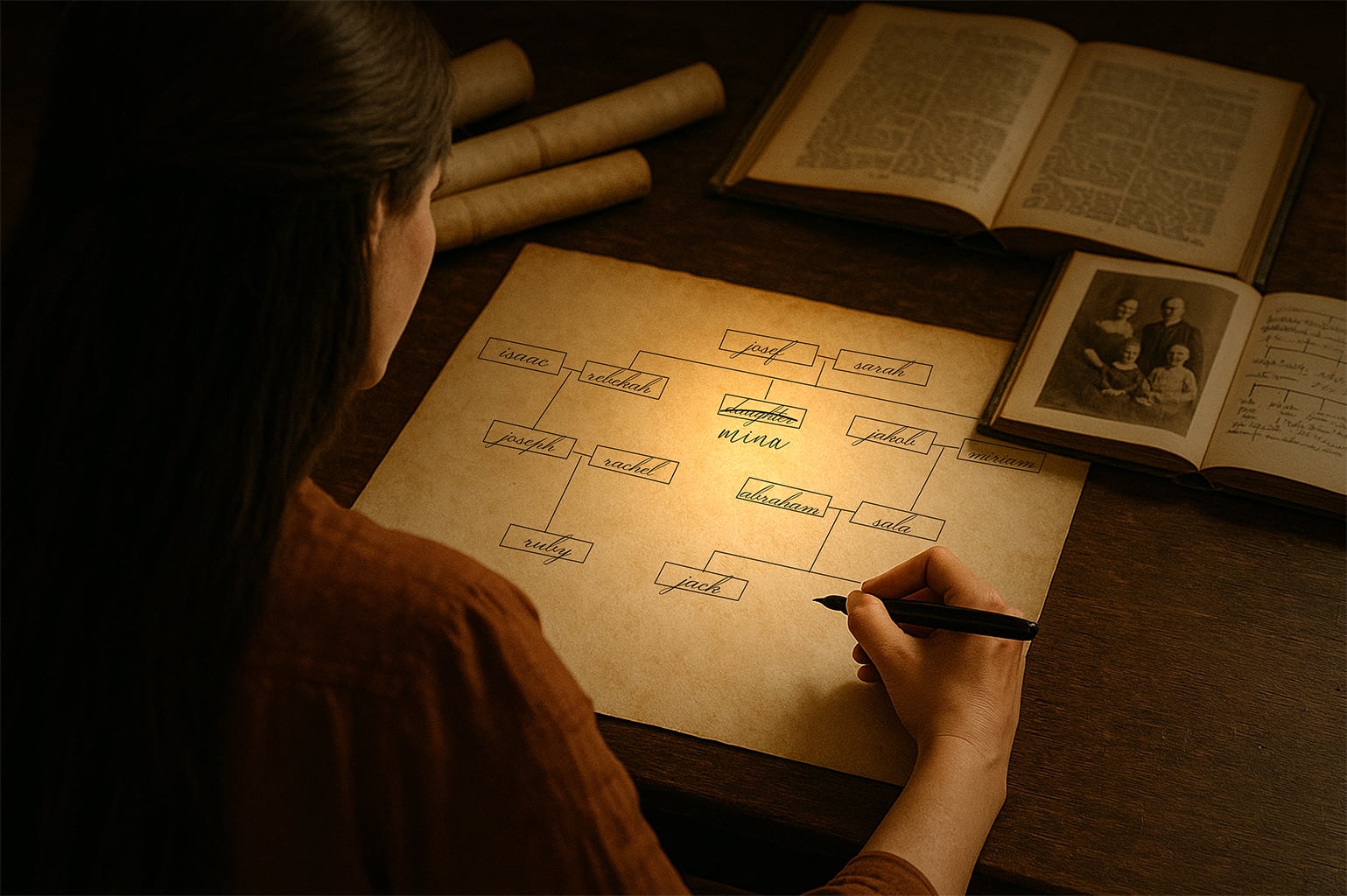
Image of a women updating her family tree to reflect a women's name instead of daughter
In a post that has been circulating online, the author explains the concept of pedigree collapse – the idea that, although the math suggests each generation doubles our number of ancestors, human communities historically overlapped so much that we actually descend from far fewer unique people than we imagine. By the time you go back to the 1400s, the post argues, anyone of European descent today shares almost all the same ancestors.
It’s a beautiful exploration of connection, resilience, and the miracle that any of us exist at all. The author concludes by saying that while we can honor our ancestors, we don’t need to know their names or trace our family tree to feel that connection. It’s a meaningful sentiment – and for many people, a freeing one.
For me, that final part of the message lands differently.
In Jewish life, names matter. Our tradition insists that remembering someone by name is a form of spiritual continuity.
We read yizkor.
We name babies after the dead.
We say zikhronam livrakha – may their memory be a blessing. Not their DNA, not their survival traits. Their memory.
So when I read, “You don’t need to know their names,” it landed with an unexpected heaviness.
Where my journey into ancestry began
I can pinpoint the moment this work took hold of me: watching Jason Silva’s video about the three types of death in Mexico. Although different from the traditional version, his variation explained the deaths as:
1. The first death – the moment we understand we will one day die.
2. The second death – when the body physically dies.
3. The third death – when a person’s name is spoken for the last time.
When I learned about that “third death,” something in me shifted. My heart ached, the tears came instantly, and that idea lodged itself deep within me. Physical death feels understandable – it’s a natural part of life. There was something painfully unjust about the idea that a person could die again through being forgotten – that a lifetime of joy, struggle, relationships, meaning, and the imprint they left on the world could simply vanish because their name is no longer spoken.
Something in me wanted to resist that erasure – to honor those before us in whatever way I could.
It wasn’t just about my family; it was about anyone whose story might quietly disappear – all the lives that slip unnoticed into the overlooked corners of history.
Searching for my own ancestors became the part I could play in the much larger human task of keeping stories alive – a small gesture, but one that felt deeply meaningful.
The ones who left no line
When I began digging into my family tree years ago, I thought I was searching for facts: names, birthdates, cities, marriages, occupations. Then something shifted. The work became more than data gathering – it became human.
As someone who won’t have children, I will not be the root of a future genealogy chart. My line ends with me. But my role in my family’s story doesn’t end.
I’ve spent years researching my ancestors – not only the ones who lead directly to me, but their siblings, cousins, and the forgotten branches that ended before they truly began. In recent years, this work has taken on a deeper emotional and spiritual resonance. It’s no longer just a hobby or a puzzle to solve. It’s become a form of caretaking. A way of ensuring that people who had no descendants to carry their names forward are not erased from our story. Not everyone becomes a parent, but everyone deserves to be remembered.
Every family tree contains people whose lives left no biological continuation:
• the child who died young whose grave was never marked
• the aunt who never married or had children
• the women whose names were rarely recorded, listed only as “daughter” or “wife”
• the men who died in wars before they had families
• the ancestors lost in the Holocaust who never had the chance
• the people whose branches ended before they began
These people do not have descendants to speak their names. But I can speak them. I can restore them to the family to which they belonged. Their existence still changed history. Their choices shaped the siblings who did go on to have children. And their joys and burdens echoed through generations in ways that led eventually to me.
This is not about extending a genetic line. It is about restoring dignity to the lives history forgets first. Preserving them has become my small act of zakhor – memory as a form of justice.
Why memory matters more than genetics
Yes – the post is right. Genetically, we all share far more ancestors than we imagine. Go back far enough, and our lines overlap. Yet ancestry is not only biology. For Jews especially, ancestry is:
• story
• memory
• responsibility
• relationship
• bearing witness
If our tradition teaches anything, it’s that remembering someone – truly remembering them – is one of the most meaningful acts a person can do. And that includes remembering those who left no descendants. I may not pass on my DNA, but I can pass on something just as real – a different kind of continuity, but a powerful one nonetheless. This is my way of being part of the chain. Not by extending it forward, but by securing it backward.
Beyond my own family, I am trying to participate in something larger – something I felt the moment I first encountered the idea of the third death. The idea that a person can disappear simply because no one remembers them still feels unbearably unfair to me. Searching for my ancestors is the piece of that work I can carry.
This is my contribution to the generations that will come after me – not through descendants, but through remembrance. It is an act of witnessing, an act of care, and in many ways, an act of love. My work has become a quiet act of resistance against that erasure. A way of saying: your life mattered, and someone is still looking for you.
And that gives me hope – that in every family, across generations, there is someone like me who takes up this quiet guardianship – a witness, a memory keeper, a person who refuses to let the last death come too soon. I like to imagine that every family, across generations, has someone who steps into this role – tending to the memories so they don’t disappear into silence, whether they lived long before me, are joining alongside me now, or are yet to be born.
Because in Jewish memory, nothing is lost if someone remembers. And as long as we keep saying the names, the third death never comes.
Over time, this work has shaped its own quiet code within me – a set of promises I try to live by:
Legacy Keepers Code
I will ensure that my ancestors – even the ones whose branches ended long ago – are not lost to silence.
I will archive their documents, trace their migrations, honour their lives, and piece together the fragments they left behind.
I will preserve the names that history tried to erase.
I will honor the ones who endured so I could exist.
I will remember the ones who left no children but still shaped the world that shaped me.
I will write them into the record – and I will say their names out loud.
Related Topics
Related Posts