
Russian-American-Israeli Palestinian. Palestine is Israel.
The National Debt: The Most Misunderstood Number in America
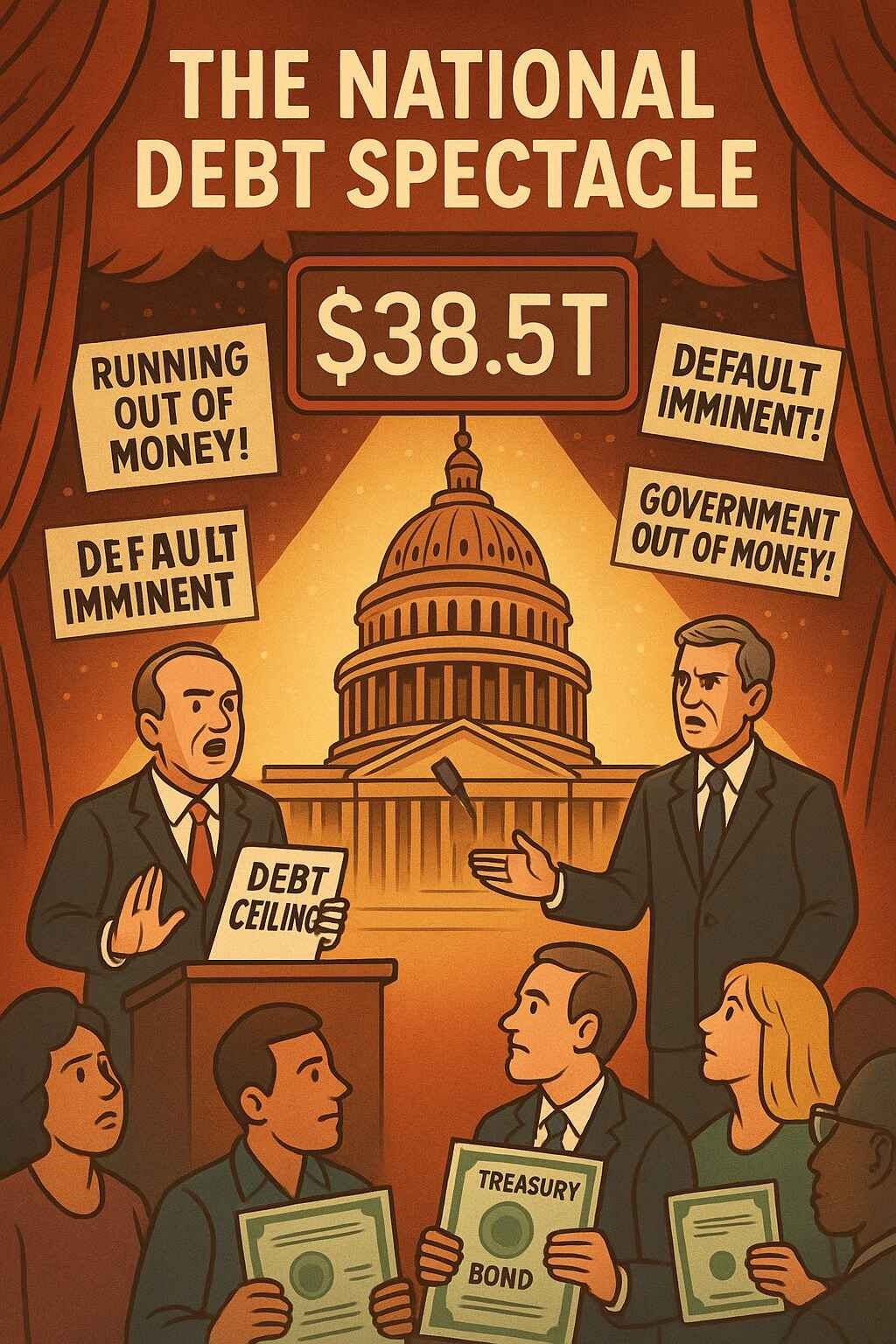
The U.S. debt-ceiling ritual: lights, cameras, countdown — all the drama of a Times Square ball drop, none of the danger of “default” or “running out” of dollars. Image © Ivan Bassov, 2025. Licensed under CC BY 4.0.
Treasuries, Savings, and the Myths That Generate Fear and Political Spectacle
Few topics generate more confusion — or more theatrical panic — than the US national debt. As of November 2025, it stands at $38 trillion and counting. Politicians posture about it, TV commentators warn of doom, and even members of Congress routinely conflate it with household credit-card bills. Yet almost none of them understand what they’re talking about — or they deliberately exploit public ignorance.
The problem begins with the word debt. It sounds scary: a burden, a liability, something that must be “paid back.” But that framing is completely wrong.
Fact #1: The “national debt” is not debt in the household sense.
A household must repay its debt. A sovereign currency-issuing government does not. Why? Because households cannot issue dollars. The US federal government can — and does.
Many people assume “debt” means the government is borrowing like a household with a credit card. In reality, calling Treasury securities “debt” is just professional jargon used in finance and accounting. It accurately describes an obligation on paper, but it does not mean the government risks running out of dollars or needs to “repay” the “debt.”
The term persists because it’s convenient for reporting, dramatic for the media, and politically useful — even though it misleads the public about how the economy actually works.
Fact #2: The national debt is simply the total amount of US dollars the government has created and has not yet taxed back.
In accounting terms, it is the sum of all outstanding Treasury securities — which are nothing more than interest-bearing US dollars in a different format.
If the government eliminated the national debt tomorrow, it wouldn’t just wipe out a line on a spreadsheet — it would eliminate the financial assets that everyone else holds. Every Treasury bond is someone else’s savings: held by households, banks, pension funds, US states, and foreign governments. You can’t “pay off the debt” without destroying the assets that sit on the other side of the ledger.
- Your Treasury bond = the government’s “debt.”
- Your savings = their liability.
- Their liability = your wealth.
Call it “debt” and it sounds ominous. Call it financial assets held by the public and foreign sectors, and it suddenly sounds obvious. It’s the same number.
Fact #3: Treasury securities exist because people want safe assets.
The private sector likes to save. Banks, pension funds, insurance firms, foreign governments, and individual investors all want a guaranteed, safe place to store wealth.
Treasury securities provide exactly that. They’re not a burden on America; they’re a service America provides to the world.
Fact #4: A sovereign issuer of its own currency cannot run out of its own currency.
The US can no more “run out of dollars” than a scorekeeper can run out of points.
This does not mean inflation is impossible — creating too many dollars can cause inflation — but it does mean solvency is never the issue. The United States does not face bankruptcy risk in its own currency.
Fact #5: Reducing the national debt means reducing the public’s wealth.
When politicians say, “We must pay down the debt,” what they’re really saying is:
We should drain dollars from the economy and eliminate your savings.
Put simply:
- Every dollar of government deficit is a dollar of private-sector surplus.
- Every dollar they “cut from the debt” is a dollar removed from someone’s balance sheet — including foreign holders.
Fact #6: Servicing the national debt is not scary — it’s the cost of wealth creation.
Headlines often warn that the “cost of servicing the debt is skyrocketing!” It sounds ominous. But this is simply the interest the government pays bondholders for holding Treasury securities. In other words, it’s the cost of keeping private-sector and foreign savings safe — and growing. Every dollar of interest paid is someone else’s wealth increasing.
Fact #7: A bigger national debt often signals national wealth, not weakness.
Some countries brag about having low national debt — Russia and Turkmenistan wave this around as “proof of strength” — and occasionally you’ll even hear claims of being “debt-free,” a status generally reserved for microstates with creative bookkeeping. But in the real world, low or zero national debt often just means nobody wants to hold that country’s currency as an asset.
In contrast, a high national debt simply reflects that the government has issued a lot of currency that the public and foreign investors choose to hold as wealth. In other words, one country’s “debt” is another’s “savings.” A bigger national debt can therefore be a sign of a strong, desirable economy — not a weak one.
(This is not always the case: some low-debt countries are wealthy and highly stable, while some high-debt countries are unstable, though these are exceptions rather than the rule.)
So what is the national debt actually?
A record of:
- how many dollars the government has issued
- how many dollars the public and foreign sectors chose to save
- how many dollars the government has not yet taxed back
The national debt is not a sign of fiscal irresponsibility. It is a measure of national (and global) savings.
The only thing “scary” is how little our public discourse understands this.
Bonus Fact: The annual debt-ceiling crisis is pure political theater.
Nearly every year, Washington stages the same ritual: countdown clocks on television, threats of government shutdowns, panicked headlines, and dire warnings that the US is “running out of money.”
None of it is real.
The debt ceiling has nothing to do with new spending. Congress already approved the spending, already approved the taxes, and already created the deficit that requires issuing new Treasuries. The debt-ceiling vote is simply about whether the government should pay the bills Congress itself already voted for.
In economic terms, the debt ceiling is simply a limit on how many safe assets (Treasuries) the public and foreign sectors are allowed to hold. A “debt ceiling” is, functionally, a wealth ceiling. And “spending” just means creating — or “printing” — new dollars by crediting bank accounts. In other words, the political terminology is upside down from what the public thinks it means.
So why repeat this ritual?
Because it’s politically useful. It lets lawmakers posture as “responsible” stewards, manufacture leverage, frighten voters, and reinforce the false analogy between the federal budget and a household checkbook. It works only because the public has been conditioned to fear a number they do not understand.
The result is confusion, panic, and yet another national debate built on a fiction: that America might somehow default or “run out” of the dollars it alone can issue.
The truth is simpler. The US does not face a solvency crisis. It faces a clarity crisis — one made worse by a political system that thrives on theatrics.
Why the myths endure
The national-debt panic survives because it serves powerful incentives. Politicians exploit fear to posture as “responsible” without real action. The media thrives on drama, turning technical accounting into clickbait doomsday stories. Most citizens naturally apply household logic to a sovereign currency issuer — and few experts translate the complex reality into simple, shareable explanations. The result: confusion becomes permanent, and the truth — that the US cannot run out of dollars and that debt is someone else’s asset — is drowned out by spectacle.
Other countries also “print” money — meaning they adjust numbers in a computer — and they also decide how much to issue through their budgets. But only in the United States does this routine process become a global spectacle, complete with countdowns, cliffhangers, and markets anxiously watching to see whether lawmakers will pretend, yet again, that the world’s largest economy is about to “run out of money.”
Related Topics
Related Posts