The Nazis took the piano. They couldn’t take the songs
Before the ghetto, before the trains, before Warsaw became a word we say in a lowered voice, there was a table at number 18 Mila Street. And around that table, a family that sang.
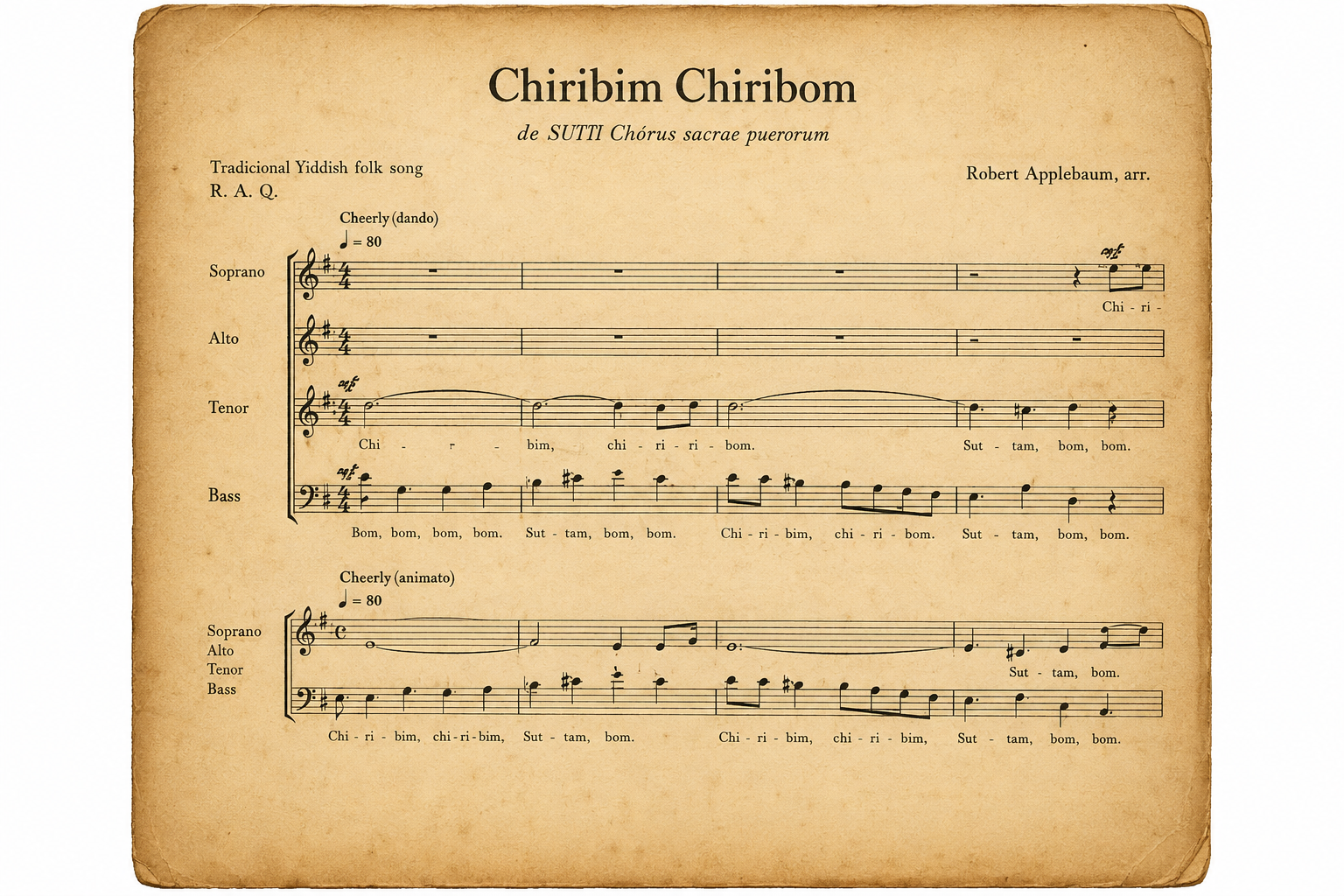
The song was “Chiribim Chiribom.” If you have never heard it, the sheet music tells you almost everything you need to know. Where a composer would normally write andante or allegro, the tempo marking on this arrangement simply reads “Cheery-bimily.” It is a playful thing, mostly nonsense syllables, a tune built for clapping and stamping and knocking on the table.
A song with no purpose in the world except joy. That, it turns out, is the whole point.
Edna was a small girl then, the sixth of eight children. Decades later she could still see the room.
“One playful Yiddish song I adored and will forever cherish is ‘Chiribim Chiribom,’” she said. “We would sing it after dinner, knocking rhythmically on the table, filling the night with laughter.”
Her mother was a trained soprano, the daughter of a rabbi. Her father played the violin. Her brother Mordecai sat at the piano. Every evening after dinner, in an apartment with floor-to-ceiling windows over the street, they made music until the children fell asleep. It is the most ordinary scene imaginable. That is exactly why it matters.
Notice one detail Edna slips in almost without comment. In her house, she wrote, Yiddish “was reserved mainly for nighttime lullabies.” Her mother insisted the children speak flawless Polish, to demonstrate refinement. So even then, before a single German crossed the border, the language of their own tradition was something kept for the dark, sung softly over a child’s bed. The hiding began early. It began as good manners.
The lullaby was “Oyfn Pripetshik.”
A fire burns on the hearth, and it is warm in the little house. And the rabbi is teaching little children the alphabet.
This is what Edna’s mother sang her to sleep with. Written by Mark Warshawsky in the 19th century, it is a song about a teacher instructing small children in the Hebrew alef-beys by the light of a fire. On its surface, it is the gentlest thing in the world. But there is a later verse most people never reach, and it is the reason the song has outlived everyone who first sang it:
When you grow older, children, you will understand for yourselves how many tears lie in these letters, and how much weeping.
Sit with what that means. A lullaby that tells a Jewish child: the alphabet I am teaching you is soaked in the tears of your people, and one day you will carry them too. It is not an escape from history. It is an enlistment into it. To sing it over a sleeping child is to say, quietly, in the dark, you belong to this, and this will not end with you.
Then the Germans came, and they set about proving otherwise.
They emptied the parlor and the dining room. The china cabinet vanished from the wall, leaving a pale rectangle on the paper. The dining room where the family had knocked out “Chiribim Chiribom” was turned into a barracks of narrow beds. They took the furniture, the space, the safety, the ordinary evenings. And still, on the last night before the strangers moved in, Edna heard her mother singing in the dark. “No piano accompanied her, no violin enhanced the melody,” she said. “Yet it was the most beautiful sound I had ever heard.”
That is the first thing to understand about music and oppression. It is the last thing they can reach.
You can seize a piano. You cannot seize the tune.
The cruelest chapter came later, on the Aryan side of the city, when Edna and her sister Miriam kept themselves alive by singing on street corners for coins. They were good. They earned more in an afternoon than their mother had given them to buy food. But there was one rule, and Miriam laid it down before they sang a note.
“Nothing in Yiddish,” she said. “No Jewish folk songs, no matter how well we know them.”
Read that again. Two hungry Jewish girls, singing for their lives on an occupied street, and the one thing that could get them killed was the music of their own home. They had to pronounce every Polish word perfectly, because a single flattened vowel could betray them. The very thing that had been the freest expression of who they were became the mask they wore to survive. Song fed them, and song hid them, in the same breath.
And yet. Even stripped of its Yiddish, even sung in the oppressor’s own language on the oppressor’s own street, the act itself was defiance. Edna called it “a small flame of joy and defiance kindled in the darkness of occupied Warsaw.” They took her home, her language, and in the end most of her family. They could not stop her from singing.
That is the whole of it, really. A tyrant can outlaw a language, burn the books, saw the dining table into firewood. He cannot reach inside a child and remove the melody her mother knocked out on the table after dinner. A song needs no printing press, no permit, no wall left standing. It lives in the body of whoever remembers it, and it passes to the next person for nothing.
This is why every regime that has ever tried to erase a people has also tried to silence its music, and why it has never once succeeded.
Edna lived. She grew old enough to understand how many tears lay in those letters, which means the rabbi in the lullaby was right. And she grew old enough, at last, to let me write it all down. She taught them to us anyway.
The men who wanted the Jews gone are gone.
“Chiribim Chiribom” is still here.
Cheery-bimily. Knock on the table. Knock on wood — it’s the same table.
––
My book, Little Edna’s War, based on my mother-in-law’s Holocaust testimony, was published on January 27, 2026, on International Holocaust Remembrance Day.