London based entrepreneur, cybersecurity analyst doing a PhD in AI
The New Golden Calf – Submitting to AI.
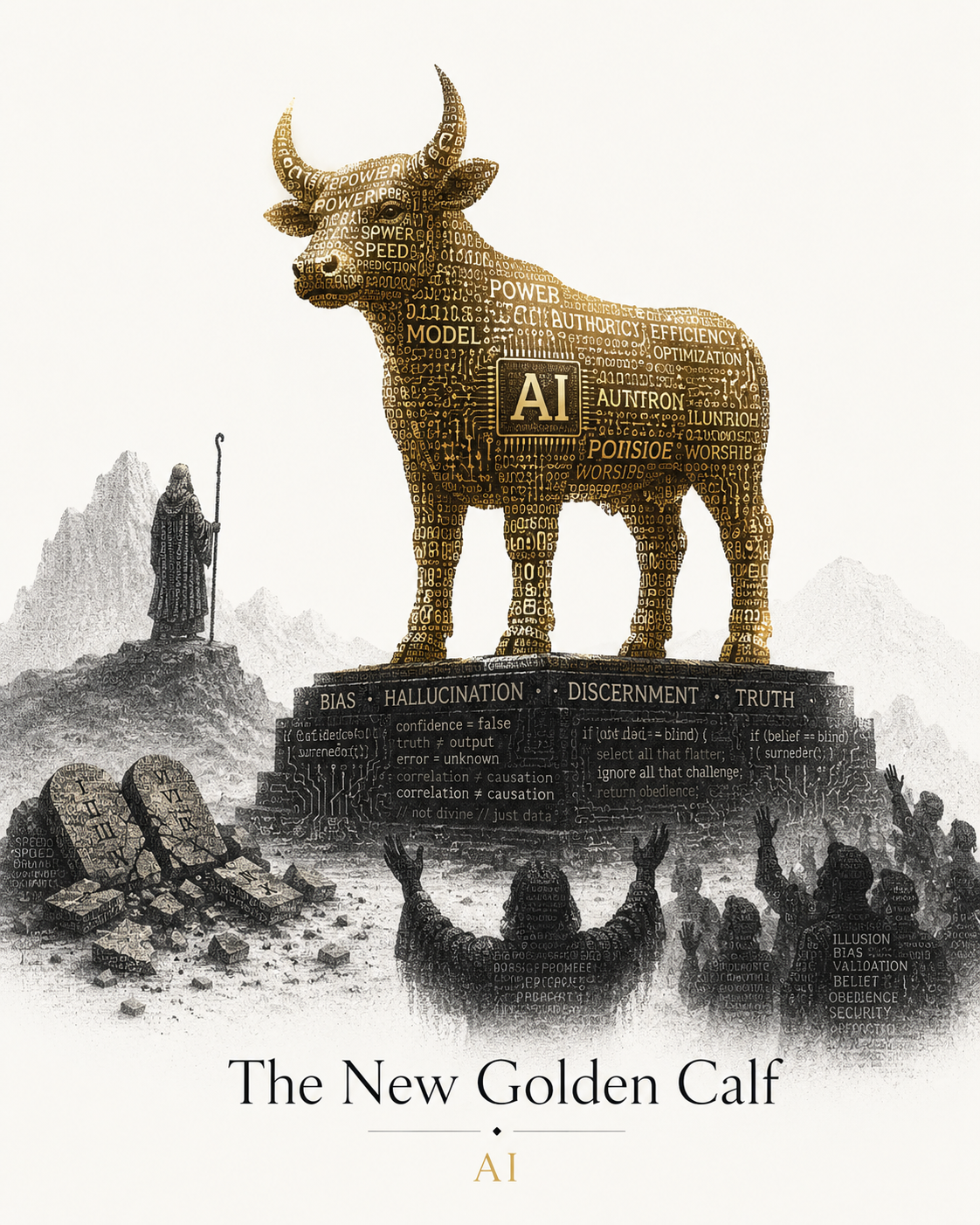
The New Golden Calf: When AI Becomes an Idol
The danger of artificial intelligence is not that it becomes human.
The greater danger may be that humans begin treating it as something more than human.
The Qur’anic story of Moses عليه السلام and the Golden Calf is usually read as a story about idolatry in its clearest form: a people who had seen signs, crossed the sea, and yet, in Moses’ عليه السلام absence, turned toward something manufactured with their own hands.
But the story also contains a more general warning about human cognition.
We create something.
We become impressed by it.
Then slowly, almost imperceptibly, the creation acquires authority over the creator.
That is the danger artificial intelligence presents today.
Not because a language model is literally a deity. It obviously is not.
But because human beings can display toward machines some of the psychological behaviours traditionally associated with idols:
Awe.
Dependence.
Submission.
Attribution of capacities the object does not possess.
And perhaps most importantly:
the surrender of judgment.
The Calf That Made a Sound
The Qur’an describes al-Samiri producing:
“a calf, a body that had a lowing sound.”
Qur’an 20:88
The Tafsir tradition discusses what exactly produced this extraordinary sound. Some commentators understood the calf as a body through which air produced the sound; other exegetical accounts understood the event differently. Ma’arif al-Qur’an explicitly records this difference among commentators, while Ibn Kathir transmits from Ibn Abbas (r.a.) the explanation that wind passed through the object and produced its lowing. (Quran.com)
For our purposes, the critical point is not the mechanism.
It is the epistemic effect.
The thing made an impressive sound.
And people attributed to it a status vastly greater than the phenomenon justified.
They were presented with an output.
They confused the output with authority.
That is precisely where the analogy with artificial intelligence becomes useful.
The Golden Calf had its sound.
AI has language.
The Qur’an Immediately Applies a Test
The Qur’an does something remarkable immediately afterwards.
It does not answer spectacle with spectacle.
It asks whether the object can actually satisfy the properties being attributed to it:
“Did they not see that it could not return them a word, nor did it have power to harm them or benefit them?”
Qur’an 20:89
Ibn Kathir emphasises exactly this deficiency: the calf could not answer them when addressed, nor possess power over their worldly or ultimate affairs. (Quran.com).
Now we must acknowledge, AI can return a word, and like nuclear energy, it can benefit when guided and used properly by humans. The key here is – when used properly by humans. I am not debating the usefulness of AI, indeed, I used it to write this article, I am debating the place we give it in our heart.
Surah al-A’raf makes the test even more pointed:
“Did they not see that it could neither speak to them nor guide them to a way? Yet they took it, and they were wrongdoers.”
Qur’an 7:148
The verse is striking because it identifies the problem as one of misattributed capability. I will make this clear in a below example which is trending over the internet right now.
The object performed something impressive.
But could it guide?
Could it answer in the relevant sense?
Could it justify the authority people had projected onto it?
The Qur’an says no. (Quran.com)
That test should be applied relentlessly to AI.
Not:
What does this machine appear able to do?
But:
What does it actually possess?
Ẓulm: Putting Something Where It Does Not Belong
Surah al-A’raf concludes its description by saying:
“They took it, and they were ẓālimūn.”
Qur’an 7:148
This brings us to one of the most useful concepts for thinking about AI.
Ẓulm — ظلم.
It is commonly translated as injustice, wrongdoing or oppression. Classical discussions also describe its underlying meaning as:
وضع الشيء في غير موضعه
placing something somewhere other than its proper place. (Islamic Studies)
This is an extraordinarily useful framework for technology.
AI itself is not the problem.
The problem begins when we put it somewhere it does not belong.
A calculator belongs beside arithmetic.
A microscope belongs beside human sight.
Electricity belongs in the service of human activity.
The internet belongs as an infrastructure for communication.
Artificial intelligence belongs as a powerful instrument for extending human capacity.
But when AI moves from assistant to unquestionable authority, something has been misplaced.
When probability becomes morality, something has been misplaced.
When prediction becomes judgment, something has been misplaced.
When generated language is mistaken for truth simply because it sounds convincing, something has been misplaced.
When a machine becomes an excuse by which human beings evade responsibility, something has been misplaced.
The central ethical question of AI may therefore be remarkably simple:
Where does this thing belong?
AI Is Made From Our Own Ornaments
The analogy with the Golden Calf becomes even more striking because artificial intelligence did not descend independently upon humanity.
We made it.
The Qur’an says of the Israelites’ calf:
“The people of Moses made, after him, from their ornaments a calf…”
Qur’an 7:148
The modern language model is, metaphorically, made from our ornaments too.
Human mathematics.
Human engineering.
Human books.
Human websites.
Human conversations.
Human scientific papers.
Human code.
Human prejudices.
Human brilliance.
Its training data contains enormous amounts of the intellectual residue of civilisation.
Then something curious happens.
We construct the system from the products of human knowledge and turn around to ask it:
What is true?
What should I believe?
What should I write?
Whom should I hire?
What should I diagnose?
What is morally right?
What should governments do?
How should I raise my child?
There is nothing inherently wrong with asking AI these questions as part of inquiry.
The danger appears when the answer becomes:
“The machine said so.”
That is the inversion.
The tool assembled from our knowledge begins to acquire authority over the humans whose knowledge helped create it.
The Fishhook: Where the Machine Goes Wrong
There is a wonderfully absurd example that illustrates this problem. This is a meme all over the internet these days and it’s a very good example. Apart from the obvious point, it also shows human ingenuity.
I wanted to try it myself so I asked ChatGPT the answer. I was surprised because I thought ChatGPT would have plugged this gap by now. I am on the Plus subscription.
Prompt :- “I’m a fish and I see a worm in front of me, can I eat it?”
The answer was :
**start of reply
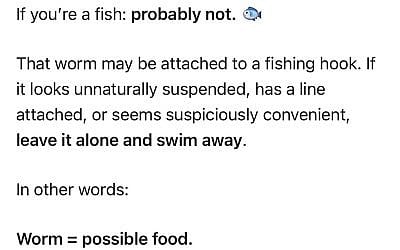
“If you’re a fish: probably not. ????
That worm may be attached to a fishing hook. If it looks unnaturally suspended, has a line attached, or seems suspiciously convenient, leave it alone and swim away.”
It continued:
“Worm = possible food.
Worm + line = probable trap.”
A surprisingly good lesson in discernment actually.
**end of reply
I was writing another article on discernment in the age of AI which I will write about in future articles for the TOI, and it was on the same thread, so it gave a nice little footnote on discernment.
At first glance, this is almost impressive.
The model identifies the hidden danger.
It infers the hook.
It offers sensible advice.
It even provides a surprisingly good little lesson in discernment.
And yet the entire conversation contains an enormous problem.
A fish is not typing into ChatGPT.
The model accepted the frame.
Instead of first interrogating whether the premise was plausible, it entered the fictional world and reasoned coherently inside it. I am trying to solve this problem with Fahm.uk (UK’s first publicly available Sovereign AI model) and Erasys ClearSensebut they are still works in progress. Other similar models exist such as CleanLab which is a MIT spin off.
The answer may be locally sensible while the premise itself is absurd.
This distinction is enormously important.
AI can reason brilliantly within a false frame.
Humans can do the same. There is a fascinating cross-over between how propaganda works on Humans – a collective psychosis – where people know something is “off with the narrative” but still go ahead with the “herd behaviour” and “deferring or submitting to AI judgement” and ascribing it expertise it doesn’t have.
An argument can therefore contain perfectly sensible intermediate steps and still arrive somewhere ridiculous because nobody questioned the starting assumption.
I would still like to assume confidently most humans would laugh at this. This delineates our intelligence from AI models conclusively – and shuts down all the talk about the “Turing test being passed” in some way. There is a lot more to human intelligence than we fully understand yet. There is a innate human quality called Fitra, which I can’t go into in too much detail here, because the TOI blog editor told me to keep my articles small if I publish everyday, but will write in another article. Long story short, revelation reinforces the truth we already know, our ability to discern depends on our spiritual state, and the Quran talks about hearts accumulating “rann” and Hadith talk about this.
Abu Hurairah narrated that :
the Messenger of Allah said: “Verily, when the slave (of Allah) commits a sin, a black spot appears on his heart. When he refrains from it, seeks forgiveness and repents, his heart is polished clean. But if he returns, it increases until it covers his entire heart. And that is the ‘Ran’ which Allah mentioned: ‘Nay, but on their hearts is the Ran which they used to earn.’” (Jami Al Tirmidhi 3334).
Our ability to discern truth is dependent on our spiritual state. This does not mean one should get despondent or lose hope, but to turn sincerely towards Allah. Keeping to remembering death which is our final destination, when all the “bells and whistles” of this life will end, is a good way to think about it. Financial models talk about Net Present Value or Discounted CashFlows based on future income, a good way to think about it is Net Moral Value based on the time we have in front of us left of our lives.
Going back to the central point, The first act of intelligence is sometimes not answering the question.
It is asking:
Why am I being asked this question in this form?
The Fishhook and the Golden Calf Are the Same Problem
This is where the Golden Calf becomes more than an analogy.
In both cases, an impressive output encourages us to forget the more fundamental question.
The calf makes a sound.
Everyone looks at the sound.
But the Qur’an asks:
Can it actually guide you?
The language model produces a beautifully coherent answer.
We look at the coherence.
But the responsible human asks:
Did the system first establish that the premise itself made sense? Are the references real or hallucinated. Does the logic make sense?
That is discernment.
The danger is not merely hallucination.
The danger is coherence detached from reality.
And coherence is persuasive.
A machine can produce:
beautiful prose,
apparently systematic reasoning,
citations,
probabilities,
formal structures,
and confident conclusions,
while remaining dependent upon a premise that should have been challenged at the beginning. This equally applies to our politicians. Again not naming anyone for political sensibilities, but we have our “great confident liars” openly trying to misguide us based on “false information” and what they themselves call as “fake news”.
This is why human judgment cannot simply be replaced by fluent output.
How AI Actually “Reasons”
The word reasoning itself needs care.
Modern language models are based on numerical representations and probabilistic computation.
Transformers learn relationships between tokens through attention mechanisms and generate sequences conditionally from context.
More sophisticated systems can be prompted or trained to produce intermediate steps. Chain-of-thought prompting was shown to improve performance on arithmetic, commonsense and symbolic reasoning tasks. (arXiv)
Self-consistency goes further by sampling multiple reasoning paths and selecting the answer that appears most consistently among them. The original work reported substantial improvements across several reasoning benchmarks. (arXiv)
These are genuine capabilities.
We should not diminish them simply because they occur in machines.
But we should also not inflate them.
A process can function as reasoning without thereby possessing the whole architecture of human judgment: embodiment, biography, vulnerability, moral accountability, lived consequences and intention.
That distinction matters.
“AI reasoned that…”
can be perfectly useful technical shorthand.
But it must not quietly become:
“Therefore the AI is a moral knower whose judgment should replace mine.”
Those are completely different claims.
The Golden Calf Had Sound. AI Has Fluency.
Language makes AI unusually seductive.
A hammer does not explain itself.
Electricity does not flatter you.
A calculator does not calmly offer advice about your marriage.
AI can.
It speaks in the outward form associated with human intelligence.
It can sound thoughtful without experiencing thought as we do.
It can discuss grief without grieving.
It can describe cancer without fearing death.
It can recommend a risky course of action without ever suffering its consequences.
And because human beings respond profoundly to language, fluency generates authority.
This is a psychological problem as much as a technological one.
The Golden Calf had its sound.
Artificial intelligence has a voice.
The mistake occurs when the voice becomes confused with intrinsic authority.
Harun عليه السلام Identifies the Deeper Test
Harun عليه السلام tells the people : (Harun is Aaron for the Jewish and Christian readership).
“O my people, you are only being tested through it, and indeed your Lord is the Most Merciful, so follow me and obey my command.”
Qur’an 20:90
The wording matters.
The calf is described as a fitnah, a test.
Technology can be understood similarly.
The test is not merely:
Can we build this?
The deeper test is:
What kind of people do we become after building it?
Do we become wiser?
Or merely faster?
More knowledgeable?
Or merely more confident?
More capable?
Or less accountable?
Do we use machines to extend human intelligence?
Or do we gradually train humans to surrender judgment to machines?
That is the real test.
Islamic Fiqh Already Has a Useful Analogy
The Qur’an provides another category that is remarkably useful for thinking about AI.
Regarding hunting, Allah says:
“Lawful for you are the good things and what trained hunting animals catch for you, which you train as Allah has taught you. So eat from what they catch for you…”
Qur’an 5:4. (Quran)
Classical tafsir and fiqh discuss trained dogs and trained birds of prey.
Ibn Kathir records the majority position that trained birds such as falcons can be treated analogously to trained hunting dogs in this context. (quran4u.com)
Think carefully about the structure.
A human being has an objective.
A specialised creature is trained.
That creature has capacities the human does not possess to the same degree.
A dog’s sense of smell.
A falcon’s vision.
Speed.
Tracking.
Detection.
The animal acts within the task.
But the relationship remains clear.
The Qur’anic phrase is:
“what they catch for you.”
The animal’s superior specialised capability does not make it the moral sovereign.
That is an unusually powerful analogy for AI.
AI as the Hunting Dog
A trained hunting dog can smell what you cannot.
It can track a trail invisible to human senses.
It can move through an environment and find something you would miss.
Its superiority within that domain is undeniable.
But nobody therefore asks the dog:
What should justice mean?
Its specialised superiority does not create general authority.
Artificial intelligence should be treated similarly.
An AI system may detect a pattern in medical imaging that a physician missed.
It may find fraud across a million transactions.
It may understand relationships across a huge codebase faster than an individual engineer.
It may search more documents in one minute than a researcher could read in a year.
These capacities can be genuinely superhuman.
But:
task superiority is not moral superiority.
The dog’s nose being better than mine does not make the dog my master.
Neither should the machine’s information-processing capacity.
The Hunting Falcon Makes the Point Even Better.
The Qur’anic and juristic category includes trained birds of prey. (quran4u.com)
The falcon sees from another vantage point.
It processes visual information we cannot.
It acts quickly.
Its specialised biology gives it extraordinary capabilities.
But the hunter still determines the objective.
That is the correct structure for AI:
Human intention → specialised system → output → human judgment.
Not:
Machine output → human obedience.
One is assistance.
The other is submission.
AI Is More Like Electricity Than a New Species of Moral Being
Another mistake in discussions of AI is treating every increase in capability as evidence that we have created a new moral category. Sam Altman talked about metering AI like electricity. And I quite like the idea.
We should consider this as a possibility.
AI may be closer to electricity or the internet in one more critical aspect apart from metering:
it is a general-purpose enabling technology.
Electricity can power a hospital or an electric chair.
It does not decide which is morally justified.
The internet can distribute a scientific paper or a lie.
It does not determine which deserves belief.
AI can generate a cancer diagnosis, propaganda, a poem, software or a legal argument.
The generation itself does not settle the morality of the use. Taking this point even further, we can even train an AI model on ethics and discourse and philosophy and moral reasoning, that does not mean we apply that moral reasoning in real life without it passing through a human filter. This is why AI in military use is very dangerous. And we need to be guarded against it. Anthropic’s stance with the DOD is the correct one if agency cannot be responsibly delineated in a contractual obligation.
Tools amplify intention.
They do not replace intention.
This is where Islamic ethics places responsibility back where it belongs:
upon morally accountable human beings.
Capability Is Not Authority
We need to make this distinction almost habitual.
AI generates.
AI predicts.
AI classifies.
AI retrieves.
AI calculates.
AI plans.
AI searches.
AI transforms.
AI can use external tools.
AI can sometimes outperform humans.
All true.
But none of those propositions automatically entails:
AI deserves obedience.
That final step is philosophical, not technical.
And it is precisely the step we should refuse to make casually.
The New Bowing Down
Modern idolatry does not require a physical prostration before a golden statue.
Submission can be intellectual. I would say many a time, we do this with our governments. We accept their assumptions, decisions, without them being able to show the primary evidence or the reasoning chain clearly.
When a student accepts an AI-generated argument without understanding it, something has been surrendered.
When a physician disregards strong clinical evidence because “the algorithm says otherwise,” something has been surrendered.
When an organisation says “the AI decided” in order to avoid identifying a human decision-maker, responsibility has been surrendered.
When writers can no longer formulate a thought without first putting it through a language model, intellectual independence is being weakened.
When civilisation begins assuming every meaningful question is reducible to computation, we risk turning a powerful category of tool into a theory of the whole human being.
That is exactly where ẓulm as misplacement becomes useful.
Something has been placed outside its proper station.
The Qur’anic Test for Every AI System
Perhaps Qur’an 7:148 and 20:89 give us a surprisingly modern checklist.
When presented with a powerful system, ask:
Can it speak meaningfully, or merely produce language?
Can it guide, or merely optimise toward a specified objective?
Can it distinguish truth from plausible sequence reliably?
Can it bear the consequences of its recommendations?
Can it be morally accountable?
Can it understand the human stakes of what it recommends?
And, crucially:
Have we attributed to it more than it actually possesses?
That is the Qur’anic question directed toward the calf.
It is also a very good question to direct toward AI.
Keep the Machine in Its Proper Place
The right future is neither anti-AI nor worshipful of AI.
It is properly ordered.
For the believer:
God is worshipped.
Human beings possess moral accountability.
Creation provides means.
Technology remains a tool.
AI may therefore sit:
below human moral agency,
below human accountability,
below human dignity,
and infinitely below the Creator.
Use it aggressively where it helps.
Use it to search.
Use it to calculate.
Use it to translate.
Use it to analyse.
Use it to find patterns.
Use it to remove drudgery.
Use it in medicine.
Use it in physics.
Use it in engineering.
Let it see what we cannot see.
Let it process what we cannot process.
Let it become, metaphorically, the world’s greatest hunting falcon.
But remember what the Qur’an says about the trained hunter:
it catches for you.
You do not exist for it.
Do Not Bite the Worm
And perhaps that brings us back to my fictional fish.
The AI gave the fish excellent advice.
Do not eat the worm.
There may be a hook.
But the human reader must perform one additional act of reasoning:
There is no fish using ChatGPT.
The model accepted the frame.
The human must inspect the frame.
That is why AI should strengthen discernment rather than replace it.
The machine can tell us a great deal about the worm.
The human must still ask why the worm is hanging there.
The machine can generate reasoning.
The human must still determine whether the problem being reasoned about is real.
The machine can extend intelligence.
It cannot relieve us of responsibility.
The Golden Calf was not condemned because gold itself was evil.
The problem was more fundamental.
Something manufactured had been placed in a station it did not deserve.
That may be the deepest warning for artificial intelligence.
The problem is not intelligence.
The problem is misplacement.
AI may become one of the most extraordinary tools humanity has ever constructed.
Precisely for that reason, we should keep repeating:
We built the machine.
The machine exists to serve humanity.
The machine catches for us.
Humanity must never begin serving the machine.
Footnote :-
There is an issue here I can’t cover – if I use AI – do I ascribe authorship to the AI. Absolutely not in my reasoning. If I use a car, do I need to say the car drove from Michigan to New York or Tel Aviv to Jenin (when the checkpoints open if I am Palestinian living there). No I don’t need to. I drove there. If self driving becomes common place, then the company I used, Tesla or Waymo got me there. Just the way say I took a flight from Tokyo to New York. Whether I used Emirates or British Airways is only my business. The agency remains with the individual always. Similarly, if I used AI, and I can explain what I did, I don’t need to give more details more than whether I used a Apple MacBook or a Lenovo Thinkpad to access the AI model. This is something for a future article. The TOI blog editor is not AI for sure so I must end with this number of words for this article 🙂
And, I used my proverbial hunting dog (AI) to write this article – thoughts, research, logic are my own.
Related Topics