
Geopolitical Analyst: Bridging Somaliland & Israel to the world
The New Strategic Encirclement Around Somaliland: From Aden to South Somalia
The reported Houthi-al-Shabaab radar plan clearly does show how the Iran war, maritime insecurity, recognition of Somaliland, and anti-Israel politics are converging around Berbera
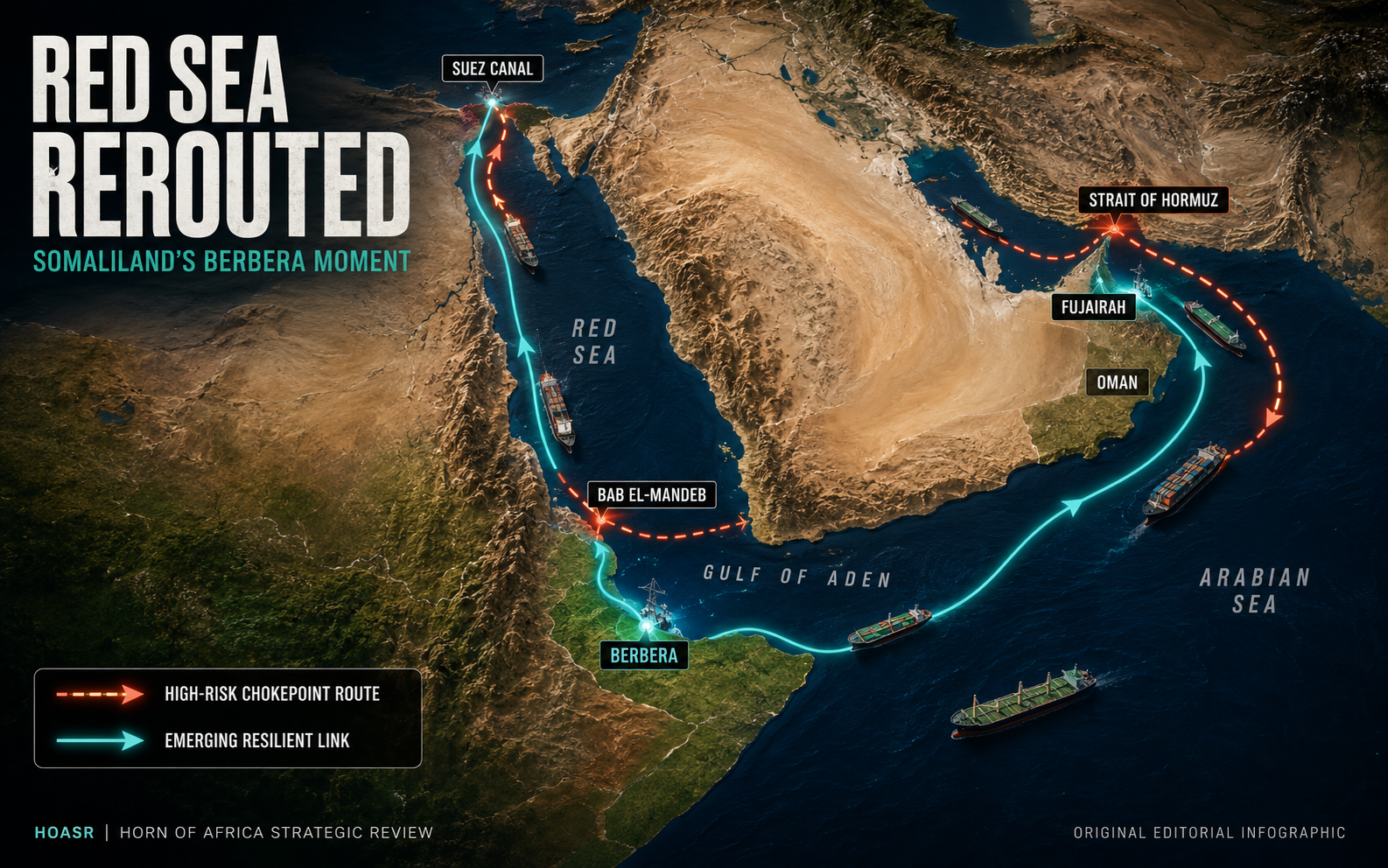
The central focus must remain safeguarding commerce and freedom of navigation.original-HOASR-infographic-showing-Hormuz-and-Bab-el-Mandeb-alternative-supply-routes-Berbera-and-commercial-shipping.png
The warning is bigger than a radar mast
The most consequential part of the Wall Street Journal’s new investigation is not simply the claim that the Houthis want help to deploy radar in Somalia. It is what such a system would represent: a move from episodic attacks launched from Yemen toward a cross-Gulf network that can find, watch, and eventually threaten ships from both shores of the Gulf of Aden.
According to reporting published by the Wall Street Journal (August 2026), a Houthi aim outlined in a regional intelligence briefing was to secure al-Shabaab’s help in deploying radar capability to monitor shipping lanes. The Journal also reported a June meeting between a four-person Houthi delegation and al-Shabaab figures in Jilib, further detailing that the Houthis sought to disrupt Israeli maritime activity around Berbera. These are serious reported claims, and must not be easily dismissed.
That caution does not make the danger small. It makes the danger clearer. A sensor, logistics, and training relationship would give the Houthis a way to reduce the distance between Yemen’s northern shore and Somalia’s militant-held south. Somaliland would then face a security environment shaped by pressure from Aden in the north and by a potentially better-equipped al-Shabaab network to the south.
First, get the actors right
The Houthis and al-Shabaab are not the same kind of organization, and treating them as one monolithic bloc would weaken rather than strengthen the analysis. The Houthis are an Iran-aligned Yemeni movement with a demonstrated anti-shipping capability. Al-Shabaab is an al-Qaeda affiliate that emerged from the militant wing of Somalia’s Islamic Courts Union in 2006 and officially pledged allegiance to al-Qaeda leadership in 2012, according to official documentation from the U.S. Department of State Country Reports on Terrorism. Al-Shabaab is not an Iranian proxy.
The relationship is best understood as a transaction between two armed movements with different ideologies but overlapping tactical interests. The United Nations Analytical Support and Sanctions Monitoring Team (2024 Report) documented that al-Shabaab held at least two high-level meetings with Houthi representatives in Somalia in 2024. The U.N. report described the relationship as explicitly transactional and opportunistic: al-Shabaab sought advanced weaponry, drones, and specialized operational training, while the Houthis expected increased maritime piracy and systemic disruption of commercial cargo shipping.
Iran may benefit from a wider field of instability, and the Houthis may use their relationship with Tehran to obtain technology, finance, and strategic depth. The threat is a convergence of interests, not a proven single chain of command.
A Red Sea campaign looking for a second shore
The Houthi campaign against shipping escalated dramatically following the outbreak of the Gaza war in late 2023. Official data compiled by the U.N. Panel of Experts on Yemen recorded at least 134 distinct attacks launched from Houthi-controlled territory against merchant vessels, commercial shipping, and U.S. and U.K. naval warships between November 15, 2023, and July 31, 2024. The Panel found that, despite public Houthi claims that they were selectively targeting Israeli-linked ships, the attacks were entirely indiscriminate in practice.
Crucially, the U.N. Panel noted that roughly one-third of these maritime attacks occurred deep in the Gulf of Aden—well beyond the Houthis’ organic radar coverage and line of sight. This technical limit strongly suggested the involvement of outside actors supplying intelligence to identify, locate, and track vessels. While that does not prove al-Shabaab supplied targeting information in every instance, it establishes precisely why access to Somali coastal networks and radar capability would be strategically invaluable.
Similarly, security evaluations by the Africa Center for Strategic Studies warned that expanding Houthi-al-Shabaab cooperation was sharply compounding security risks across the Red Sea, Gulf of Aden, and western Indian Ocean. The Journal’s latest disclosures suggest this alliance may now be evolving from a covert arms-smuggling route into a functional operational partnership.
The Iran war and the Makkah Pact changed the strategic Climate
The military operations involving the United States, Israel, and Iran have rendered both the Strait of Hormuz and the Bab el-Mandeb strait increasingly dangerous. As reported by Reuters, sustained attacks on maritime trade and a Houthi blockade targeting Saudi-linked traffic have driven up global transit, shipping, and war-risk insurance costs across the region.
This surrounding instability provided the impetus when Saudi Arabia, Türkiye, and Pakistan signed the historic Makkah Joint Defence Agreement on August 7, 2026. The pact provides for significantly deeper trilateral defense cooperation and specifies that an armed attack against one signatory will be treated as an attack on all three.
The agreement is highly significant, but its scope must not be exaggerated. Somalia is not a signatory. The public text does not name Israel, Somaliland, Iran, or the Houthis as adversaries, and it does not represent an ‘Islamic NATO’ orchestrating a campaign against Somaliland.
Concurrently, Türkiye’s separate ten-year defense and economic agreement with Somalia—as outlined in official government frameworks reported by Somali and Turkish Official Statements—establishes a legitimate maritime security mandate for Ankara. However, it also guarantees that any emergency along the Somali coastline will be viewed through a complex lens involving Turkish, Gulf, Pakistani, Iranian, and Israeli strategic stakes.
Somaliland and Israel: a real trigger, not a licence for speculation
Diplomatic movement and engagement between Israel and Somaliland altered political calculations across the region. Following these developments, Houthi leader Abdul-Malik al-Houthi explicitly declared that any Israeli presence or facility in Somaliland would be treated as a direct military target, as broadcast by Al Jazeera.
This threat must be evaluated soberly without inventing facts. Clarifying the reality on the ground, Somaliland’s Defense Minister stated in an interview with Reuters that while Israel has provided defensive training assistance, there are no negotiations, agreements, or plans for establishing an Israeli military base on Somaliland territory.
If the Houthis are attempting to leverage al-Shabaab contacts to monitor shipping or disrupt Israeli-associated movement around Berbera, their core intent is to alter the regional environment before a durable, formal Israel-Somaliland security agreement can be consolidated.
Could anti-Israel politics be turned into a coordinated front?
This key question demands analytical rigor. Somalia’s Federal Government has formally rejected Israel’s diplomatic engagement with Somaliland and reaffirmed its backing for Palestinian self-determination. According to an official statement issued by the Ministry of Foreign Affairs of Somalia, Mogadishu stated it will not permit foreign arrangements that import proxy conflicts into the Horn of Africa, warning that local instability will inevitably be exploited by extremist groups like al-Shabaab and ISIS.
The true risk is indirect and ideological. Widespread anti-Israel sentiment can foster a permissive environment for propaganda that paints Berbera Port as a hostile platform rather than a commercial engine. Somalia’s sovereignty dispute with Somaliland, broader regional concern over an Israeli security foothold, Houthi hostility toward Israel, and al-Shabaab’s search for tactical relevance can become mutually reinforcing. No joint war room is needed: distinct actors can pursue separate goals while benefiting from shared geopolitical friction.
This dynamic illustrates how separate entities exploit the same adversary or geographical vulnerability without needing a formal treaty. Such a convergence can destabilize Somaliland even in the absence of a structured military coalition.
Do not turn Berbera into a contest over who becomes the sheriff
Israel maintains a clear interest in protecting its maritime trade and defending against long-range attacks. Somaliland has a legitimate right to seek international recognition, economic investment, and security around Berbera. Yet neither interest is served by positioning Israel as the primary security guarantor of the Red Sea, or by transforming Somaliland into an arena for foreign conflicts.
A far superior approach is a Somaliland-led maritime security model: establishing a civilian-supervised maritime domain awareness center, strengthening coast guard capacity, securing port and airport infrastructure, enabling lawful intelligence sharing, and maintaining clear rules for external military assistance. The central focus must remain safeguarding commerce and freedom of navigation.
The encirclement is not inevitable, but the warning is real
The Wall Street Journal report does not prove that a terrorist-operated radar station is currently functioning in Somalia. Nor does it demonstrate a state-directed conspiracy against Somaliland. It does, however, align with verified patterns: Houthi strikes have consistently relied on external intelligence; al-Shabaab and the Houthis have pursued transactional exchanges of arms and training; and the broader Middle East conflict has elevated the strategic value of every Red Sea bottleneck.
The strategic priority is urgent. Somaliland and its international partners must evaluate the Gulf of Aden and southern Somalia as parts of a single, interconnected maritime domain. By enhancing coastal surveillance, intercepting illicit maritime traffic, and maintaining commercial stability, regional actors can ensure Berbera remains a prosperous trade hub rather than a battlefield for regional proxies.
Related Topics
Related Posts