A Liberal Atheist Who Supports and Studies Israel
The October Turn, Part II: Most of the 36 Would Only Tell Me on One Condition
Made by author.
PART II
The kitchen
On the morning of October 7, 2023, a retired academic in rural Scotland got out of bed and put the kettle on. She was reading the news before the tea had steeped. What she felt, she says, was like a cold fear. Something had shifted inside of her. Old feelings about Israel, long filed away at university while politics filled the time, suddenly real and strikingly personal again. She calls it “the return of the repressed.”
She spent her entire working life among scholars and professors. Nearly three years on, this had a cost she can measure at dinner. Her husband took the war as the news presented, and she did not. They no longer discuss it.
And Daliah, the name she carries in this essay, is not her real name.
What this repression consisted of was the Zionism of her childhood, colorful and light; a time of connected warmth. Jewish great-aunts, Litvak family history, the East End. She was about ten when the Six-Day War ran across the television, sixteen for Yom Kippur. What those wars left in her remained—not an idea or distant abstraction, but a connection that held her close. Adulthood put it aside.
Labour politics came first, then trade unionism, and eventually settling into the identity of a Bundist, she had no need for it. Her words for herself were socialist, doikaytist, diasporist—a Jew whose politics preached hereness and building where you stand. Later came the SNP, where she held positions in her local party and sat on a committee.
After the kettle, and still in her baffies, she did what a career among scholars had trained her to, she read. UN Watch, the Oslo record, the legal doctrine of uti possidetis juris. The conclusions she reached in her politics and leftism had taken a life from her; an exchange between one inhabited comfortably, and one quickly pressed with disappointment. She muted colleagues and academics she had known for years. Quiet corrections of false claims about Israel went nowhere, so she withdrew from her social circles altogether.
What infuriated her most was watching feminist groups abandon ‘believe all women’ when the women were Jewish. Her rupture had altered smaller things as well. Her village still feels ordinary; Edinburgh doesn’t, especially on the way to shul.
The byline sheet
I know the shape of these stories because mine is similar. For years I was an antizionist, fluent in the academic parlance of settler-colonialism, and the power-dynamics of class and race, certain of the villain in the lager story of the Levant and the present story of Israel and Palestine. I found my way out after October 7. My Substack is titled Inverted World because that’s what mine became, whether I changed, the world had, or both.
When I went searching for others who had the same turn, I found them scattered, many convinced they were alone.
So, in June I opened a survey with one question at its heart: did October 7 change your views about Israel? Thirty-six people answered, from five continents: teachers, professors, musicians, attorneys.
Ten of them sat for long written interviews. The tenured professor asked to be anonymous. The attorney in Part I as well. The writer would only speak unnamed. The schoolteacher wanted a Hebrew pseudonym with a single initial. The Scot chose an alias. These people came to believe Israel deserved more than destruction and dismissal, a conviction much of the world seemed to be abandoning.
Six of the ten will speak only if I withhold who they are. Where a full name appears in this essay, its owner provided explicit consent.
The school
Shoshannah K teaches at a school in the United States where most are not Jewish. Her father lives in Israel. He’s ninety-four. Her colleagues know both of these facts, and in the first week after October 7, while her nephew fought Hamas on the front line in Gaza and her niece rode a tank nearby as a paramedic, she waited for someone at work to ask about him. Two did. One, Chaldean woman from Iraq who had lived through war beside Jews and needed nothing explained. Everyone else said not a word.
The silence had not started that way. In the earliest days a teacher who saw her crying brought flowers to her classroom. Messages of sympathy came in; a close friend at work was kind. Then Israel went into Gaza and the niceties expired. The friend began saying, “I am empathetic to you and your family, but…” A couple she and her late husband had been close to for years posted that the Nova festival was a false flag, and that Israel had killed its own people. She presented evidence against the lies by text and the wife wrote back, “I’m sorry, I believe this is a genocide.” She never spoke to them again.
A school counselor put up a montage of demonstrations and banners reading GLOBALIZE THE INTIFADA captioned with “we all agree.” Shoshannah sent four words: I saw your post. The answer was “I don’t want to talk about it,” and that was the last exchange. Then the war reached Lebanon, and she texted a Lebanese colleague to say she was thinking of her. That message went to the principal. What came back was advice, delivered gently, she should not discuss the war at school, because others found it upsetting. She answered that she had spoken to no one and was also scared.
She stopped sleeping that autumn. Her social world narrowed to the people from temple, a book club, and the two non-Jewish friends. When she finally flew to Israel she cried walking into the airport, past the hostage posters that lined the entrance, and felt more at home than she ever had. Three years remain until her retirement, and a daughter of twenty-four holds her in America.
“I am so very enraged, angry, furious,” she wrote to me, “and often depressed or anxious about all of this. It has completely changed me. I do not like what I have become.”
The academy
Molly Dunn held opinions about Israel long before she knew much of anything about it. She entered graduate school as Ferguson erupted. A professor circulated a collective letter for students to sign in her opening weeks, Edward Said’s Orientalism was on the reading list, and a Jewish mentor aligned with Jewish Voice for Peace showed her that standing against the state could be considered a Jewish value. All of this in her first semester.
Doubt began inside her dissertation, months before October 7. In the spring, alone in Flagstaff, she was comparing the nineteenth-century panic over white slavery to the modern anti-trafficking movement, and Jews kept surfacing in her sources. Never as subjects, she noticed, but as another entry in the era’s list of villains. “Why are they always here?” she thought. That question led through Edward Bristow to Joshua Trachtenberg’s The Devil and the Jews, and partway into it she froze, recognizing she had spent seven years on racism without a single course, paper, or footnote touching antisemitism outside the Holocaust. She found herself worse than upset: she was indifferent.
October 7 made this private correction public. The social cost was the academic community, the publication venues, the teaching, friendships, and part of her family. Her contract was not renewed. Somewhere in the middle of it she sent her old mentor the 1941 photograph of the Mufti of Jerusalem seated with Hitler.
“I don’t buy it,” he replied. She describes that answer as the moment she stopped outsourcing her judgment. Then she did what no one else in my thirty-six did: she brought a Title VII discrimination case against her former university, and it ended in her favor. She documents antisemitism for a Jewish organization now. The antisemitism she describes from her academic years is all-too-common. One example being Israeli hostage posters torn from a colleague’s office door, over and over, and nobody saying a word.
North of the border we meet a tenured professor at a Canadian university. His expertise, of all things, is the religious history of the Near East. He answered my survey as a progressive whose union branch backed Hamas. His letters of objection went nowhere. A colleague who fled southern Israel wrote to him in the immediate days after the massacre. He feels anxiety teaching the region he spent a career mastering. He mentions that there is a sentence he does not speak on campus at all: that Gaza is a front in a civilizational war. He asked me to withhold his name and his university.
The count
The pressure question sat on the survey from the first day, June 3, before I planned writing this: Have you ever felt pressure to stay quiet about your changed views? Of the thirty-six, twenty-six said yes, eighteen of them often, which is half the sample. Ask the companion question and it sharpens: nearly two-thirds agreed to an interview; three people declined. Coaxing is not what these sources lack. Cover is.
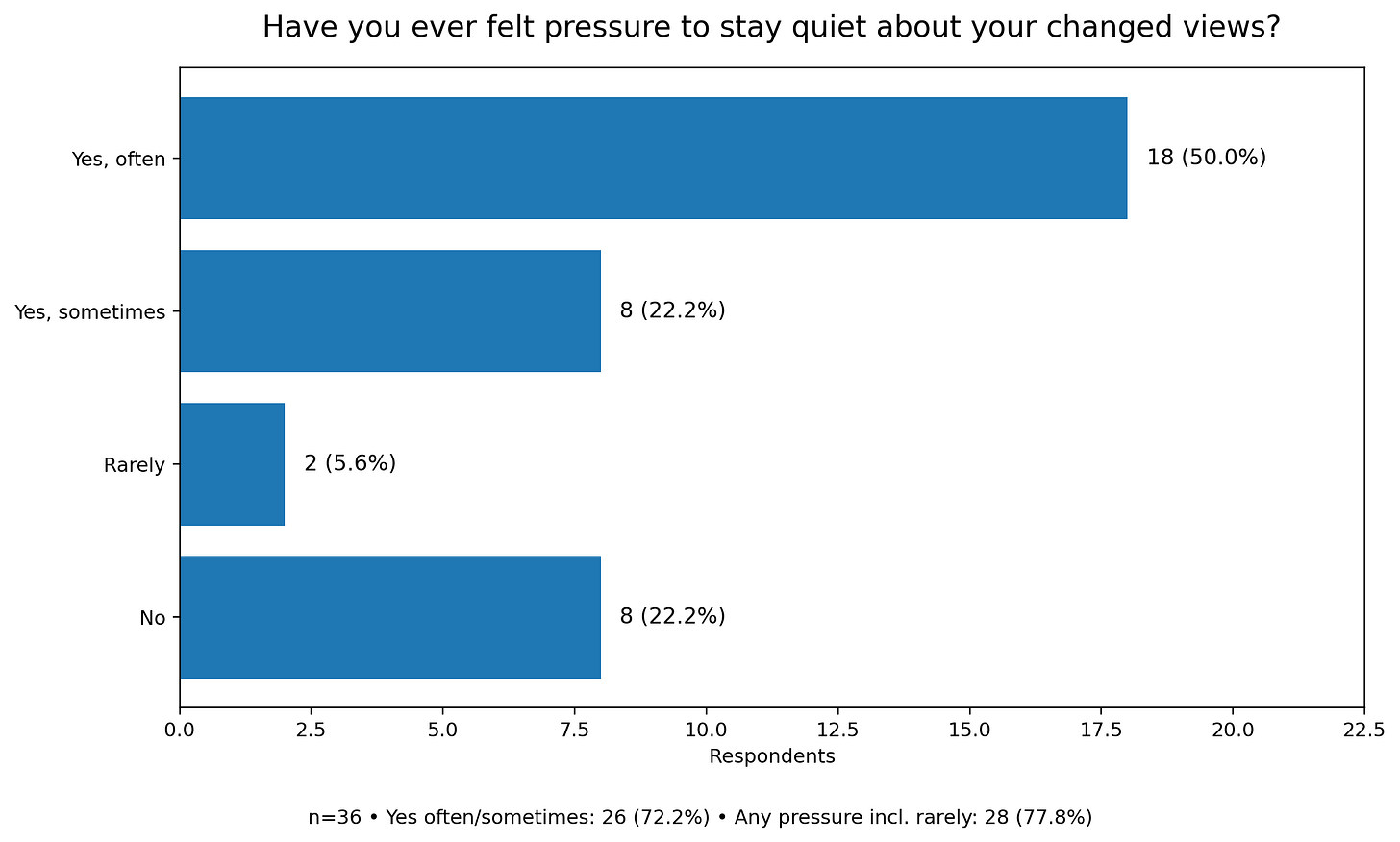
The sample is self-selected and the pressure self-reported, and I claim nothing more for these figures than what they are. The climate around those who responded has numbers of its own, none of them mine. The ADL counted 6,274 antisemitic incidents in the United States in 2025, and its own tagging marks 2,847 of them, 47% as related to Israel or Zionism. Nearly half of the recorded hatred of Jews now presents itself as related to the Jewish state, which is the position these thirty-six are punished for abandoning.
The other direction
Honesty requires me sharing this respondent. Among the thirty-six is a person moving the opposite way. They were raised Zionist, now convinced that practicing their religious beliefs is incompatible with the state, becoming, in their own word, antizionist. They left the pressure box unmarked and wrote it out instead, worried about being expelled if it became known. “I don’t want to lose my community, but sticking with Israel means losing my soul.” I believe this person has it wrong, and I print them anyway.
Watch where the weight falls. A respondent hides from the Jewish community. Every other withheld their name in this essay because of a school, a campus, a union, an institution.
The morning nobody knows
The writer’s change of mind began at a massacre most people have never heard of. Psyduck was a small trance gathering in the fields between Kibbutz Nir Oz and Kibbutz Nirim, two kilometers from Gaza, with around a hundred dancers. On the morning of October 7, Hamas killed seventeen of them. Nova had thousands, and the world learned its name. The writer read about Psyduck first, and his earlier way of seeing never came back. What remains is a habit of his care: a list, kept to this day, of things they are working not to say, kept, he says, to protect a possibility of dialogue.
The price
There is a schoolhouse in America and a lecture hall in Canada; a dissertation was written alone in Flagstaff, and a mind harkened to youth in a kitchen in Scotland. In each, tense conditions, environments of duress, where they learned to speak carefully or not at all. These are the conditions set through antizionism, lending themselves to neither liberation nor freedom. They decide which sentence a professor can say in his own field, whose contract comes up for renewal, who gets flowers in October or a closed door by December.
A movement that claims to speak against power runs the workplaces on five continents, and its first demand is silence.
Antizionism advertises itself as dissent. In nearly every life this essay entered, it operates as authority. It’s what you check your sentence against, the reason a professor lowers his voice, why a schoolteacher says nothing about a father in a war zone. Dissent does not make twenty-six people whisper.
Power does.
I asked the writers what could ever move them back. One answered he would “have to unlearn the love I found for Israelis” and “relearn an anger I am trying to let go of.”
–
This is a three-part series. Part I is here.
Related Topics
Related Posts