The Other July 4th
The Other July 4th?
What will you be thinking about on July 4th this year?
By the time you finish reading this article, I hope the answer will be different.
I was born and raised in Toronto, Canada. While studying in Israel, I met my future husband, a Chicago-born American who was very American through and through. We married in Toronto and moved to Israel—forever, or so we thought.
A few short months into “forever,” the Toronto Jewish community made a passionate appeal for us to return. We committed to three years with Aish in Toronto. Three years became thirteen as we helped build a new outreach synagogue, The Village Shul, from the ground up.
Eventually, after creating something from nothing, we handed the community over to another rabbi and moved to the United States with our five children to help Jewish communities across North America grow and innovate.
As a Canadian, America fascinated me.
In sports terms, it felt like getting called up to “the show”—the major leagues. It was bigger, louder, and more confident than anything I had known.
It was also a glimpse into the future of Canadian Jewry. America was further down the road. Jews had been there longer, and I saw a troubling pattern: Jews weren’t leaving Judaism because of what they knew. They were leaving because of what they didn’t know.
And then there were the holidays.
I was constantly asking women in my classes, “What do people do on this holiday?”
Columbus Day. Presidents Day. Martin Luther King Jr. Day. Veterans Day. Memorial Day.
The answer was usually some variation of: “We barbecue” or “We shop the sales.”
I remember seeing a Presidents Day mattress commercial featuring cartoon versions of Lincoln and Washington perched on a customer’s shoulders, each trying to convince him to buy a different mattress. It wasn’t exactly a stirring lesson in American history.
But then there is July 4th.
Americans are deeply patriotic. They wave flags, wear red, white, and blue, and speak emotionally about their country in ways that Canadians rarely do. And every year, that patriotism culminates in fireworks, parades, concerts, and celebrations.
This year is especially significant. America is marking its 250th birthday—its Semiquincentennial—celebrating two and a half centuries since the signing of the Declaration of Independence in 1776.
Many Americans still remember the Bicentennial celebration of 1976. Ask someone who was around then what they remember about July 4th, 1976, and you’ll likely hear about the fireworks, festivities, and national pride.
But if you’re Jewish, that date carries another meaning entirely.
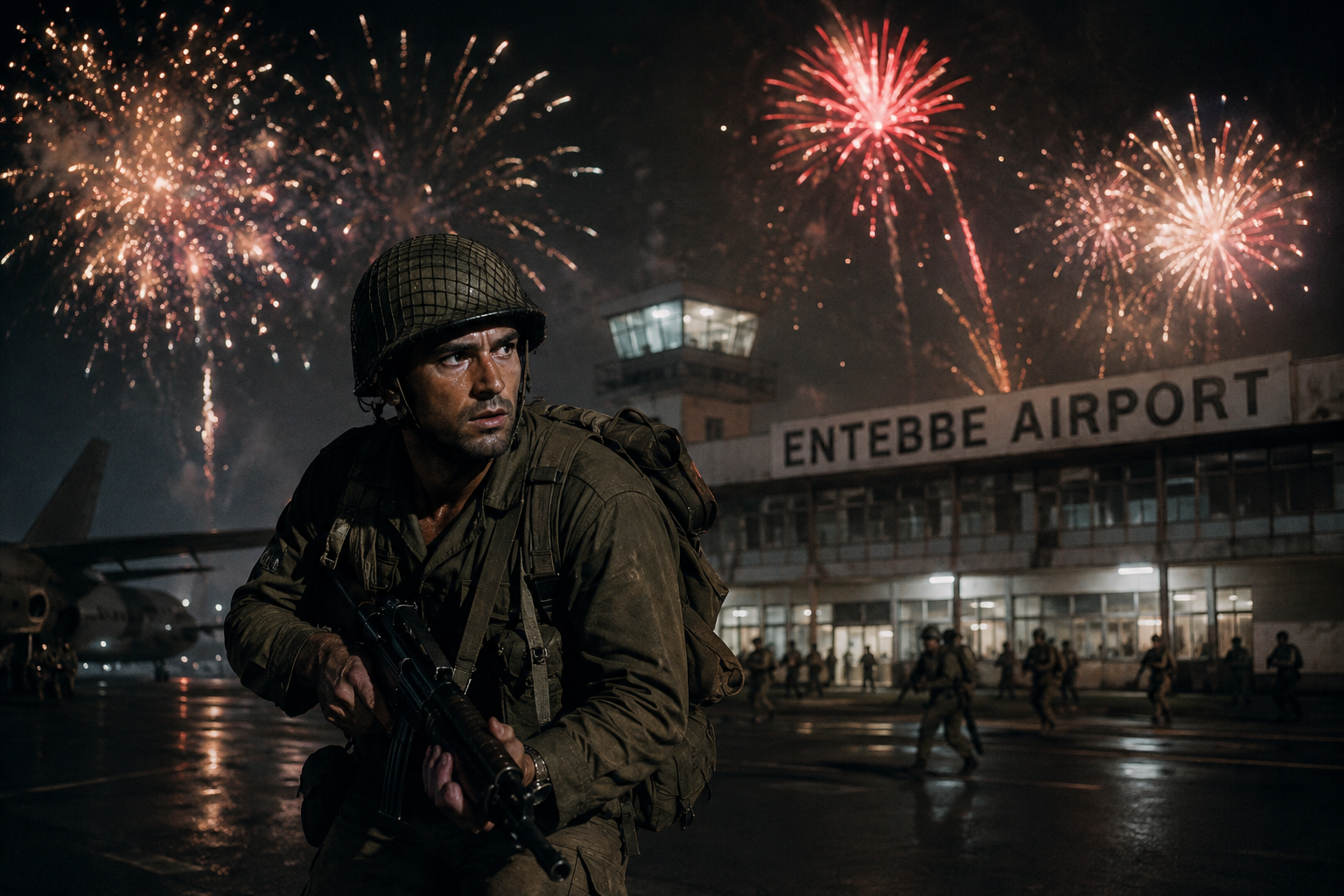
July 4th, 1976, was the day of the Entebbe Raid.
After an Air France flight carrying Israeli and Jewish passengers was hijacked and diverted to Uganda, more than 100 Jewish hostages were held at Entebbe Airport. The terrorists released the non-Jewish passengers but kept the Jews.
The message was chillingly familiar.
Jewish lives were once again being separated from everyone else’s.
The terrorists demanded the release of dozens of prisoners. Instead, Israel made a different decision.
A team of Israeli commandos flew over 2,500 miles into enemy territory on one of the most daring rescue missions in military history. Against all odds, they stormed the terminal, killed the terrorists, and rescued 102 hostages.
One Israeli soldier was killed during the operation: Lt. Col. Yonatan “Yoni” Netanyahu, the mission commander.
Several years ago, my husband and I met an Israeli who had participated in the raid.
Today he is an observant Jew but told us he had grown up very secular and never prayed in his life. He shared that before Entebbe he had fought on the Golan Heights during the Yom Kippur War. As a young soldier, he was among the first to report the massive Syrian tanks that had suddenly appeared before him.
My husband asked him, “Was that the first time you prayed?”
“No,” he answered.
“The first time I prayed was on the flight home from Entebbe.”
The soldiers were flying back to Israel in complete darkness, without lights, trying to avoid detection. The turbulence was intense.
He asked the pilot if they could fly lower to avoid the turbulence.
The pilot replied, “We can’t. We’re surrounded by the mountains of Kenya. It’s pitch black. We have no lights. We can’t see them.”
“That,” he told us, “was the first time I prayed.”
“Because you were afraid you would die?” my husband asked.
“No,” he said.
“We all knew we might die during the rescue. We accepted that.
“But now that we had succeeded—now that we had rescued the hostages—if we crashed into a mountain, the world would never know the miracle that had happened. They would only know the tragedy.”
The world did learn about the miracle.
The images of hostages reuniting with their families are unforgettable. The courage, ingenuity, and determination displayed by those young soldiers still inspire people to this very day.
This July 4th marks the 50th anniversary of the Entebbe Raid.
As Americans celebrate 250 years of freedom, my husband and I will commemorate another kind of freedom.
We now live in Israel and plan to visit Har Herzl, Israel’s national cemetery in Jerusalem, and place a simple stone on the grave of Yoni Netanyahu—the young commander who gave his life so that Jewish hostages thousands of miles from home could live.
So this July 4th, enjoy the fireworks.
But take a moment to remember another July 4th.
A day when Jewish courage, Jewish responsibility, and Jewish unity lit up the world far brighter than any fireworks ever could.