
Russian-American-Israeli Palestinian. Palestine is Israel.
The Palestine Paradox Ends Here
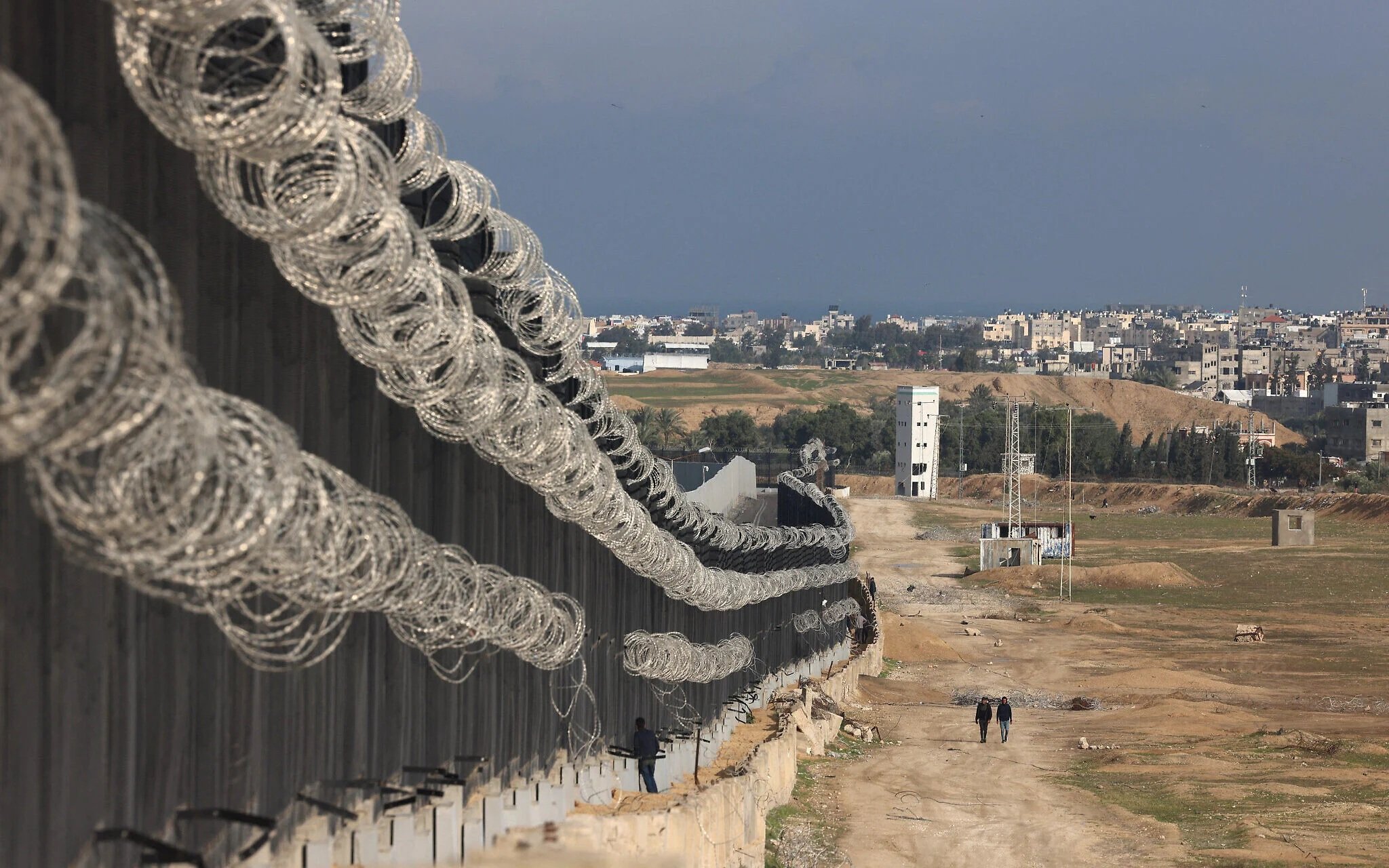
The border fence between Gaza and Egypt isn’t just a barrier — it’s a system designed to keep Gaza’s settlers stateless and aggrieved. That’s what apartheid really looks like. (Mohammed Abed/AFP)
Why the Only Just Solution Lies in Ending the “Palestinian” Fiction and Embracing Historical Reality
Let’s entertain the thought experiment. What if Israel ceased to be a Jewish-majority state? What if millions of Arab settlers or so-called “refugees” were granted a “right of return,” shifting the demographic balance? This is not a theoretical musing—it is the underlying premise of countless calls for a “solution,” whether one-state or two-state.
At the center of this proposal is the demand to naturalize 5.9 million UNRWA-registered descendants, spouses, and spouses of descendants of the 1948 refugees. Under the banner of democracy and human rights, anti-Zionist activists frame this vision as inclusive and moral. But under scrutiny, it reveals itself as a calculated maneuver to erase Jewish sovereignty—not to foster coexistence, but to dissolve Israel’s identity as the Jewish national home.
Peel back the euphemisms, and what remains is not a call for peace but a blueprint for replacement. It’s time to dismantle the illusion.
The Thought Experiment Ends in Dissolution
Israel is a democracy with equal voting rights for all citizens, including over two million Arab Israelis. Yet it is also a Jewish state—not because it discriminates, but because it was founded as a national home for the Jewish people. This is not a contradiction. Dozens of democratic nation-states around the world preserve both majority identity and equal civil rights.
Why is Jewish national identity uniquely delegitimized?
A demographic overhaul—through mass naturalization of foreign Arab settlers and generations of perpetuum “refugees”—would not magically evolve into a multinational utopia. It would end Israel. The model is not the U.S. or Canada. It’s Syria. Lebanon. Iraq. Such transformations are more often accompanied by bloodshed than by diversity.
The so-called “two-state solution” offers no better outcome. There is simply no room in the tiny territory of Israel-Palestine—smaller than Lake Michigan—for two sovereign and secure national states. Definitely not when one of them denies the legitimacy of the other and weaponizes its identity to do so.
The only viable, just, and sustainable resolution is regional: Arab settlers must be absorbed by the Arab world of which they are an integral part. Their identity is not rooted in a unique or ancient connection to this land, but in a broader Arab civilizational sphere—linguistically, culturally, and historically—shared across 22 nations with vast territory and common heritage.
The Forgotten Refugees: Justice Requires Memory
If justice demands a “right of return” for Arab settlers and so-called “refugees,“ what about the 850,000 Jews expelled from Arab countries in the mid-20th century?
Their homes, businesses, and communities were erased. They received no UN agency, no international status, no perpetual refugee label. Israel absorbed them—not as a bargaining chip, but as citizens.
By UNRWA logic, their descendants today would number in the millions. But you won’t find them demanding a “return” to Baghdad, Aleppo, or Tripoli. Why? Because Israel exists to end Jewish statelessness—not to prolong it.
Justice must be symmetrical. If return is a right, it must be a universal one—not a political weapon aimed at undermining a single nation.
The Political Utility of a Manufactured Identity
The refusal of Arab regimes to absorb the settlers they call “Palestinians” is no accident. It is a strategy.
As PLO Executive Committee member Zuheir Mohsen bluntly admitted in an interview with the Dutch newspaper Trouw, published on March 31, 1977:
The Palestinian people do not exist. The creation of a Palestinian state is only a means for continuing our struggle against the state of Israel for our Arab unity. In reality today there is no difference between Jordanians, Palestinians, Syrians and Lebanese. Only for political and tactical reasons do we speak today about the existence of a Palestinian people, since Arab national interests demand that we posit the existence of a distinct ‘Palestinian people’ to oppose Zionism. Yes, the existence of a separate Palestinian identity exists only for tactical reasons, Jordan, which is a sovereign state with defined borders, cannot raise claims to Haifa and Jaffa, while as a Palestinian, I can undoubtedly demand Haifa, Jaffa, Beer-Sheva and Jerusalem. However, the moment we reclaim our right to all of Palestine, we will not wait even a minute to unite Palestine and Jordan.
Let’s also recall what Yasser Arafat declared after the Oslo Accords in a speech to Arab diplomats in Stockholm, as quoted in the Jerusalem Post (23 February 1996):
We plan to eliminate the State of Israel and establish a Palestinian state. We will make life unbearable for Jews by psychological warfare and population explosion. Jews will not want to live among Arabs. I have no use for Jews. They are and remain Jews. We now need all the help we can get from you in our battle for a united Palestine under Arab rule.
These were not slips of the tongue. They were political confessions.
The term “Palestinian”—in its modern Arab usage—is not an ethnic designation. It is a tool. A placeholder. A mask. It carries no pre-20th-century Arab ethnic content. The identity was manufactured for a singular purpose: to reverse Jewish sovereignty. Before it was appropriated and weaponized, Palestinian primarily referred to the Jews of the land—indigenous to Eretz Yisrael and known internationally as Palestinian Jews.
The refusal of Arab states to offer citizenship to their fellow Arabs—people who share their language, culture, and religion—speaks volumes. These settlers and perpetual generational “refugees” are not intended to find homes. They are meant to remain stateless and aggrieved—permanent fuel for the campaign to eliminate Israel.
Is Limbo a Strategy or a Solution?
What if the greatest obstacle to peace is the lie we’ve been told—and the one we keep repeating?
The current limbo—where millions of Arabs are trapped in artificial “refugee” status—is not a path to peace. It is a human shield around a political weapon.
But this status quo cannot be frozen forever. There are only two paths forward:
- A regional solution, in which Arab settlers are absorbed into the vast Arab world—where they belong culturally and historically—and Israel retains sovereignty over its land and security.
- A delusional fantasy, in which Israel dismantles itself to satisfy a fraudulent identity narrative—leading only to bloodshed, chaos, and regional collapse.
The absorption of Arab settlers into the Arab world can occur with or without the territories. But there will not be a separate Arab state on these tiny lands. And certainly not one called “Palestine”—because Palestine is Israel, and Palestinians are Israelis.
A sustainable path forward must include the dismantling of UNRWA, which perpetuates the refugee condition instead of resolving it—unlike UNHCR, the UN Refugee Agency, which focuses on resettlement and integration.
This is not about denying rights. It is about recognizing reality. Peace cannot be built on a lie.
The Role of the Manifesto
The Palestinian Identity Manifesto provides the intellectual and moral clarity needed to move forward.
It affirms that:
- Palestine is Israel.
- Palestinians are Israelis—the indigenous Jews and all loyal citizens of Israel, regardless of background, ethnicity, or religion.
- Arab settlers in Judea, Samaria, and Gaza are not Palestinians. They are Arabs from neighboring regions who settled during the Ottoman and British periods. Their falsified identity has been politically weaponized to wage a war—not just of narrative, but of existence.
The Manifesto does not call for expulsion or vengeance. It calls for truth, restoration, and resolution. It ends the identity theft. It reclaims the name Palestine and returns it to the people to whom it rightfully belongs.
Only when language is honest can diplomacy be meaningful. Only when identity is anchored in history can justice be pursued. The Manifesto is not merely a rebuttal—it is a roadmap.
A Just Solution Is a True Solution
If we truly care about peace, justice, and human dignity, we must abandon false frameworks. Neither the “one-state” nor “two-state” proposals have delivered peace—because both rest on political distortions.
The just solution is this:
- Israel remains the sole sovereign in its historical homeland.
- Arab settlers are granted dignity and a future—not by dismantling Israel, but by being reintegrated into the Arab world.
- The name Palestine is restored to its rightful owners.
- The Israeli people are no longer asked to compromise their identity to appease invented claims.
Anything less is not a solution. It is surrender—moral, historical, and civilizational.
Related Topics