
The Paradox of Authoritarian Asphyxiation
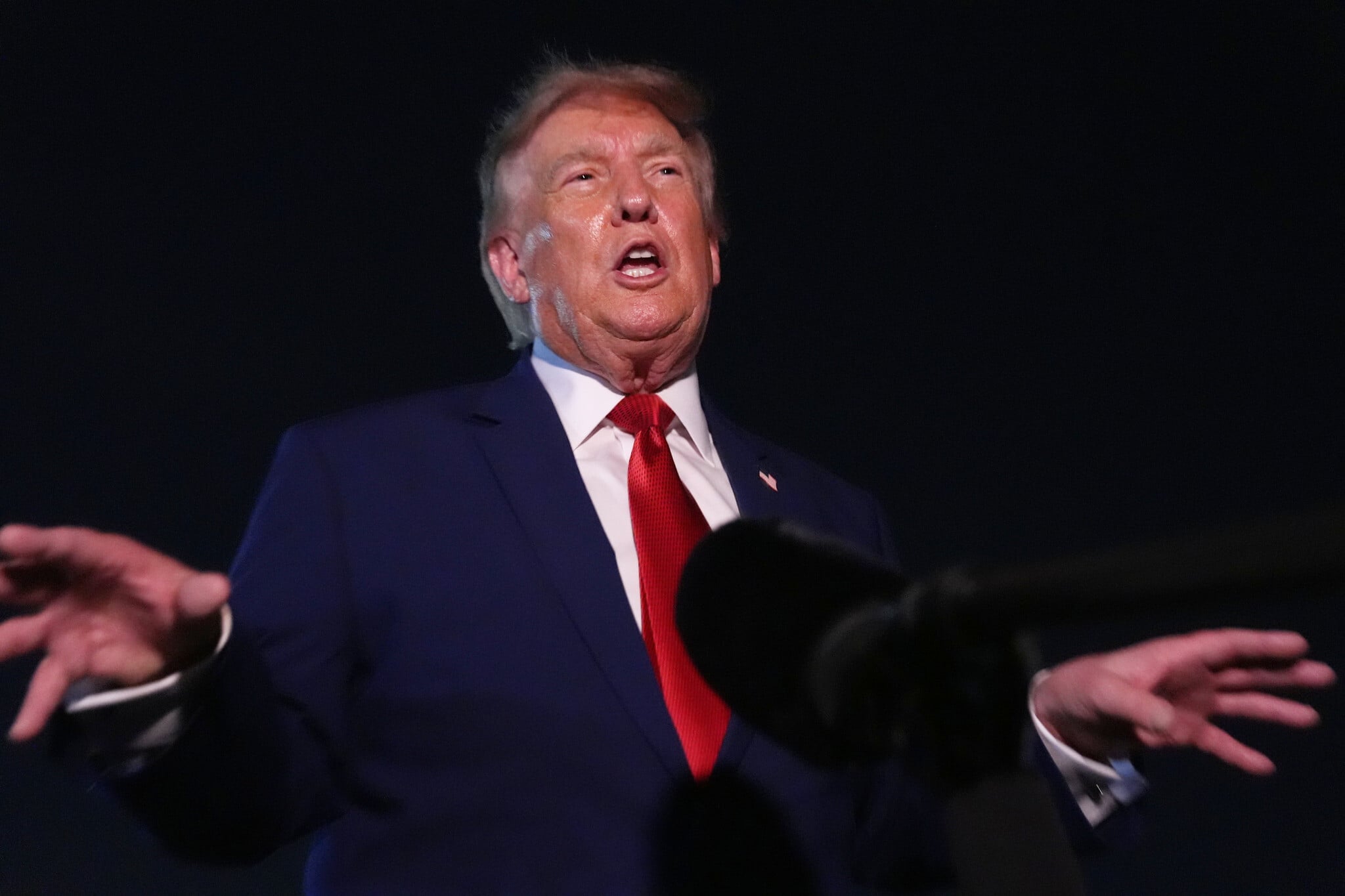
President Donald Trump talks to reporters after arriving on Air Force One August 11, 2026, at Joint Base Andrews, Md. (AP Photo/Mark Schiefelbein)
Why Ruining an Economy Is Not Enough to Topple a Regime
When an economy collapses, the reaction is almost automatic: discontent rises, protests multiply, and the regime eventually falls. Yet the history of authoritarian regimes warrants greater caution. An economy can be deeply weakened without the core of power collapsing. This is what I would call the ‘paradox of authoritarian asphyxiation’: the economic pressure that should hasten a regime’s fall can also create mechanisms that delay it.
The Iranian case is particularly interesting. The economy is under severe pressure, inflation is high, and oil revenues are fragile. But observing that the economy is suffering does not mean that the regime is close to falling. It is important to distinguish three things: the weakening of the economy, the weakening of the state, and the weakening of the regime.
First window: power can transfer suffering to the population. An authoritarian regime does not primarily seek to preserve the general standard of living; it seeks to preserve the organs on which its survival depends. When resources shrink, it prioritizes security forces, strategic sectors, and loyalty networks. The population can therefore reach its economic breaking point well before the state reaches its political breaking point.
Second window: scarcity can strengthen those who control it. The scarcer resources become, the more their distribution becomes political. Whoever controls these resources controls an increasing share of the economy. In Iran, this can strengthen structures close to power, particularly those linked to the Revolutionary Guards—first paradox: sanctions can weaken the country while strengthening certain pillars of the regime.
Third window: impoverishment can also weaken the opposition. We often think that poverty automatically produces revolt. This is not always true. Demonstrating, organizing a strike, or maintaining a national mobilization requires resources. When families must focus on survival, some of the energy available for protest disappears. Economic asphyxiation can thus generate more anger while reducing the ability to channel it into an organized political movement.
Fourth window: external pressure can provoke a national reflex. A population can reject its government while also rejecting foreign pressure seen as an attack on the country. The more visible the sanctions or military coercion, the more the authorities can change the narrative: the problem is no longer just the regime’s mismanagement but also external aggression. This can blur the line between opposition to the regime and defense of the nation.
Fifth window: sanctions create their own beneficiaries. When normal channels are closed, parallel circuits appear: shell companies, intermediaries, clandestine transport, indirect trade, opaque financial networks. Those who know how to circumvent them acquire a rent. Some elites may then have an interest not only in the regime’s survival but also in the survival of the sanctions economy itself.
Sixth window: asphyxiation is almost never total. To survive, Iran does not need to return to a normal economy. It may need only to keep enough oil revenue, trading partners, clandestine circuits, and essential imports to maintain the system’s core. There is a considerable space between making an economy suffer and preventing it from functioning. Within this space, an authoritarian regime can survive for years.
Seventh window: fear of chaos can become an ally of power. A regime does not survive only because it is supported. It can survive because part of the population fears even more what might come next. Who would govern if Iran’s authorities fell? Would the opposition remain united? Would the armed forces retain cohesion? Would the country risk fragmentation? Even citizens hostile to the regime might hesitate before leaping into the unknown. The regime only needs to convince them it is better than chaos.
Eighth window: the war of clocks. The United States has much greater economic power than Iran. But the strategic question is not just who is more powerful; it is who is in greater hurry. Sanctions operate over time. Tehran may estimate that if it can hold out for six months, a year, or more, Washington may need a deal before it does. Thus, a superior power may have many more resources yet lose a negotiation if its adversary believes it is more pressed to reach an agreement.
Then comes the decisive window: the fracture of the core of power. Sanctions may reduce resources, heighten internal tensions, and make the system costlier to maintain. But the truly dangerous threshold for Tehran is probably not just the rial’s value or the inflation rate. It lies in the cohesion of the ruling core. The day simultaneous divisions appear at the top, defections occur in the security forces, the loyalty networks cannot be maintained, coordinated social movements arise, and a credible political alternative emerges. Economic asphyxiation can become the catalyst for a regime crisis.
This is where the perspective error of many analyses lies. We look at the rial, inflation, oil exports, and financial reserves. All these indicators tell us how much Iran is suffering. But they do not necessarily tell us how close the regime is to falling.
To answer this second question, we must look elsewhere: at the cohesion of the elites, the loyalty of the Revolutionary Guards, the authorities’ ability to protect their supporters, the organization of the opposition, and, above all, the behavior of the coercive apparatus.
“The paradox of authoritarian asphyxiation” can thus be summarized as follows: the more economic pressure increases, the closer it can bring a regime to its breaking point. But as long as it retains control of coercion, scarce resources, and its elites, this same pressure can make society more dependent, the opposition weaker, and the system more closed.
An economy can therefore collapse well before its political regime collapses.
The real question for Iran may not be: “How far can the economy fall?” Rather, it is: “How far can the economy fall before the loyalty of those who protect the regime also begins to collapse?”
That is probably where the true tipping point lies.
Related Topics
Related Posts