
CFO | Empower Society for Good I Author
The Paradox of Jewish Power
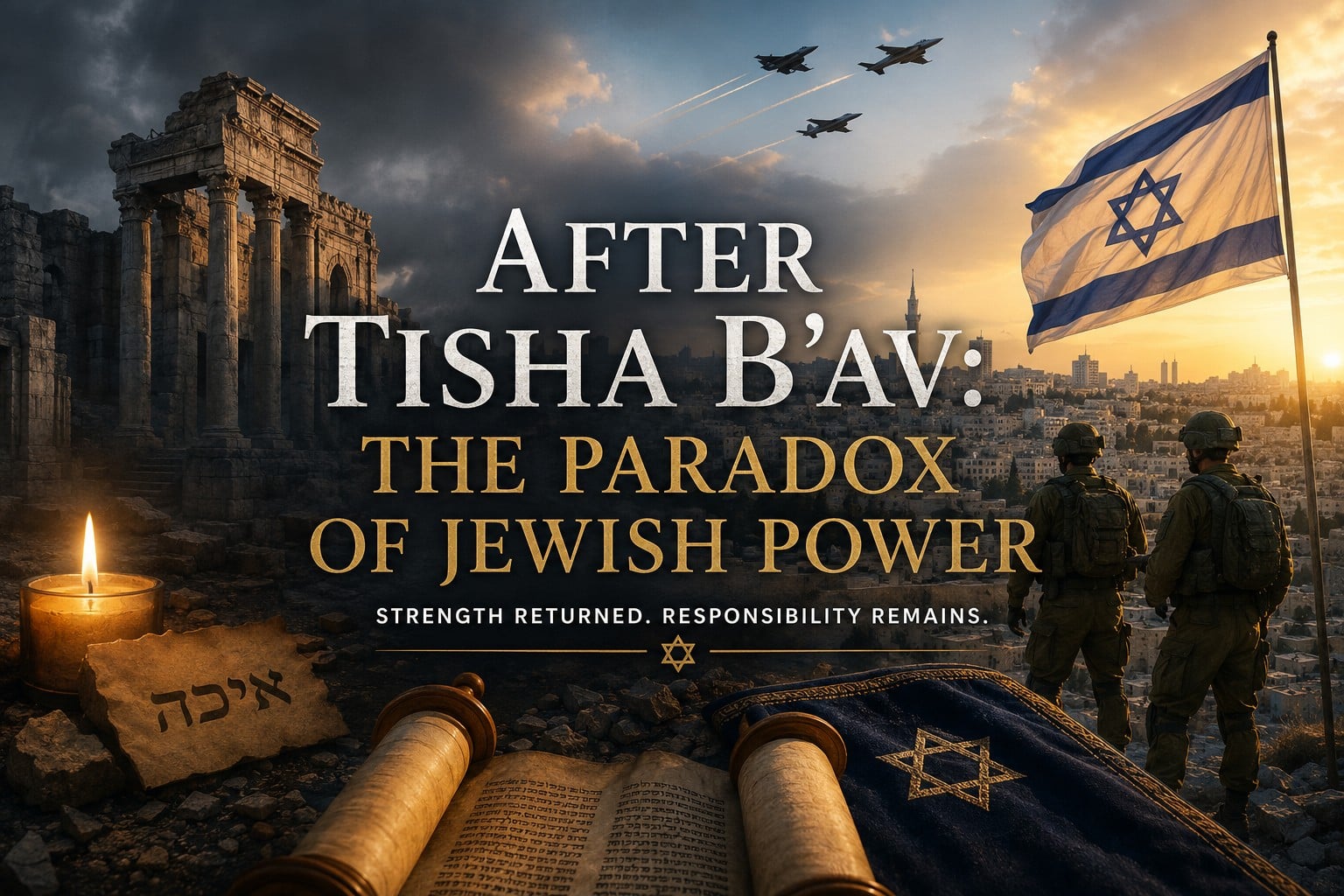
Never in modern Jewish history have power and vulnerability existed side by side so starkly.
Over the past year, Israel has demonstrated military, intelligence and technological capabilities that few nations on earth can match. We have intercepted massive missile barrages, struck deep inside Iran, dismantled much of Hezbollah’s military leadership, and inflicted significant damage on Hamas. For the first time in two thousand years, the Jewish people are no longer powerless. We possess the ability to defend ourselves, to deter our enemies and, when necessary, to take the battle to those who seek our destruction.
Yet if there is one emotion that lingers across Israel today, it is not triumph.
It is uncertainty.
The return of many hostages has brought moments of profound joy, but it has not erased the trauma of October 7. The wounds remain visible in bereaved families, survivors, reservists and communities rebuilding their lives. Military victories have restored confidence, but they have not removed uncertainty. Hamas has been weakened but not eliminated. Hezbollah has suffered devastating blows, yet remains armed. Iran’s military capabilities have been damaged, but its ideological commitment to Israel’s destruction has not disappeared. Many Israelis quietly wonder whether we have resolved these threats—or merely delayed their next chapter.
At the same time, another reality has become impossible to ignore. Israel’s alliance with the United States remains one of its greatest strategic assets, and American support has been indispensable. Yet Israel is particularly vulnerable to the profound changes now taking place within American politics and within the Jewish Diaspora itself. Support for Israel can no longer be assumed to pass automatically from one generation to the next. Younger Jews are often more distant, more critical, and less instinctively connected to Israel than their parents and grandparents. At the same time, Israel has too often taken Diaspora support for granted, while many Diaspora communities feel increasingly unheard, misunderstood or alienated.
This relationship requires repair. Israel and the Diaspora are not separate stories. The strength of Israel has long sustained Jewish confidence abroad, while the strength, advocacy and engagement of Diaspora Jewry have reinforced Israel’s security and legitimacy. If that bond weakens, both become more vulnerable. Friends are invaluable and alliances are essential, but neither diplomatic support nor Jewish solidarity can survive indefinitely without trust, mutual respect and a renewed sense of shared destiny.
That emotional tension makes this year’s reading of Parshat Va’etchanan, immediately following Tisha B’Av, particularly profound.
For centuries, Tisha B’Av commemorated what the Jewish people had lost. We mourned the destruction of the First and Second Temples, but over time the day came to embody the entire tragedy of Jewish exile: expulsions from England, France and Spain, the ghettos of Europe, the pogroms, the Holocaust, and now, inevitably, the horrors of October 7.
The modern Version of Tisha B’Av carried an irony almost unprecedented in Jewish history.
For two thousand years, we mourned in exile. Today we mourn living in a sovereign Jewish state. We lament the destruction of Jerusalem while praying in Jerusalem itself. We recited the words “Next year in Jerusalem” knowing that for our generation, they are no longer merely a dream but a lived reality.
History has brought us home. Yet returning home, we have discovered, does not mean history has ended. It is precisely at this moment that the Torah asks us to open Parshat Va’etchanan.
There, Moses delivers one of the most remarkable speeches in the Bible. Standing on the eastern bank of the Jordan River, knowing he will never enter the Promised Land himself, he speaks not only to the generation before him but to every generation that will follow. Before Israel has even crossed the river, Moses sketches an astonishing panorama of Jewish history: prosperity, complacency, exile, survival and, ultimately, return.
The people will inherit the land.
They will flourish.
They will forget the covenant.
They will be scattered among the nations.
Yet they will never disappear.
And one day, if they seek God with all their heart and soul, they will return.
For centuries these words seemed unimaginable. History is littered with civilizations that vanished after losing their homeland. The Assyrians, Babylonians, Philistines and countless other ancient peoples disappeared into history. Yet the Jewish people preserved their identity across continents and centuries. Hebrew, a language that had ceased to be spoken in daily life, became the language of children, universities and parliament. A people dispersed for nearly two millennia returned to rebuild sovereignty in its ancestral homeland.
No comparable story exists in recorded history.
We are living inside the history Moses foresaw.
But perhaps the most important part of Moses’ message is what comes next.
Immediately after recounting Israel’s past and future, he repeats the Ten Commandments. Then comes the sentence that has become the beating heart of Judaism:
שְׁמַע יִשְׂרָאֵל, ה’ אֱלֹהֵינוּ, ה’ אֶחָד
“Hear, O Israel: The Lord is our God, the Lord is One.”
The sequence is no accident. History brings Israel home. The Ten Commandments teach us how to build a just society. The Shema reminds us why.
Moses understood something that every generation must learn anew: sovereignty is not the destination. It is the beginning of responsibility.
That lesson is reinforced only a chapter later, when Moses addresses one of the Bible’s most misunderstood ideas.
“For you are a people holy to the Lord your God. The Lord your God has chosen you to be His treasured people out of all the peoples on the face of the earth. It was not because you were more numerous than any other people that the Lord set His affection on you and chose you, for you were the fewest of all peoples.” (Deuteronomy 7:6–7)
The Torah dismantles any notion of superiority before it can arise. Israel is not chosen because it is stronger, wiser or greater than other nations. Quite the opposite. It is chosen despite being the smallest.
The covenant is not a declaration of privilege but an acceptance of responsibility. Israel is called upon to demonstrate that power can be restrained by justice, that national identity can coexist with compassion, and that freedom without moral purpose eventually destroys itself.
Rabbi Jonathan Sacks frequently observed that Judaism is less concerned with how power is acquired than with how power is exercised. After nearly two thousand years without sovereignty, that may be Moses’ most urgent lesson for modern Israel.
Perhaps this also helps explain one of Jewish history’s enduring paradoxes.
Long before the establishment of the modern State of Israel, the Jewish people occupied a place in the world’s imagination far beyond their numbers. Throughout history, Jews were expelled, isolated, stereotyped and persecuted in ways that defied rational explanation. Today, the world’s only Jewish state occupies less than 0.01% of the earth’s landmass and represents less than 0.2% of humanity, yet it commands extraordinary international attention.
Some of that scrutiny is legitimate. Some reflects political disagreement. Some are unmistakably rooted in antisemitism. Whatever its source, Jews have rarely been permitted the luxury of anonymity.
The Torah offers a different perspective. If Israel accepted a covenant that demanded greater moral responsibility, perhaps it should not surprise us that the world often judges Israel through a moral lens—even when that judgment is inconsistent or unfair.
The challenge is not to resent the scrutiny. The challenge is to remain worthy of the covenant. That challenge feels especially urgent today.
Before October 7, Israeli society was deeply divided over judicial reform, politics and the nature of democracy. Since then, new divisions have emerged over military service, the burden carried by reservists, relations between religious and secular communities, and competing visions of Israel’s future. As we reflect on Tisha B’Av, Moses’ words remind us that nations are not weakened only by enemies beyond their borders. They can also be weakened by the erosion of shared purpose, mutual responsibility and empathy.
Military strength remains indispensable. Strategic alliances remain essential. Technological superiority saves lives. But none of these alone can secure Israel’s future. Ultimately, our greatest strategic asset has always been the quality of the society we build.
That is why Va’etchanan follows Tisha B’Av.
Tisha B’Av reminds us what happens when Jewish sovereignty is lost.
Va’etchanan reminds us that sovereignty itself is only the beginning.
Every generation has wondered whether it was living through a decisive chapter of Jewish history.
Ours does not need to wonder.
We have witnessed the ingathering of exiles.
We have watched Hebrew become a living language once again.
We have seen Jerusalem rebuilt.
We have experienced the horror of October 7.
We have discovered that even extraordinary military power cannot, by itself, guarantee lasting peace.
The return to Zion fulfilled one of the oldest hopes in human history.
The harder task begins afterwards.
Building a society whose justice is equal to its power, whose unity is stronger than its divisions, and whose moral purpose justifies the extraordinary privilege of coming home.
Moses’ question is no longer whether the Jewish people will return to the Land.
History has answered that.
The question confronting our generation is whether we will build a society worthy of remaining there.
Questions to Ponder
- What does Jewish sovereignty demand of us beyond military strength?
- If the Torah’s idea of being “chosen” means responsibility rather than privilege, how should that shape Israel’s national priorities?
- Can a nation remain secure if it loses its internal unity and shared sense of purpose?
- What does the Shema teach us about the moral foundation of a good society?
- How can Israel balance military necessity with the ethical standards expected of a covenantal nation?
- As we rebuild after October 7, what kind of Israel do we want our children and grandchildren to inherit?
Key Takeaway
Tisha B’Av reminds us what we lost. Va’etchanan reminds us why we returned. The miracle of our generation is that the Jewish people came home. The challenge of our generation is to build a society worthy of that miracle.
Related Topics
Related Posts