The Paradox of Peace: Why Muslim Moderates Are Treated as Suspects
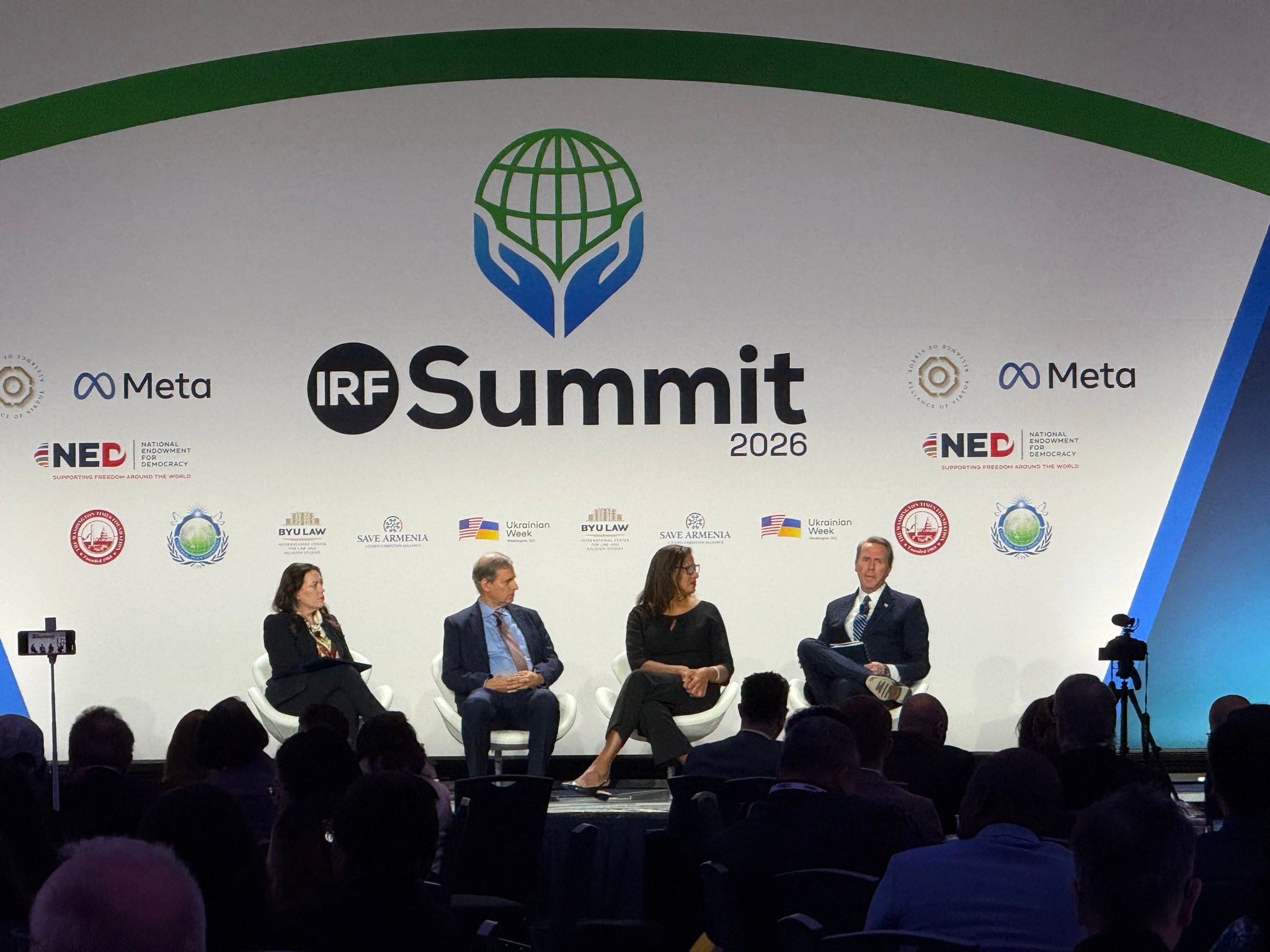
The sixth annual International Religious Freedom (IRF) Summit took place from February 2–4 in Washington, D.C., and it wrapped up with a powerful message: the global fight for the freedom to believe is heating up just as repression is on the rise. The summit brought together more than 90 organizations representing over 30 faith traditions, underscoring that religious freedom is not a parochial cause but a universal one.
Co-chair Sam Brownback, former U.S. ambassador-at-large for international religious freedom, framed the issue not only as a moral imperative but as a geopolitical reality. Dictators, he argued, fear religious freedom more than military hardware because belief systems create loyalties beyond the state. People of faith living under repression, Brownback said, are often the greatest internal challengers to authoritarian power.
And… that's a wrap! Thank you to everyone who attended #IRFSummit2026. We pray that this gathering will help propel the #IRF movement forward.
Continue to follow along as we share more powerful moments from this impactful gathering.
Tomorrow, we head to the Hill to advocate… pic.twitter.com/XWWTPhb4ZD
— IRF Summit (@IRFSummit) February 4, 2026
Speaking to a crowd of advocates, faith leaders, and policy experts at the Washington Hilton, IRF Summit co-chair Dr. Katrina Lantos Swett highlighted the irony of our times with a quote from Charles Dickens: “It was the best of times, it was the worst of times.” On one hand, the movement for freedom of conscience is more widespread and organized than ever. On the other hand, more individuals are living under governments that limit or suppress religious beliefs than at any time in recent memory. Almost 80 percent of the global population resides in countries where there are significant governmental or societal restrictions on religion—a statistic that should concern anyone who values human dignity and social harmony.
IRF Summit Co-Chairs @SamuelBrownback and @LantosSwettK speaking with Rep. Chris Smith ahead of the joint hearing on Defending Religious Freedom Around the World. #IRFSummit2026 #CongressionalAdvocacyDay pic.twitter.com/P2MRBLTQNH
— IRF Summit (@IRFSummit) February 4, 2026
This linkage between authoritarianism and the suppression of belief was echoed by Maureen Ferguson of the U.S. Commission on International Religious Freedom (USCIRF), who noted that governments target people of faith precisely because they “can’t control the way they think and believe.” History supports this view. From the Soviet Union to present-day autocracies, restrictions on religion often accompany broader crackdowns on civil liberties.
Rep. Chris Smith: Religious persecution is festering and exploding around the world.
More than ever before, vigorous U.S. leadership and diplomacy are needed to address religious freedom violations globally. pic.twitter.com/ED8LLysm1t
— House Foreign Affairs Committee Majority (@HouseForeignGOP) February 4, 2026
One of the most revealing discussions happened quietly on the sidelines—when Anila Ali, President and CEO of the American Muslim & Multifaith Women’s Empowerment Council (AMMWEC), and IRF roundtable’s volunteer coordinator Kashif Mirza met U.S. Senator James Lankford of Oklahoma, one of Washington’s most consistent bipartisan advocates for international religious freedom. Their discussion focused on an alarming trend: Muslim advocates who speak out for religious freedom, counter extremism, and defend minorities are themselves being silenced or subjected to intimidation—even within Western systems that claim to champion these values.
Anila Ali’s activism is particularly striking because it defies stereotypes. She is not a fringe activist but the founder of the first Muslim women’s civil rights movement in the United States, established after 9/11 to counter violent extremism and promote interfaith harmony. Her family history is deeply intertwined with Pakistan’s pluralistic legacy. She is the daughter of Qutub-ud-din Aziz, one of Pakistan’s founding fathers, a journalist and public intellectual who spent his life defending minority rights and writing for international publications. Her grandmother founded educational institutions dedicated to respect for all faiths. Her question is simple: why are those who stand most firmly against extremism, antisemitism, and religious persecution increasingly being treated as suspects rather than partners?
I advocate for religious liberty- because it is what my parents and grandparents believed in when they helped build Pakistan—a vision where minorities were equal citizens.@usembislamabad @SecRubio @State_SCA
My father, #QutubuddinAziz, spent decades as a journalist and public… pic.twitter.com/Sfku4azTOM— Anila Ali (@anilaali) February 2, 2026
Their concern centered on the deeply troubling visa experiences faced by two Pakistani minority journalists—myself, a Christian writer, and Mishal Kaur, a Sikh journalist—both invited to attend the IRF Summit. Instead of a routine consular process, we encountered questioning that felt ideological, invasive, and disconnected from the stated purpose of our travel.
This is not about a visa refusal alone. Sovereign states have the right to deny visas. What demands reflection is how and why such refusals take place—especially when the applicants are advocates of the very values Western democracies claim to uphold.
@SenatorLankford
Junaid Qaiser, a Christian journalist and Mishal Kaur, a Sikh journalist who applied for visa for @IRFSummit at the @usembislamabad experienced harassment and intimidation.
Requesting investigation- #Ammwec is an American Muslim & Multifaith Women’s… https://t.co/Qk6iypFsbE pic.twitter.com/PeTTrwIXeT— Anila Ali (@anilaali) February 4, 2026
Anila Ali’s presence in this narrative is truly significant. For over twenty years, she has taken a stand where many Muslim leaders hesitate to tread. Since the events of 9/11, she has bravely faced violent Islamist ideologies, brought to light the Muslim Brotherhood’s influence in the West, and boldly challenged antisemitism, even when it meant facing backlash. On October 7, when Hamas unleashed its horrors, she didn’t hold back. She firmly supported Israel’s right to exist and defend itself, at a time when taking such a clear moral stance was anything but easy.
The organization she established, AMMWEC, is more than just an advocacy group—it’s the first civil rights movement led by Muslim women, proudly multifaith and fearless. It advocates for persecuted Christians in Nigeria, documents anti-Christian violence in Pakistan, including the tragic events in Jaranwala, and confronts antisemitism, Hamas, IRGC-linked extremism, and Islamist supremacy wherever it arises.
Ironically, it’s this very clarity that seems to have made the organization—and its affiliates—targets of suspicion. When I went for my visa interview in Islamabad, the questions I faced were mostly irrelevant to my travel plans and focused instead on ideology: my opinions on the Abraham Accords, the dynamics of Pakistan–Israel relations, and even whether I intended to visit Israel after coming from the U.S.—even though I was just applying for a visa to attend a religious freedom conference in Washington.
What really struck me as unsettling was the inquiry into the funding, salaries, and personal details of AMMWEC leadership and IRF coordinators in Pakistan—topics that were completely outside my purview.
The episode raises an important policy question about whether the U.S. Embassy in Islamabad is fully aligned with President Trump’s broader peace vision, particularly the principles underpinning the Abraham Accords.
This inversion should alarm anyone serious about countering extremism.
In Western societies, there’s often a question that pops up: Where are the moderate Muslims? Yet, when individuals like Anila Ali step up to speak out—against Hamas, Al-Qaeda, antisemitism, and radical intimidation—they find themselves under fire from all directions. Extremists label them as traitors, and alarmingly, it seems that bureaucratic systems are treating them with suspicion instead of support. Democratic societies should be standing up for these voices, not leaving them vulnerable.
Anila Ali shared a strikingly simple truth with Senator Lankford: American Muslims who oppose radicalism are facing backlash for doing exactly what the West expects of them. Her organization doesn’t rely on foreign funding, operates transparently, and its mission is firmly rooted in American constitutional values. Yet, it appears that its name is being unfairly tarnished during visa interviews abroad.
So, here’s the thing: if American Muslims who stand up for Christians, support Jews, and challenge extremist ideologies are seen as liabilities, what kind of message does that send to reformers in the Muslim world?
A visa denial is one thing, but intimidation, character attacks, and ideological distrust are entirely different issues. If democratic institutions can’t differentiate between extremists and those who oppose them, they’re at risk of repeating the very mistakes that allowed radicalism to thrive in the first place.
Religious persecution—whether it’s aimed at Muslims, Christians, Jews, or Hindus—is fundamentally un-American. And silencing those who are fighting against it is even more troubling.
If democracies shut their doors to those who advocate for pluralism and peace, they shouldn’t be surprised when that space is filled by voices that reject both.