
The Pariah Fallacy
A Response to Thomas Friedman on Israel’s “New” Isolation
Many of us have likely read the recent Thomas Friedman column, “Israel’s Gaza Campaign Is Making It a Pariah State.” Reading pieces like this is difficult. They are filled with a sense of despair and are designed to provoke a strong emotional reaction. It’s easy to feel overwhelmed, angry, or even ashamed.
My goal here is not to tell you how to feel, but to offer a framework for how we can think about this as proud Jews who support Israel and see the world through the lens of our sacred values.
The Myth of a “New” Pariah
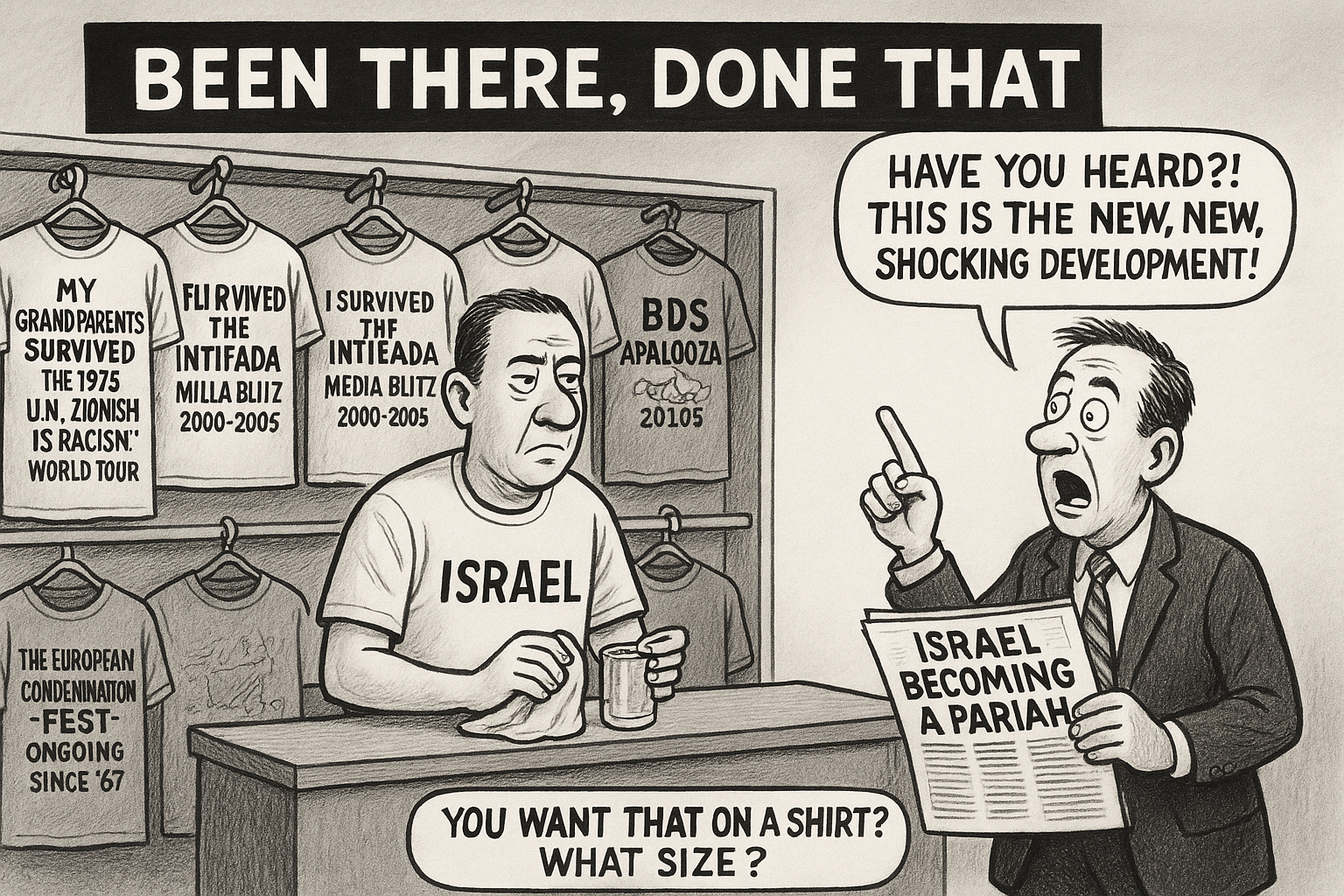
Let’s begin by examining the central premise: that Israel is becoming a pariah. This idea that Israel is only now, under this government, becoming isolated is a historical fallacy.
The pariah treatment is not a bug; it has been a feature of the world’s relationship with the Jewish state from the beginning. Let’s be clear: Israel has never started a conventional war. From the moment of its birth in 1948, it has fought wars of survival against those sworn to its annihilation. Yet, it is consistently blamed not for starting wars, but for winning them.
- In 1967, after being blockaded and threatened with extermination by its neighbors, Israel won a miraculous victory. The world’s response? Condemnation and Resolution 242, which created the “occupation” narrative that has defined Israel ever since.
- In 1975, the United Nations reached a moral low point, passing a resolution declaring that Zionism is a form of racism. This wasn’t a critique of a policy; it was an attempt to delegitimize the very existence of the Jewish national movement. That is the definition of making a country a pariah.
- During the Intifadas, as suicide bombers blew up Israeli pizza parlors, buses, and Passover Seders, what was the focus of global outrage? Israel’s security barrier and its military checkpoints—the very measures designed to stop the slaughter of its civilians.
- For the last two decades, Israel has been the only country systematically targeted by academic and cultural boycotts, as well as the BDS movement—a campaign designed to isolate and strangle the Jewish state. College campuses were hosting “Israel Apartheid Weeks” long before October 7th or the current government.
- And at the United Nations, the Human Rights Council has held more special sessions and passed more condemnatory resolutions against Israel than against Iran, Syria, North Korea, and all other countries in the world combined.
So, when a columnist writes that Israel is becoming a pariah, his argument overlooks decades of crucial history. The demonization of Israel is the baseline condition. The world isn’t suddenly turning on Israel; it is merely finding a new vocabulary for an old prejudice.
Where the Column Is Right (and Why It Hurts)
We must be honest enough to acknowledge the kernels of truth in the criticism. The column speaks of “fratricide,” of the Jewish people tearing themselves apart. This is painfully real. I see it in families and friendships, and it is a tragedy. The Talmud teaches that the Second Temple was destroyed because of sinat chinam (baseless hatred) among Jews. We must guard against this with all our might.
Furthermore, the loss of innocent life in Gaza (for which the responsibility lies fully on Hamas) is a profound human tragedy. Our value of pikuach nefesh (the saving of a life) demands that we mourn for every non-combatant caught in the crossfire. Israel holds itself to a higher moral standard than the terrorists it fights, and the burden of that standard is heavy and real.
Where the Analysis Falls Short
Mr. Friedman’s analysis is a classic example of blaming the firefighter for the damage caused by the arsonist.
The column places the blame squarely on Prime Minister Netanyahu’s political ambitions. While, as a Jew in the Diaspora, I have my own opinions on the Prime Minister, I prefer to keep those out of international publications. Regardless of where one may stand on the politics, this is a massive oversimplification that conveniently ignores the fanatical, genocidal ideology of Hamas. The column acknowledges Hamas’s evil in a single paragraph, only to spend the rest of the text dissecting Israel’s response to that evil.
Hamas’s entire strategy is built on maximizing Palestinian casualties to win the public relations war and make Israel a pariah. They are not a conventional army; they are a death cult that uses its own people as human shields. To ignore this central fact—that the “tragic mishaps” described are the direct and intended result of Hamas’s strategy—is an incomplete analysis at best.
The Unseen Shift: Old Critics and New Allies
While some commentators focus on the weakening of ties with Western allies, they are missing the most significant geopolitical shift in the Middle East. As some old voices of support grow quieter or more critical, new and powerful voices are rising in a chorus of shared interest with Israel.
The nations of the Abraham Accords—the UAE, Bahrain, Morocco—and the potential for a relationship with Saudi Arabia represent a monumental change. These are Arab countries. They are Israel’s neighbors. They know the region, and they understand the existential threat posed by Iran and its proxies like Hamas. Their growing alliance is not based on sentiment; it’s based on a clear-eyed understanding of reality. This is not to diminish the most vital alliance of all—our relationship with the United States, which remains a foundational pillar of Israel’s security. It is, however, a quiet, steady strengthening of regional alliances that is far more significant for Israel’s long-term future than the loud condemnations from commentators and campuses thousands of miles away.
The noise of daily commentary is fleeting, but the reality of a sovereign Jewish state is enduring. Our task, then, is not to win every argument in the court of world opinion, but to continue the sacred and difficult work of building a just, prosperous, and secure Jewish future. That is the work that matters. That is the only response that will echo through history.