Research Fellow at the Hebrew University of Jerusalem
The Path Forward for a Democratic, Inclusive and Post-Mullah Iran
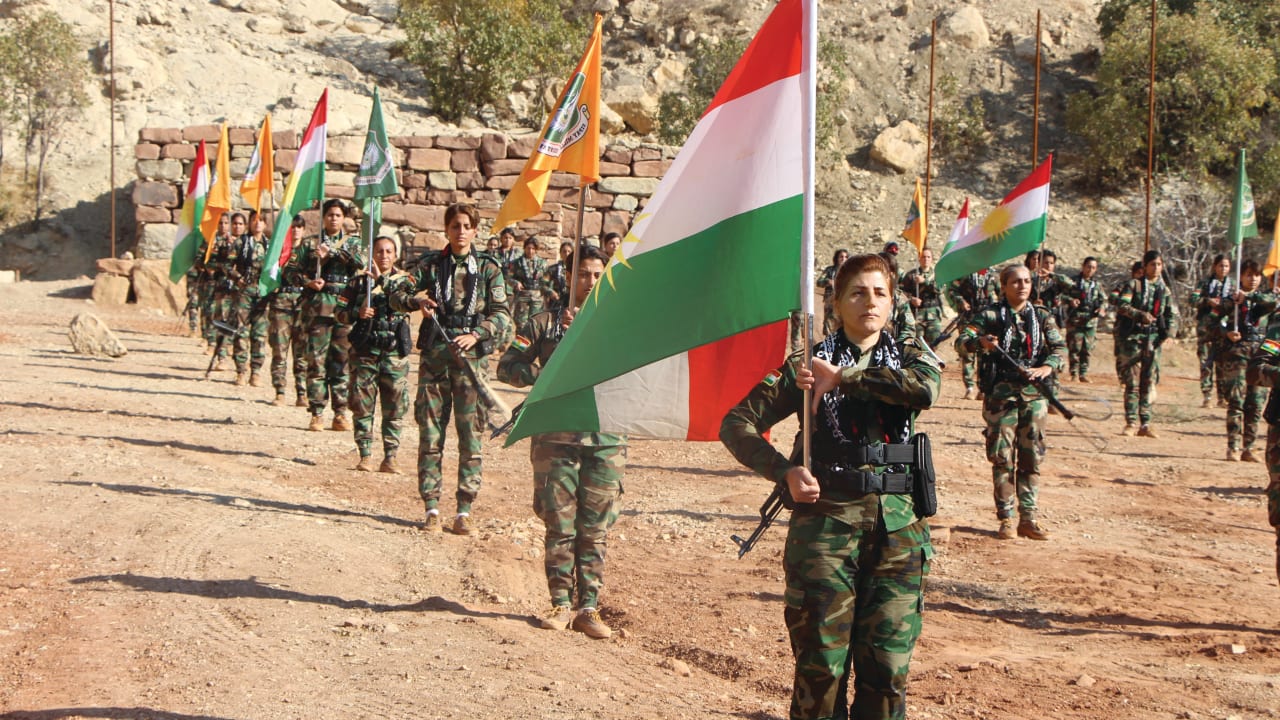
Kurdish female fighters from Iran are stationed at their base nearby. The author gratefully acknowledges Jonathan Spyer's generosity in granting permission to use the image.
Since December 28, 2025, Iran has experienced a wave of unrest. Widespread frustration and long-standing grievances among Iranians regarding the domestic and economic policies of the theocratic regime have fueled this unrest. This recent protest movement originated in Tehran’s bazaars, where small business owners and merchants gathered to oppose surging inflation, rising living costs, and the steep devaluation of the rial. It quickly spread across the country, drawing in various social groups and marginalized ethnic populations, including Kurds and Baluchs, in cities such as Kermanshah, Ilam, Isfahan, Hamadan, and Shiraz, as well as Baluchestan province.
While economic hardship served as the immediate catalyst, the unrest reflects much deeper, long-standing grievances among Iranians. The regime’s persistent failure to implement necessary reforms lies at the heart of this unrest. Instead of addressing these concerns, the Islamic Republic has responded with repression and execution, diverting state resources to support terrorist organizations such as Hamas, Hezbollah, and the Houthis, along with Shia militias in Syria and the Hashd al-Shaʿbi militias in Iraq. Furthermore, it has invested heavily in a nuclear program and ballistic missile capabilities aimed at neighboring countries, including the Kurdistan Region of Iraq and Israel.
In response to decades of mismanagement, corruption, negligence, and authoritarian rule, ordinary Iranians have broadened their protest movement beyond just economic grievances to include clear political demands, such as calls for regime change. These demands are expressed through slogans like “death to the dictator”, “death to the mullah regime”, and “neither shah nor supreme leader”. However, despite the widespread nature of shared grievances, Iran’s opposition remains highly fragmented. The lack of legitimate leadership, coordination, and cooperation, ongoing since the 1990s, has consistently allowed the regime to suppress mass movements and maintain a repressive order that primarily benefits a narrow elite associated with the Khamenei clique.
The lack of a unified leadership in Iran is due to deep-seated trauma and distrust among the country’s many social, ethnic, religious, and cultural groups. A notable figure in this context is Reza Pahlavi, the eldest son of Shah Mohammad Reza Pahlavi, who has often positioned himself as the leader of the opposition. However, in reality, his claims have led to more fragmentation than unity, an effect that the mullah regime welcomes. His nationalist and exclusionary agendas have not garnered widespread support, as they overlook historical realities, the systemic repression faced under the monarchy prior to 1979, and the legitimate economic, political, and social grievances of Iran’s diverse communities after 1979. Reza Pahlavi’s political vision reflects his father’s legacy, romanticizing the positive aspects of his rule—for instance, its embrace of the West and of the process of modernization more generally—while ignoring that his government faced widespread criticism for corruption, repression, and disconnection from societal needs of diverse Iranians. These failures directly contributed to the regime change in 1979 and the establishment of the Islamic Republic. Living abroad, the aspiring monarch likewise appears detached from the daily struggles of Iranians enduring clerical authoritarianism. Instead of fostering coordination among opposition groups, his assertions of leadership have exacerbated divisions and obstructed the creation of a united front capable of effectively challenging the regime.

For a society that has already experienced both monarchical and clerical authoritarianism, the prospect of restoring the past offers little promise. Iran’s mainstream population unequivocally rejects the imposed idea of drinking new wine from old bottles. Their rejection of the theocratic regime is also a repudiation of outdated and exclusionary political models that do not align with the aspirations of Iran’s diverse and pluralistic society. In contrast, Iran’s historically oppressed and marginalized communities are a major challenge to the regime’s repressive power. The Kurds, Baluchs, and progressive segments of Persian and Azeri populations have suffered from systemic exclusion and regime violence. Their lived experiences place them at the forefront of essential resistance, concentrating not solely on regime change but also on the creation of an inclusive, secular governance that embodies Iran’s diverse, multi-ethnic, and multi-religious society.
The regime has consistently treated the Kurds and Baluchs as scapegoats, subjecting them to severe security measures and collective punishment. During this wave of unrest, regime forces have already killed several protesters, primarily of Kurdish origin, in the city of Ilam. The Kurdish population in Iran, estimated at 10 million, has engaged in a prolonged struggle against both monarchical and clerical rule since the formation of the modern Iranian state in 1925. They seek recognition of political and cultural rights and autonomy. Nevertheless, successive regimes have rejected Kurdish aspirations and quashed them by systematically eliminating their leadership. For instance, Kurdish leaders such as Simko Shikaki in 1930, Qazi Mohammad in 1946, Abdul Rahman Ghassemlou in 1989, and Sadegh Sharafkandi in 1992 were assassinated. Kurdish political mobilization has persevered despite these repressive measures. The 2022 uprising, which originated in Iran’s Kurdish region following the killing of the Kurdish girl Jina Amini, demonstrated this resilience. Embracing the Kurdish slogan “Jin, Jîyan, Azadî” (“Woman, Life, Freedom”), the protests quickly transcended ethnic boundaries, mobilizing Iranians throughout the country and the diaspora, threatening the foundations of the theocratic regime.
Kurdish mobilization, shaped by their experiences of oppression and resistance, has developed into an inclusive platform that addresses the grievances of all Iranian people and articulates a shared aspiration for democratic and pluralistic governance in Tehran. Recently, Kurdish civic and political actors have highlighted their collaboration with all segments of Iranian society, their commitment to peace, and their support for regional stability—objectives that also include an unequivocal rejection of antisemitism and anti-Zionism. Such political maturity sharply contrasts with narrow nationalist visions that are rooted in a longing for authoritarian pasts, as represented by Reza Pahlavi and the Mullah regime. To effectively confront the Islamic Republic, Iran’s grassroots opposition, including Kurdish actors, may seek a unified front to collaborate with regional and global powers dedicated to curbing nuclear proliferation and missile development while fostering regional stability. It is essential to support a cohesive and inclusive opposition movement, led by various Iranian factions that are directly impacted by harmful policies of the Mullah regime. This coalition could represent the most viable strategy to dismantle the mullah regime and establish a democratic and peaceful Iran, one that promotes stability in the Middle East rather than perpetuating domestic repression and regional and international terrorism.
Related Topics