


Political Analyst - Columnist
The path of justice in a pirates’ world
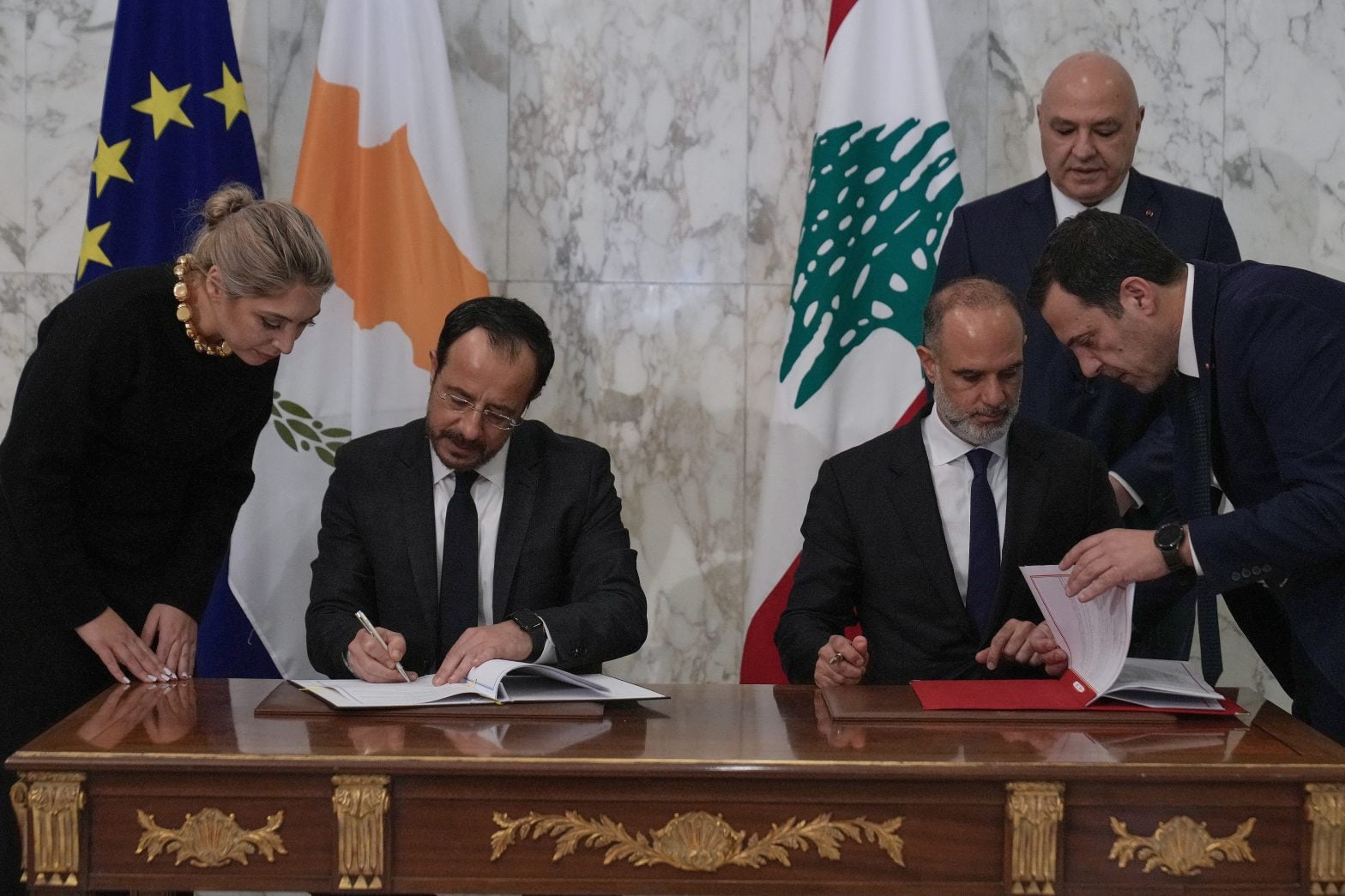
Cyprus President Nikos Chistodoulides, left, signs a long-delayed maritime border agreements with Fayez Rasamni, the Lebanese minister of Public Works, at the presidential palace in Baabda east of Beirut, Lebanon, Wednesday, Nov. 26, 2025. (AP Photo/Hussein Malla)
It was barely overlooked by the vast majority of the Greek media and also didn’t make any strong headlines in the newspapers. I am referring to the signing of the Exclusive Economic Zone (EEZ) demarcation agreement between the Republic of Cyprus and the Republic of Lebanon on November 26, 2025. However, this agreement came at the right time to promote the power of international law, while international pirates are showing their teeth.
The signing of the agreement obviously came as a culmination of the political will of the President of Cyprus, Nikos Christodoulides, and the President of Lebanon, Joseph Aoun. However, before the positive outcome, this issue has been through two decades of obstacles and difficulties. The initial agreement to demarcate the Cyprus-Lebanon EEZ was signed in 2007. However, it was never ratified by Lebanon. The dominant problem was Lebanon’s conflict with Israel, given the chaotic situation inside the Arab country. In 2010, the Republic of Cyprus proceeded with an EEZ maritime deal with Israel and at that time Lebanon raised allegations of loss of maritime sovereignty. Of course, the elephant in the room here was Hezbollah’s shadowy dominance in almost the entire Lebanese power system. On a parallel basis, Turkey was already causing problems by sending naval forces to prevent any possible gas explorations in the field. It would be another fifteen years before Israel effectively dismantled Hezbollah and thus contributed to Lebanon’s gradual return to the group of free, democratic countries.
Turkey’s immediate reaction to the above development came as no surprise at all. Though, comically enough, Turkey cannot impose any practical threat any more in a region that is now being “filled” with legal agreements. We can also recall the Cypriot-Egyptian demarcation agreement of 2003-2004 and the Greek-Egyptian EEZ of 2020 partial demarcation agreement. Turkey, being aware of the specific events as well as of the intense interest of the United States of America for the region, limited itself to pressure on the pseudo-state of Northern Cyprus to proceed with an illegal and pirate agreement with the new Syrian regime of Al-Sarra. Except that even the former jihadist Al-Sarra recently began building a personal relationship with President Donald Trump, being accepted to the Oval Office and removed from the list of international terrorists.
Back to the main point, right after the signing ceremony, Cyprus and Lebanon jointly submitted a request to the World Bank in order to prepare an economic viability study for the electrical interconnection of the two states. Thus, the EEZ is yielding its tangible results in practice. Something similar should be done by Greece and Cyprus in the much-vaunted case of the respective electrical interconnection with Crete.
All of the above comes at a time when the two pirates of the region, Turkey and Russia, are openly challenging international law. A possible legalization of Russian conquests in Ukraine would constitute a huge setback for the civilized world that insists on pursuing its interests through legal agreements which abide by the International Law of the Sea and not through the force of arms. Cyprus has already shown the way towards this direction and must be followed by its friends and even more so by its brothers.
Related Posts
