
The Problem with Halacha
The Problem with Halacha: Responding to Life’s Complexities by Multiplying Fences
Halacha is one of Judaism’s most astonishing achievements: a living legal civilization that carried a people across continents and centuries. It preserved identity without a state, continuity without power, and a shared language of obligation amid radically changing conditions.
And yet, the very mechanism that made halacha resilient has also created a spiritual and moral hazard — one that many committed Jews feel but struggle to name.
When life becomes complex, halacha often responds by multiplying fences.
This is not merely a technical tendency. It is an anthropology: a picture of the religious human being as unreliable, suggestible, and perpetually one step from transgression. In that picture, the ideal Jew is kept safe not by understanding, but by distance — a flock protected by layers of constraint.
But Judaism at its best does not aim to produce compliant sheep. It aims to produce thoughtful, responsible human beings who live before God with discipline and moral agency. A Torah that believes in free will cannot be satisfied with a religion that trains people to outsource their conscience.
A framework built for durability — and the danger built into it
Halacha emerges from a layered structure. There is Torah, there is tradition, there is interpretation, and there are rabbinic safeguards. Even in the most classical account, not every law is identical: some are core obligations, others are applications, and others are protective decrees — fences intended to keep the community far from the edge.
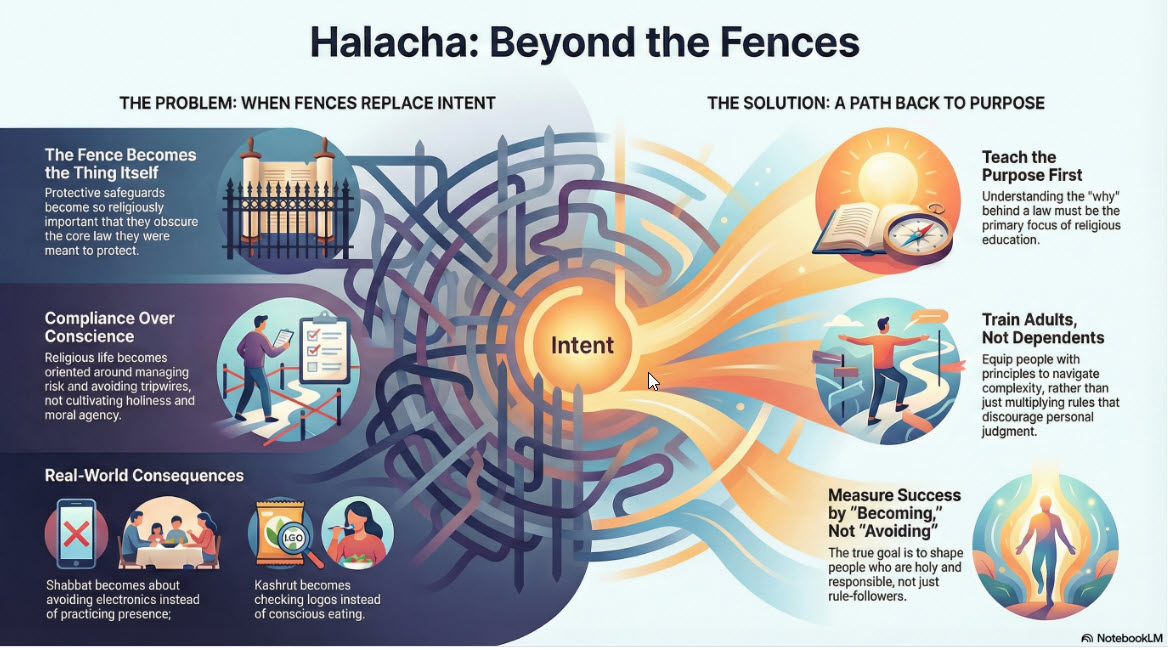
Fences are not inherently a problem. Every legal system has preventive measures. But halachic fences carry a unique risk: because they are religiously freighted, a fence can quietly become experienced as the thing itself. Over time, people forget what the boundary was meant to protect. Observance becomes defined by avoiding tripwires rather than pursuing sanctity.
In that shift, the “original intent” is not only obscured — it is often replaced.
And when replacement happens, the results are predictable: scrupulousness without tenderness, conformity without moral clarity, and a religious life oriented around managing risk rather than becoming holy.
What the prophets were warning us about
This danger is not a modern insight. It is one of the Torah’s oldest anxieties.
Again and again, the prophets warn that form can eclipse substance, that ritual precision can become a substitute for covenantal responsibility, and that religious systems can survive while their purpose quietly dies. They do not attack law itself; they attack the illusion that law, detached from intent and moral agency, fulfills God’s will.
The prophetic critique is consistent and unmistakable: sacrifices without justice, observance without compassion, ritual without humility are not misunderstood religion — they are rejected religion. Not because the laws are wrong, but because they have been severed from what they were meant to shape.
This matters for halacha because the prophets are not marginal voices. They are part of Tanakh itself — a built-in warning system against confusing compliance with fidelity. Their message is not “abandon structure,” but “structure without purpose is not what God intended.”
If a halachic culture responds to complexity by insulating people from moral responsibility rather than training them for it, then it risks reenacting precisely the failure the prophets describe: preserving religious form while hollowing out covenantal substance.
The flaw in “original intent” as halachic culture
To speak of “original intent” is already controversial in a tradition that includes Oral Law, rabbinic authority, and evolving precedent. Yet the Torah itself repeatedly frames mitzvot not as arbitrary tests, but as instruments aimed at something: the sanctification of life, the dignity of the vulnerable, the restraint of power, the shaping of a people capable of covenant.
The problem is not that halacha lacks intent. The problem is that halachic culture often treats intent as optional — an inspiring afterthought — while treating fences as the substance of religion.
This is how we end up with Shabbat reduced to a compliance checklist rather than a weekly exercise in relinquishing mastery; with kashrut reduced to technical separations rather than a discipline of consumption; with laws of speech reduced to fear of missteps rather than cultivation of truth and care.
When the fence becomes the center, the mitzvah’s purpose becomes an inconvenience.
Shabbat as a case study: when holy meaning is replaced by holy wiring
Consider Shabbat. The Torah’s first Shabbat is not a story of divine fatigue. It is a declaration of completion. Creation ceases, and time is sanctified. Shabbat trains the human being to stop world-making, to accept that the world does not need my intervention every day, to practice the courage of “enough.”
The Torah then makes a stunning point: even the most sacred project — the Mishkan — must stop for Shabbat. Holiness does not override Shabbat; Shabbat disciplines holiness.
But modern technology has exposed how easily a fence can become the whole story. The halachic conversation about electricity and devices is necessary and serious — but in many communities it has become the definition of Shabbat. Shabbat turns into a day of “don’t touch that,” a minefield of chargers, sensors, keypads, cameras, elevators, and motion detectors.
A person can spend Shabbat successfully avoiding violations — and still fail to enter Shabbat’s deeper demand: relinquishing control, receiving the world, and practicing presence. We have guarded the wiring and forgotten the light.
Kashrut and the industrial maze: when certification replaces consciousness
Kashrut offers another revealing example. Whatever its purposes — restraint, identity, holiness, discipline — kashrut is meant to shape how Jews eat.
Yet modern industrial food production and certification economies can reduce observance to symbol navigation. Kashrut becomes not “how I eat,” but “which logo appears on the package.” Oversight is necessary, but when the mitzvah’s meaning is outsourced entirely, the discipline risks becoming technical compliance divorced from consciousness.
The fence remains. The formation disappears.
Chumra culture: when fear replaces covenant
A related phenomenon is chumra culture, the social and spiritual elevation of stringency itself as a religious ideal, in which the safest position becomes the holiest, and risk avoidance replaces moral responsibility. Stringency becomes identity. People learn to fear halacha rather than love it, to measure righteousness by distance rather than depth.
Here too, the prophetic warning echoes loudly: religion that multiplies constraints while shrinking conscience is not fidelity — it is evasion.
Complexity is not an excuse to abolish agency
The standard defense of multiplying fences is familiar: life is complex; people err; without fences, the Torah will erode.
But complexity is not a flaw in creation. It is the arena in which free will operates. If God wanted frictionless obedience, humanity would not have been created with moral agency.
A religion that responds to complexity by infantilizing its adherents does not protect holiness — it prevents it. It trains dependence rather than discernment, avoidance rather than becoming.
Preserving intent while building relevant fences
If halacha is to remain a divine instrument rather than a self-perpetuating machine, we need a healthier hierarchy:
- Teach the purpose first.
- Keep fences visibly secondary.
- Prefer principles over permutations.
- Train adults, not dependents.
- Measure success by becoming, not merely avoiding.
This is not a rejection of halacha. It is a fulfillment of the prophetic demand that law serve covenant, not replace it.
We don’t need fewer laws. We need more human beings.
Judaism does not survive on inspiration alone. It needs structure. But structure that mistrusts the human being will eventually produce a Judaism that mistrusts the human soul.
The Torah did not aim to create a community of managed dependents. It aimed to create a people capable of carrying holiness into a complex world.
We do not want sheep.
We want a religion lived by beings created in the image of God.
And if halachic culture cannot recover the primacy of intent — if it continues to respond to life’s complexities by multiplying fences until the original purpose disappears — then we will preserve the form of Torah while quietly betraying the very warning the prophets were sent to deliver.