
Russian-American-Israeli Palestinian. Palestine is Israel.
Why the Pig?
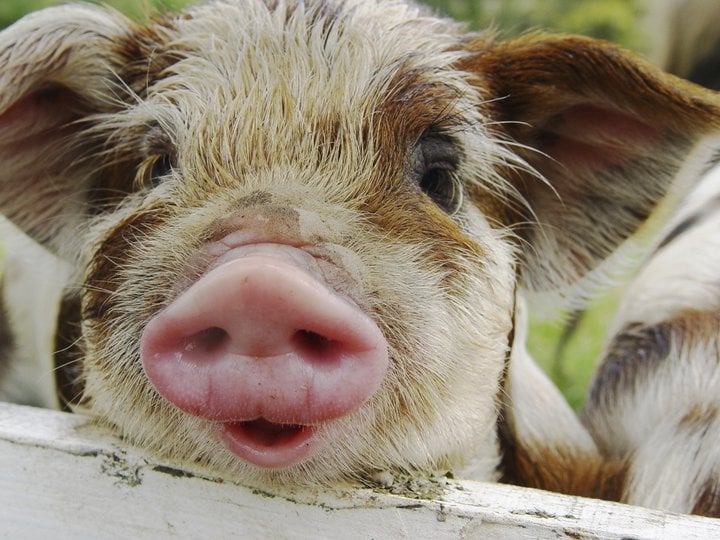
Pigs are widely regarded as among the most intelligent domesticated animals. Photo © Mercy For Animals (MFA), Los Angeles, USA, 2011. Licensed under CC BY 2.0. Source: Wikimedia Commons.
How One Forbidden Animal Became the Symbol of Kashrut
This article continues the series:
Fins and Scales, Hooves and Cud
Kashrut Through the Lens of Information Theory: The Hidden Logic of Redundancy
If every fish with scales also has fins, why does the Torah mention fins at all?
If the pig is the only split-hoofed mammal that does not chew the cud, why not simply list it as an exception?
Perhaps the answer is not about shorter definitions—but about preserving meaning across millennia.
Fins and Scales, Hooves and Cud, Part II
What We Still Don’t Know About Kashrut
Why fins and scales? Why split hooves and chewing the cud? And why have dietary laws at all?
The Torah tells us which animals are kosher. It tells us the signs to look for. But it does not explain why these particular signs were chosen. Perhaps the absence of an obvious answer is itself part of the answer.
The Most Misunderstood Animal
No non-kosher animal has become as closely associated with kashrut as the pig.
Yet this association often creates a misconception. The pig is not more non-kosher than shrimp, lobster, oysters, or any other prohibited animal. There is no scale of “degrees of non-kosher.”
So why has the pig become such a powerful symbol?
There are two principal reasons.
The first is biological. The second is historical.
Together, they transformed one prohibited animal into perhaps the best-known symbol of Jewish dietary law.
A Unique Biological Position
Among the mammals discussed in the Torah, the pig occupies a unique position.
The Torah identifies two characteristics that distinguish kosher land animals: they must have split hooves, and they must chew the cud.
Most prohibited mammals fail both tests.
The pig is different. It possesses one sign perfectly while lacking the other. Its split hooves are immediately visible, yet it does not chew the cud.
Precisely because it appears to satisfy one criterion while failing the other, it receives explicit attention in both the Torah and later rabbinic literature.
In the previous article, we asked why the Torah defines kosher animals through two biological signs rather than simply listing every permitted species.
The pig illustrates the power of that system. Because the Torah defines categories rather than individual animals, the pig naturally becomes the most striking exception.
Its biological uniqueness made it memorable.
But that alone does not explain its extraordinary place in Jewish tradition.
Its biology became the foundation for something much deeper.
The Pig as a Moral Metaphor
The pig is not only a biological exception. It became a moral metaphor.
A Midrashic interpretation, discussed by Kli Yakar on Leviticus 11:4:1, imagines the pig stretching out its split hooves as if to say:
Look at me! I’m kosher.
Yet it lacks the other required sign—it does not chew the cud.
The image became a powerful metaphor for hypocrisy: an impressive external appearance hiding an internal deficiency.
The Sages captured this idea with the expression ein tokho k’varo (אין תוכו כברו)—literally, “his inside is not like his outside” (Berakhot 28a).
The ideal person is one whose private character matches his public image.
The visible hoof became a symbol of outward appearance; chewing the cud, hidden from immediate view, became a symbol of inner character.
The Midrash continues with a vivid illustration.
There was a government official in Caesarea who sentenced thieves, adulterers, and sorcerers to death. Afterward, he leaned toward a colleague and quietly admitted:
I myself committed all three of those acts in a single night.
The lesson is unmistakable.
Public virtue means little if private conduct tells another story.
The pig therefore came to symbolize far more than a prohibited animal.
It became a symbol of appearances without substance.
This symbolism eventually entered everyday Jewish speech. The Yiddish expression chazer fissel (”pig’s feet”) came to describe ostentatious piety without genuine inner sincerity—or, more broadly, people who present themselves as something they are not.
Centuries later, the Hasidic master known as the Bat Ayin carried this symbolism even further (Bat Ayin, Shmini 8).
He compares the pig to our own spiritual lives.
How often do we display our own “split hooves”?
How often do we present ourselves as righteous, humble, or compassionate while our inner reality tells a different story?
According to a famous rabbinic tradition, the pig will somehow become permissible in the Messianic era.
The Bat Ayin offers a remarkable interpretation (Bat Ayin, Shmini).
It is not redemption that transforms the pig.
Rather, the transformation of the pig brings redemption.
Only when the pig’s inside finally matches its outside—only when hypocrisy gives way to authenticity—does the world become ready for redemption.
Whether understood literally or symbolically, the message is profound.
A Symbol Forged by History
Biology explains why the pig attracted attention.
History explains why it became unforgettable.
Throughout history, enemies of the Jewish people repeatedly used pork as a weapon of humiliation, coercion, and forced assimilation.
During the persecutions carried out by Antiochus IV, faithful Jews were tortured and executed for refusing to eat pork. The Books of Maccabees preserve some of the most moving accounts of Jewish martyrdom (2 Maccabees 6:18–31; 7:1–42).
The pig became more than food.
It became a test of loyalty.
Similar episodes occurred under Roman rule and, in different ways, throughout later centuries whenever Jews were pressured to abandon their identity.
As a result, the pig became not merely another prohibited animal, but perhaps the most “hated” animal in Jewish historical memory—an emotionally charged symbol of persecution, resistance, and Jewish continuity.
Its prominence is therefore historical and cultural—not because it is somehow “more forbidden” than other non-kosher animals.
The Mystery of the Pig
Explaining why the pig became the symbol of kashrut is not the same as explaining why the Torah prohibited pigs in the first place.
That question has fascinated scholars for centuries, and many explanations have been proposed.
› Health Was Probably Not Enough
Some argue that pork carried a greater risk of parasites or disease in the ancient world. Others suggest that pigs were poorly suited to the climate of the Levant, requiring water and feed that were scarce compared to sheep or goats. Still others point to ecological, economic, or symbolic considerations.
› The Classification Theory
One influential modern theory, proposed by the anthropologist Mary Douglas, suggests that the Torah favors animals that fit clear biological categories. In this view, animals that blur those categories become anomalous. The pig, with its split hooves but not chewing the cud, is something of a “trans-category” animal: it appears to straddle the boundary between kosher and non-kosher land animals, making it the most conspicuous exception.
› Predators and Prey
Another proposed explanation focuses on the distinction between predators and herbivores. Kosher land animals are herbivores that chew the cud, while the birds traditionally recognized as kosher are generally non-predatory. Some commentators have suggested that the Torah favors animals that do not kill other animals for food, making predatory behavior itself symbolically significant.
The idea is appealing, but it is not without difficulties. Many kosher fish are predatory, and the Torah never explicitly states that predation is the underlying principle of kashrut. Like the other theories, it illuminates part of the picture without fully explaining the system.
› The Cannibalism Theory
Popular culture has generated even more imaginative explanations. One frequently repeated claim is that pork resembles human flesh and was therefore prohibited to discourage cannibalism.
Interesting as the story may be, the idea appears to be a modern folk explanation rather than one rooted in biblical or rabbinic tradition. Although anecdotal reports from extreme survival situations have sometimes compared the taste of human flesh to pork, such accounts are exceptionally rare and cannot be verified systematically.
› Archaeology Complicates the Picture
Archaeology complicates the picture even further.
Pig remains have been discovered at numerous ancient Near Eastern sites, showing that pigs were successfully raised in Mesopotamia thousands of years before the emergence of ancient Israel. They remained an important source of meat in many neighboring societies throughout antiquity.
Nor are pigs unique to the ancient Near East. They were independently domesticated in East Asia and eventually became one of the world’s principal sources of meat.
› Rethinking the Pig
Far from being uniquely dirty or unintelligent, pigs are now recognized as remarkably intelligent, social, and clean animals under appropriate living conditions.
Modern medicine has revealed another surprising fact. Because many pig organs are physiologically similar to human organs, pig tissues have long been used in medicine, and genetically modified pig organs are now being studied for transplantation into humans.
Ironically, modern discoveries about the biological similarity between pigs and humans have given new life to old speculations about why pork was prohibited. Yet biological similarity does not mean that pork and human flesh are the same, nor does it explain the origins of kashrut.
› No Single Theory Explains Everything
Each theory explains something.
None explains everything.
These theories remind us how eager people are to discover a practical explanation.
Yet perhaps their very diversity tells us something.
Perhaps no single practical explanation can fully account for the Torah’s choice.
The Question We Still Cannot Answer
In the previous article, we asked:
Why fins and scales?
Why split hooves and chewing the cud?
Our answer was simple.
We still do not know why these particular criteria were chosen. The Torah gives us the signs, but not the deeper rationale behind them.
This article does not change that conclusion.
It answers a different question:
Why did the pig become the enduring symbol of kashrut?
The answer lies in a remarkable convergence of biology, symbolism, and history.
Biologically, the pig occupies a unique place within the Torah’s classification of animals.
Morally, it became a timeless metaphor for external appearances concealing internal reality.
Historically, it became a symbol of persecution, resistance, and Jewish continuity.
None of these make the pig more non-kosher than shrimp, lobster, oysters, or any other prohibited food.
They simply explain why one particular animal came to symbolize the entire system of kashrut.
The pig did not become the symbol of kashrut because it is more forbidden than other animals. It became the symbol because it is the exception that makes the rule memorable.
The deeper question remains.
Why did the Torah choose these particular biological criteria?
Perhaps we have been asking the wrong question all along.
Instead of asking why the Torah selected these specific signs, we might ask whether the specific signs were ever the essential point.
If the purpose of kashrut was to create a clear, objective, and enduring communal boundary, then the stability of the system may have mattered far more than the particular biological criteria themselves.
Perhaps the lack of an obvious rationale is itself part of the answer.
Or perhaps the oldest answer remains the wisest:
For so it is written.
Related Posts