
Iranian-Born British Analyst of Politics and Civilisation
The Qatar Paradox: Why Does Washington Trust Doha?
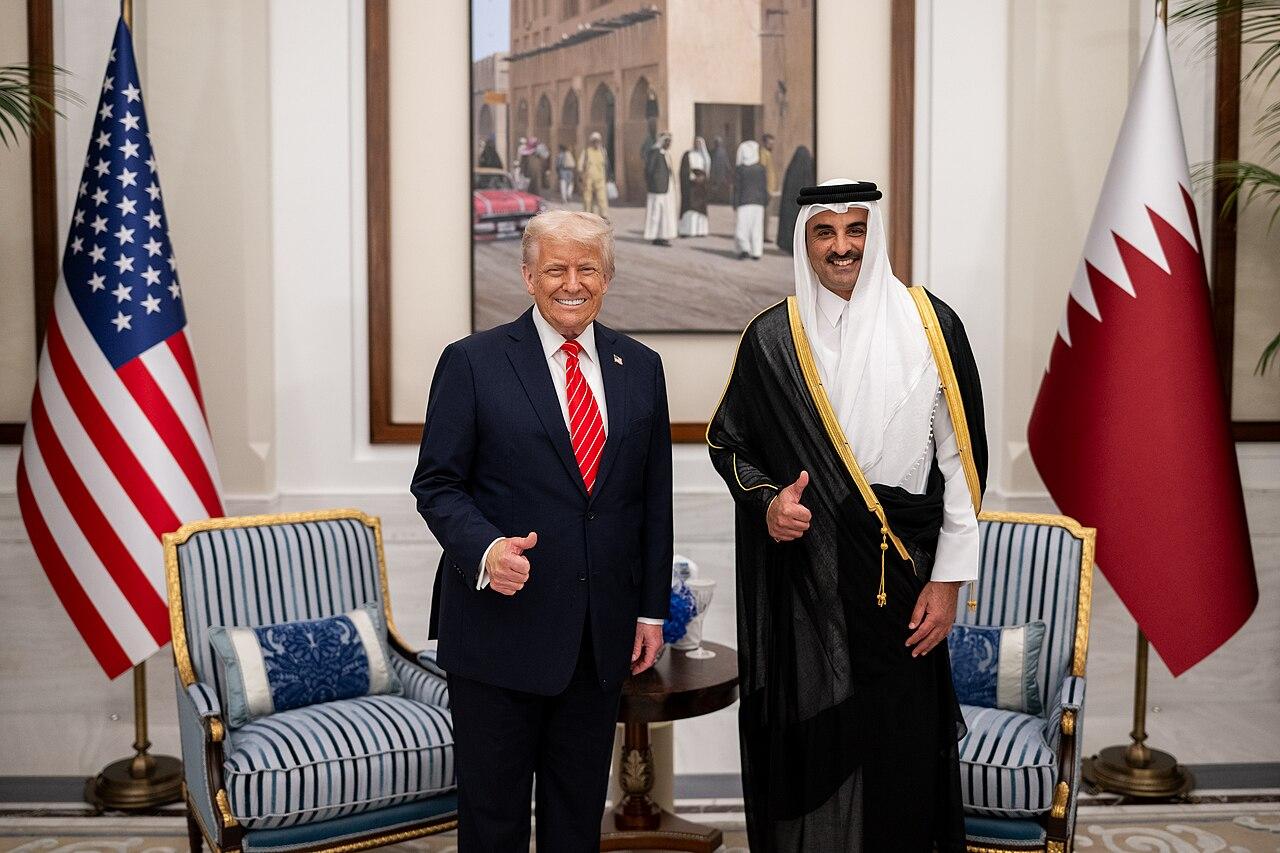
US President Donald Trump meets Qatar's Emir, Sheikh Tamim bin Hamad Al Thani, at Lusail Palace in Doha, May 14, 2025. (Official White House Photo by Daniel Torok/Public Domain)
In 2017, four Arab governments accused Qatar of supporting extremism and destabilising the region. Eight years later, Washington extended explicit security assurances to Doha. What explains this transformation?
On 5 June 2017, four Arab countries made an extraordinary decision. Saudi Arabia, the United Arab Emirates, Bahrain and Egypt severed diplomatic relations with Qatar and imposed an economic and transport blockade.
Their accusations included support for extremist movements, interference in regional affairs and relationships with the Muslim Brotherhood.
Qatar denied the allegations, arguing that its neighbours were attempting to undermine its sovereignty and independent foreign policy.
On 29 September 2025, President Donald Trump issued an executive order committing the United States to Qatar’s security and territorial integrity against external aggression.
Between those two dates lies one of the most remarkable diplomatic transformations in modern Middle Eastern politics.
How did a country once isolated by four of its Arab neighbours become so strategically important to Washington?
The Arab warning
The 2017 confrontation was not an isolated diplomatic dispute. Its ideological roots can be traced to the Arab uprisings of 2011, when competing visions for the future of the Middle East emerged.
Saudi Arabia and the UAE regarded the Muslim Brotherhood and affiliated political movements as threats to their political systems and regional stability.
Qatar pursued a different strategy, cultivating relationships with Islamist political actors and providing them with diplomatic and media platforms.
The four countries presented Doha with 13 demands, including severing ties with the Muslim Brotherhood, closing Al Jazeera, reducing relations with Iran and shutting down a Turkish military base.
Some of these demands reflected legitimate security concerns. Others reflected a struggle for regional influence and control. The blockade formally ended with the Al-Ula reconciliation in January 2021. But diplomatic reconciliation does not, in itself, establish that every underlying concern was unfounded.
The historical significance of the dispute is that opposition to Qatar’s policies was not confined to Israel or Western critics of political Islam. It came from within the Arab world itself.
The economics of influence
Qatar’s enormous energy wealth has enabled it to establish relationships across American politics, business, academia and the media.
A September 2025 report by the Quincy Institute for Responsible Statecraft documented the scale of this activity.
Qatari interests had spent nearly $250 million on registered American lobbying and public relations firms since Trump’s first election.
Between January 2021 and June 2025, Qatar’s registered foreign agents reported 627 in-person meetings with political contacts in the United States.
The report also identified $6.25 billion in funding to American universities since 2001 and more than $9 million to American think tanks over five years.
Most university funding supported educational operations within Qatar itself. It would therefore be misleading to present the entire sum as money directed towards influencing American campuses.
Nor does foreign funding automatically establish political interference. Nevertheless, the scale and breadth of these relationships raise legitimate questions about transparency, institutional independence and conflicts of interest.
Foreign influence does not necessarily require an explicit exchange of money for political decisions. Access, institutional relationships and commercial incentives can all shape the environment in which those decisions are made.
America’s military ally and Hamas’s diplomatic host
The most consequential aspect of Qatar’s foreign policy for Israel concerns Hamas.
Qatar hosts Al Udeid Air Base, a major centre of American military operations in the Middle East. In 2022, Washington designated Qatar a major non-NATO ally.
Photo credit: US Air Force, via Wikimedia Commons.
At the same time, Doha has historically hosted the political leadership of Hamas, an organisation designated as terrorist by the United States.
Qatar maintains that the Hamas political office was established in 2012 at Washington’s request to facilitate communication with the organisation.
That detail matters because it places American policymakers within the history of the arrangement rather than outside it.
There is an important distinction, however, between maintaining diplomatic channels with a terrorist organisation and allowing individuals to facilitate its financial operations.
On 18 October 2023, the US Department of the Treasury imposed sanctions on Muhammad Ahmad Abd Al-Dayim Nasrallah, a Qatar-based Hamas operative whom it accused of facilitating the transfer of substantial funds to the organisation, including its military wing.
This designation did not establish Qatari government complicity. It did, however, demonstrate that concerns about Hamas-linked financial activity extended beyond the existence of its political office.
For Israel, the distinction between diplomatic engagement and the enabling of terrorist activity has immediate national-security consequences.
For Washington, it raises questions about the safeguards and obligations that should accompany its relationship with Doha.
The mediator’s dilemma
Qatar’s diplomatic strategy is built around maintaining communication with governments and organisations that often refuse to engage directly with one another. This includes Washington, Hamas, the Taliban and Iran.
Doha’s diplomatic channels have produced tangible results, including contributions to hostage negotiations and ceasefire agreements involving Israel.
These achievements should not be dismissed. But they also illustrate a structural dilemma. The greater the importance Washington attaches to Qatar’s relationships with its adversaries, the more costly it becomes to challenge those relationships.
A mediator’s access to an armed organisation may provide diplomatic leverage. It may also increase the organisation’s international political visibility.
Both possibilities deserve examination. The relevant questions are whether mediation reduces the threat posed by such organisations, whether financial restrictions are effectively enforced and whether diplomatic engagement is accompanied by meaningful accountability.
From strategic partnership to security assurance
The relationship entered a new phase in September 2025. Following an Israeli strike targeting Hamas leaders in Doha, President Trump issued an executive order concerning Qatar’s security.
The order established a policy under which external armed aggression against Qatar would be treated as a threat to American security, with diplomatic, economic and potentially military responses.
Although this was not equivalent to a Senate-ratified mutual defence treaty, it represented a significant expansion of America’s stated security commitment.
For Israel, the development highlighted a complicated strategic reality: Washington’s security relationships with its regional partners do not always produce identical national-security priorities.
The United States has interests in maintaining Qatar’s stability, protecting its military infrastructure and preserving its diplomatic channels. Israel has interests in dismantling Hamas’s military, financial and political infrastructure.
The challenge for American foreign policy is reconciling these objectives where they overlap and managing them where they conflict.
The question Washington must confront
Qatar’s strategic value cannot be understood through a single explanation. Energy, military infrastructure, investment, political lobbying and diplomatic mediation all contribute to its international position.
The concerns raised by Saudi Arabia, the UAE, Bahrain and Egypt in 2017 must also be understood within the broader context of regional rivalries and competing foreign policies. Yet the transformation of Qatar’s international standing raises questions that extend beyond the Gulf.
How does Washington distinguish the legitimate diplomatic activities of a strategic partner from relationships that may undermine its wider security objectives?
What transparency requirements should accompany extensive foreign financial relationships with American institutions?
And how should the effectiveness of a mediator be assessed when its diplomatic importance depends partly on maintaining access to organisations Washington considers hostile?
The events of 2017 and 2025 provide two very different perspectives on the same country. Understanding the distance between them is essential to understanding Qatar’s place in American foreign policy.
Related Topics