
Gratitude | Purpose | Renewal
The Rebuilding Chronicles
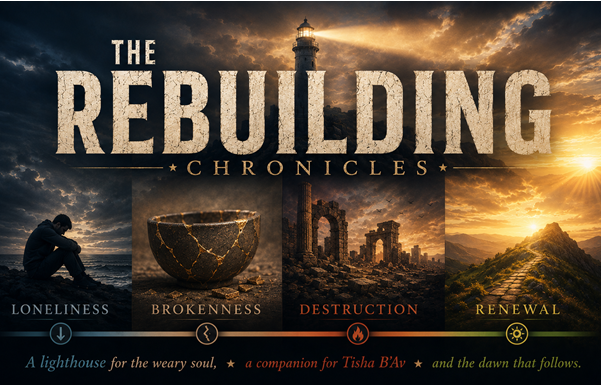
AI generated illustration
A Journey Through Loneliness, Brokenness, Destruction and Renewal
A lighthouse for the weary soul, a companion for Tisha B’Av and the dawn that follows
Every soul that rebuilds walks through four pillars: Loneliness, Brokenness, Destruction and Renewal. These are not obstacles. They are guideposts. They are the stations of the inner exile and the inner return. They are the quiet architecture of Tisha B’Av and the dawn that follows. And through each pillar, one truth remains: G‑d does not forsake. G‑d does not abandon. His mercies are new every morning. Rabbi Meir Soloveichik teaches that Jewish history is not a straight line. It is a journey of falling and rising, of exile and return, of tears and triumph. He says that the Jewish people are defined not by what breaks us, but by what we build afterward. This is the heart of the Chronicles.
Loneliness: The First Exile of the Soul
“It is not good for man to be alone.” Genesis 2:18
Loneliness begins quietly, long before we understand its name. The Torah does not hide loneliness; it begins with it. “It is not good for man to be alone.” Yet loneliness is also the place where G‑d first speaks. Adam hears the voice of G‑d walking in the garden not when surrounded by crowds but when alone. Loneliness becomes the first pillar of the journey, teaching independence, silence, and the subtle weight of carrying burdens without witness. Even in rooms filled with people, loneliness sits beside the soul as a shadow rather than an enemy.
Yet even in solitude, one truth remains: “His mercies are new every morning.” Loneliness becomes the chamber where one learns to listen for G‑d’s whisper. Rabbi Meir Soloveichik teaches that Jewish loneliness is not abandonment but covenantal solitude, the place where G‑d calls us to stand apart so we may stand for something eternal. Rabbi Jonathan Sacks wrote that loneliness is the beginning of relationship. When we feel alone, we begin to search for meaning, and when we search for meaning, we begin to hear the voice of G‑d. Loneliness is not the absence of people; it is the beginning of encounter.
Brokenness: Where the Heart Cracks and Light Enters
“The sacrifices of G‑d are a broken spirit; a broken and contrite heart, O G‑d, You will not despise.” Psalm 51:17
Brokenness is not failure. It is the moment when the soul cracks open and truth finally enters. It is the stage where illusions fall away, where the heart confronts what it has carried for too long, and where G‑d begins His quiet work of reshaping us. The Psalms sanctify brokenness. “A broken and contrite heart, O G‑d, You will not despise.” In Lurianic Kabbalah, creation itself begins with shattering. The vessels break so that light can be gathered and restored. Brokenness is not the end of holiness; it is the beginning.
Rabbi Meir Soloveichik teaches that brokenness is the birthplace of moral courage. When the heart cracks, compassion enters, and when the vessel shatters, holiness begins to gather. Rabbi Jonathan Sacks wrote that faith is not certainty but the courage to live with brokenness and still believe that tomorrow can be better than today. Brokenness becomes the second pillar of the journey; the trembling gate through which renewal will one day enter. Like the piyyut El Nora Alila, brokenness teaches that the gates of heaven tremble before they open.
Destruction: When the Old Life Falls and the Soul Stands Bare
“How deserted lies the city, once so full of people.” Lamentations 1:1
Destruction is the moment when the old life collapses and nothing familiar remains. It is when structures once trusted fall away, when identity dissolves, and when the soul stands before G‑d with nothing left to cling to. Jewish tradition knows destruction intimately. The fall of both Temples, the exile of our people and the lament of Eicha echo through generations with the haunting cry, “How deserted lies the city, once so full of people.” Yet even in devastation, G‑d speaks hope. “I will build you up again, and you will be rebuilt, O Virgin Israel.” Destruction is never the final word.
Rabbi Meir Soloveichik teaches that the destruction of the Temple was not the end of Jewish faith but the beginning of Jewish endurance. When the stones fell, the soul rose, and when the building collapsed, the covenant remained. Rabbi Jonathan Sacks wrote that destruction is not the end of Jewish history but the beginning of Jewish hope, the refusal to let devastation define the future and the courage to build again. Destruction becomes the third pillar of the journey; carrying the whisper of Lech Lecha, the call to leave behind what is familiar and walk toward what is sacred. Like the piyyut Adon HaSelichot, destruction becomes the night before dawn, the moment when the soul cries out knowing that morning will come.
Renewal: The Dawn That Rises After the Ashes
“Those who sow in tears will reap with songs of joy.” Psalm 126:5
Renewal is not restoration. It is creation. It is the stage in which the soul rises from the ashes not as who it once was but as who it was always meant to become. Renewal is the quiet miracle that follows destruction; the moment when G‑d breathes life into what seemed lost and reveals that the end of one chapter is the beginning of another. The Psalms sing of this transformation. Those who sow in tears will one day reap with songs of joy. Renewal is the promise that follows every valley, the assurance that even the deepest sorrow contains the seeds of future joy.
Rabbi Jonathan Sacks taught that hope is faith turned into action, the courage to believe that tomorrow can be better than today. Rabbi Meir Soloveichik teaches that renewal is the miracle of return, the covenant promise that no matter how far we fall, G‑d brings us home. Renewal becomes the fourth pillar of the journey; the moment when the soul discovers that it can rise again. Like the piyyut Mimkomo Hu Yifen, renewal becomes the moment when G‑d turns toward us, lifting us from the dust, restoring our strength, and guiding us home. Renewal is not an event. It is a way of living.
Epilogue: Comfort for the Weary, Light for the Returning
“Comfort, comfort My people, says your G‑d.” Isaiah 40:1
Life is made of tears and joy, valleys and mountaintops, loneliness and belonging. Through every pillar, loneliness, brokenness, destruction, and renewal, one truth remains unbroken. G‑d does not forsake. G‑d does not abandon. G‑d walks through every chamber with us. Rabbi Jonathan Sacks wrote that the Jewish people are the nation that walks through fire and sings, carrying memory in one hand and hope in the other. Rabbi Meir Soloveichik teaches that every Jew carries a personal Jerusalem within the soul, a sacred inner city that rises and falls with the rhythms of life.
When that inner Jerusalem falls, the heart breaks in ways that words can barely hold, and when that inner Jerusalem rises, the soul is reborn with a strength that feels almost miraculous. The story of the Jewish people is the story of rising from the ashes again and again, always with G‑d as our companion, always with the quiet assurance that no descent is final and no darkness is absolute. These Chronicles stand as a lighthouse for anyone walking through a valley of their own, reminding them that dawn always comes, hope always returns, and G‑d’s mercies are new every morning.
Related Topics
Related Posts