


Geopolitical Analyst: Bridging Somaliland & Israel to the world
The Red Sea Shift: When Others Begin Telling Somaliland’s Story
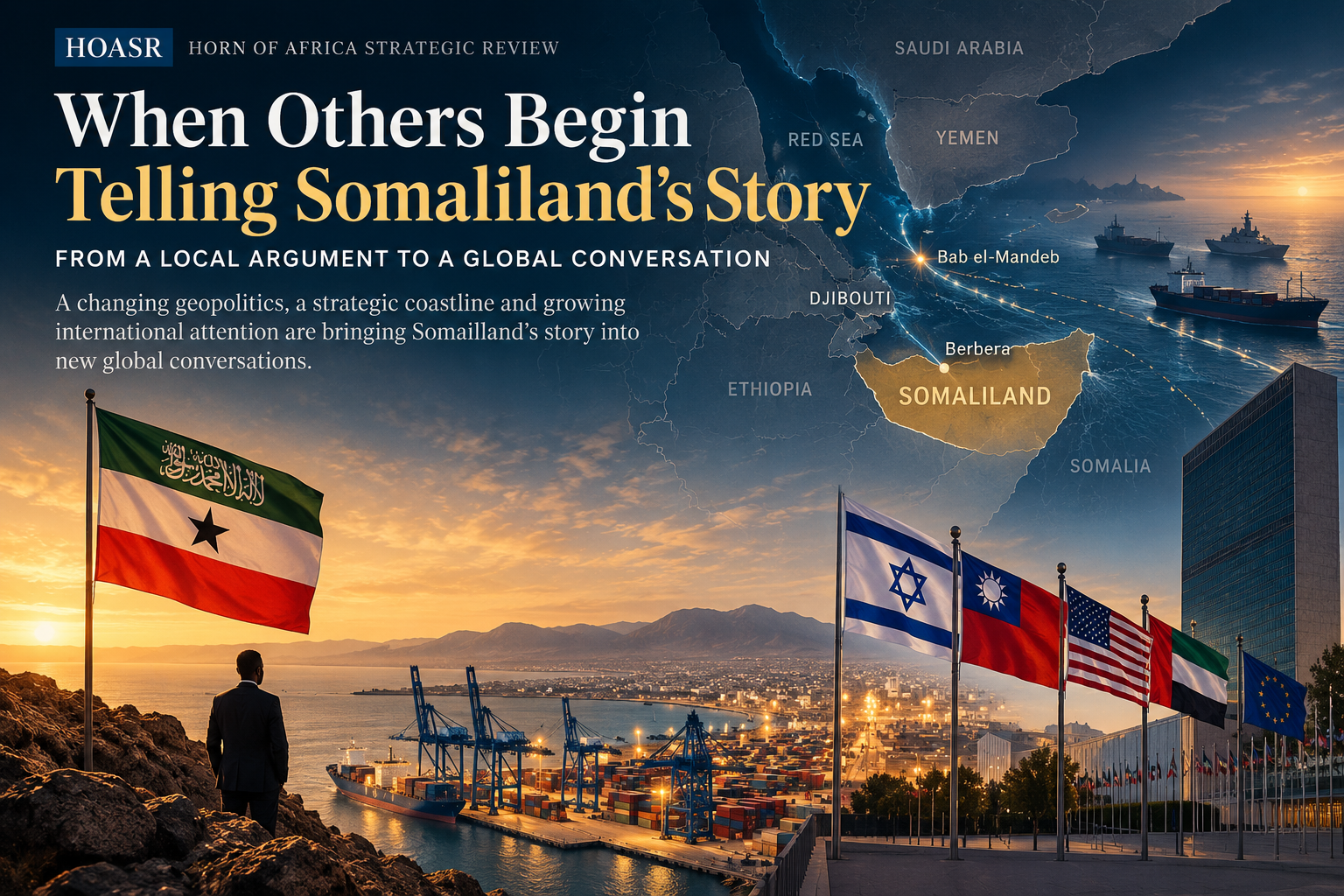
Somaliland’s growing strategic relevance is increasingly tied to Berbera, the Red Sea, Israel, Taiwan and wider geopolitical competition. Original HOASR Infographics
For three decades, Somaliland’s diplomatic argument has lived under the shadow of Somalia.
Almost every international discussion began from the same point: territorial integrity, African caution, fear of precedent and the assumption that Hargeisa’s future had to be negotiated through Mogadishu.
Somaliland could point to its history, elections, institutions and relative stability, but the diplomatic frame rarely moved. What is changing now is not simply Somaliland’s visibility, but the context in which outsiders are beginning to understand it.
The shift can be seen in places that would have paid little attention to Somaliland only a few years ago. In July, New York lawyer David Anderson wrote in Democracy Chronicles about Somaliland through Israel, Taiwan, the UAE and the Red Sea rather than through Somalia alone.
His article was openly sympathetic and some of its language was exaggerated, but its geopolitical frame was revealing. Somaliland appeared not as an unresolved African territorial dispute, but as a small state sitting inside a much larger contest over maritime routes, alliances and strategic access. [Democracy Chronicles]
By September, Anderson had returned to the subject and attended a Somaliland recognition rally in New York during United Nations General Assembly week.
Reuters separately documented Somalilanders demonstrating at Dag Hammarskjöld Plaza on September 23, placing the campaign directly inside the visual landscape of UNGA even though the rally itself was outside the UN system.
What matters here is not the size of one demonstration or the enthusiasm of one columnist. It is the gradual widening of the circle around Somaliland’s story. [Reuters]
President Abdirahman Mohamed Abdullahi Irro’s American visit pushed that widening much further.
Hudson Institute hosted him on September 14 under the title “Somaliland as a Strategic Partner in the Horn of Africa,” explicitly connecting Somaliland to the Houthis, China, Iran, Russia, Taiwan and the wider competition unfolding across East Africa and the Red Sea.
Ten days later, the Council on Foreign Relations hosted Irro in New York for a discussion on Somaliland’s recognition campaign and the regional security landscape. [Hudson Institute; Council on Foreign Relations]
These were not random speaking engagements. They reflected a larger reordering of strategic attention around the Horn.
The Red Sea crisis, the growing vulnerability of Bab el-Mandeb, China’s entrenched military position in Djibouti, the Gulf states’ competition for ports and influence, and renewed Western concern over maritime access have all increased the value of geography along the Gulf of Aden.
Somaliland has not moved; the strategic map around it has.
Berbera sits at the center of that change. For years, it was discussed mainly as a commercial port, an Ethiopian trade alternative or a development project under DP World. Today, Berbera increasingly appears in conversations about maritime surveillance, logistics, access, resilience and security across the southern Red Sea.
When shipping routes become vulnerable and regional military balances become less predictable, ports that once looked peripheral start appearing differently on strategic maps.
Israel’s recognition of Somaliland on December 26, 2025 accelerated that process. Israel became the first country to formally recognize Somaliland as an independent state, opening a diplomatic relationship that Somalia, the African Union and several regional governments strongly opposed.
The consequences extended beyond symbolism because recognition linked Somaliland directly to one of the most active strategic actors in the Red Sea security environment. [Reuters]
The relationship later moved into security cooperation. Somaliland’s defence minister confirmed in June that Israel was providing training to Somaliland police and military personnel during President Irro’s visit to Israel, while rejecting reports of negotiations over an Israeli military base.
That cooperation placed Somaliland closer to the regional security architecture emerging around Yemen, the Gulf of Aden and the broader confrontation with Iranian-aligned forces. [Reuters]
This is where the old diplomatic reading of Somaliland begins to look increasingly narrow. For years, the international file was treated primarily as a sovereignty dispute between Hargeisa and Mogadishu.
The newer strategic environment pulls Somaliland into several other files at once: Red Sea security, Gulf competition, Israeli regional strategy, Taiwan’s diplomatic survival, Chinese influence in Africa, Ethiopian maritime access and American concern over military positioning around one of the world’s most important shipping corridors.
None of those developments erases the Somalia question, but they reduce its ability to monopolize the conversation.
The United States is especially important in this changing picture because Washington has long approached the Horn through Somalia, counterterrorism and the regional security architecture built around Mogadishu and Djibouti.
That model was created in a different strategic era. China had not yet established its overseas military base in Djibouti, the Houthis had not demonstrated the ability to disrupt global shipping on the present scale, Israel had not recognized Somaliland and Berbera had not acquired its present strategic profile.
The environment surrounding American policy has therefore changed faster than the policy itself.
Irro’s Washington and New York engagements should be read against that background. Hudson’s framing of Somaliland as a “strategic partner” was itself significant because it placed the country inside an American security debate rather than simply an African diplomatic dispute. CFR’s decision to host Somaliland’s president during UNGA week reinforced the same trend from a different institutional direction. Somaliland was being discussed within the language of geopolitical strategy.
That shift also explains why outside writers such as Anderson have begun approaching Somaliland differently. His July article did not discover Somaliland’s democratic record or its history; Somalilanders have been making those arguments for decades.
What changed was the frame through which those facts became interesting to him. Israel, Taiwan, Berbera and the Red Sea turned an old recognition dispute into part of a contemporary geopolitical story.
This is how international narratives often change before diplomatic structures do.
A country once discussed almost exclusively through a neighboring capital begins appearing independently in security papers, congressional conversations, investment discussions and foreign-policy forums.
Its geography acquires political meaning. Its relationships with larger powers stop looking incidental and begin looking connected.
Somaliland is entering that phase. The clearest evidence is not one rally, one article or one presidential trip. It is the accumulation of developments that now reinforce one another: Israeli recognition, Taiwan’s continuing presence, Berbera’s growing importance, Gulf investment, worsening Red Sea insecurity,
Washington’s renewed interest in maritime access and Irro’s ability to carry Somaliland’s case into major American policy institutions.
Viewed separately, each development is limited. Viewed together, they describe a geopolitical environment markedly different from the one that preserved Somaliland’s isolation for the previous three decades.
The international system has traditionally treated Somaliland as a problem to be postponed. Geography is making postponement more complicated.
The Horn of Africa is once again becoming a theatre of competition. The Red Sea has become a frontline rather than a trade route taken for granted.
Djibouti is crowded with foreign militaries, Ethiopia remains landlocked and strategically restless, Yemen continues to reshape maritime security calculations, and Gulf states are extending political and commercial influence along both African and Arabian shores.
Somaliland sits directly inside that map. That does not require romanticizing Hargeisa or demonizing Mogadishu. It requires looking at the region as it exists rather than through diplomatic assumptions inherited from the 1990s.
Somaliland’s significance today comes from the intersection of history, location, political continuity and the strategic pressures building around the Gulf of Aden.
Anderson’s two articles are useful precisely because they illustrate that change from outside Somaliland. In July he encountered Somaliland as an unusual political story. By September he was standing among Somalilanders in New York and writing about it again.
His journey is small, personal and hardly decisive, but it reflects something larger taking place around the recognition debate.
For years, Somalilanders had to explain why the world should notice them. The Red Sea is increasingly doing some of that work for them.
The next chapter of Somaliland’s international story may therefore be written less by arguments about what happened in 1960 or 1991 alone and more by what is happening now between Berbera, Bab el-Mandeb, Jerusalem, Taipei, Abu Dhabi and Washington.
Somaliland has not suddenly appeared on the map. The map has changed around Somaliland.
Related Topics
Related Posts