The Seven Stages of Grief – Experience 66: GRIEF
First of all, I write from the perspective of someone who was part of the Los Angeles art scene for nearly two decades, from 2001 to 2019, and no longer lives in the city she once called home. Earlier, between 1987 and 1993, I lived in LA as a student, during which time I met film students, writers, and other professionals in the film industry and gained an early sense of the city’s broader creative ecosystem. I am now 5,500 miles away, having seen only one person from that life after 2,128 days. My relocation was not by choice but the result of bureaucracy, the expiration of a work visa, and the rejection of a green card application while I was in Paris just before the pandemic. Moving across continents by free choice is one thing. Being pressured to relocate to avoid legal trouble and start over at an age when others are transitioning toward retirement, without any financial backup, is quite another.
To understand this personal sense of loss more deeply, I looked into the history of the word grief. The Oxford English Dictionary traces it back to Middle English, used between 1150 and 1500 to refer to hardship, suffering, and pain. It came from the Old French word grever, meaning to afflict or burden, which in turn came from Latin gravare, to make heavy, from gravis, weighty. Grief’s modern sense of mental pain and sorrow appeared around 1300. Its earliest recorded appearance is in Cursor Mundi, a fourteenth-century Northumbrian poem, a reminder that grief has shaped human life for centuries.
This timeless emotion also finds expression in Sophocles’ Antigone, written in 441 BCE. Antigone mourns her brother Polynices, who was killed by his brother Eteocles during their battle for the throne. Forbidden to bury him, she defies their uncle Creon, driven by both love and a sense of justice, and is condemned to death. While imprisoned, she takes her own life, setting off a tragic chain of deaths, including her fiancé Haemon and Creon’s wife Eurydice. Grief, however, is not only a human experience. As a BBC article notes, animals from killer whales to crows also experience and express it.
Why some animals appear to mourn their dead
By contrast, when a star explodes as a supernova, it is purely a physical and chemical process, not an emotional one. Yet humans often project feelings onto such cosmic events, seeing a dying star as a symbol of loss, transformation, or renewal. Observing a supernova can become a profoundly cathartic experience.
Mourning ceremonies in various cultures show how grief is experienced and expressed differently. While the emotional core of loss, longing, and sorrow is universal, the outward forms, duration, and social expectations vary widely.
I remember attending the memorial for Warren Long, a Malibu artist, where his surfer friends paddled out in a circle and scattered flowers. Later, at Will Rogers State Beach, his African friend and others danced to African music. It became a joyful celebration, with his twelve-year-old daughter Tallulah singing “Somewhere Over the Rainbow.” At the memorial for his wife, the New Zealand-born actress and gallery owner Leigh Hamilton, doves were released in a friend’s garden. Then there was Cindy’s boyfriend in Venice West, who told me he carried her ashes on his motorcycle along the Pacific Coast Highway to Seattle, releasing them beside her grandmother’s resting place. Cindy, who was in her early fifties, loved motorcycling and had worked at the optometrist’s office, Eyes of Westwood. She was also a co-worker of Jean-Pierre, the stepson of Miles Davis. She so wanted to see Europe, yet her body, weakened by cancer, would not let her. I still sometimes see her in my memory buying dark chocolate at Whole Foods in Westwood. These acts of love honor the dead as individuals.
These experiences sharply contrasted with the customs of the German city where I grew up. Strict rules governed what could be done with ashes and what could appear on graves. Photographs of loved ones were forbidden. Any changes came too late for my brother, who had a severe intellectual disability and epilepsy that could not be fully controlled with medication, a condition of unclear cause. He was diagnosed at age one, at a time when Dr. Werner Catel, an expert in the Nazi-era child euthanasia program, was still alive. A 2024 investigation of Mammolshöhe by the Hesse State Welfare Association found that Catel had used his position to illegally experiment on children in postwar Germany. In particular, he tested the tuberculosis drug thioacetazone on them, despite knowing it had severe side effects. At least four children died as a result. Catel also recruited former colleagues from the Leipzig euthanasia program to Mammolshöhe, and investigations into his work were obstructed by other doctors, pharmaceutical companies, and the medical bureaucracy. People with my brother’s condition during the Nazi era were only recently officially recognized as victims of Nazi crimes. I believe that such misconduct continues to influence derogatory language today, and this fact still raises questions for me.
On a recent trip to my hometown, I was deeply troubled to read the term seelisch behindert used to describe artists with mental health issues in a local newspaper. I asked myself why the journalist called them behindert. Because they received mental health care during a crisis in their lives? Does that make someone handicapped? Someone who has endured hardship, sought help in the face of limited support, and strives to maintain a meaningful life could also be seen as a survivor or even a hero. Look at the writer Andrew Solomon, who once suffered from depression and said in his 2014 TED Talk, “Forging meaning is about changing yourself. Building identity is about changing the world.” Then consider the filmmaker Woody Allen. Imagine if he had been forced to work in a segregated film studio and his films had to be shown in segregated theaters simply because he was considered seelisch behindert for seeing a therapist. For a New Yorker, seeing a therapist is perfectly normal, and in the film industry, many people I have met come from dysfunctional families and therefore see a therapist. Do you see the absurdity?
Gravesites in Germany are leased only for a limited period, and when the lease expires, every trace of the person is removed, leaving no visible sign of their existence. Not even a small plaque with their name remains. That would not take much space, would it? To me, the German funeral industry remains an unpleasant and rigid business. It feels cold and still gives me a shiver. As for me, I do not wish to be buried in Germany. I do not consider myself to be state property.
The German psychoanalysts Alexander and Margarete Mitscherlich once wrote about the inability to mourn, describing how postwar German society struggled to confront loss and guilt. Their observations are still valid today, as any way of mourning differently, more deeply, or for a longer time is often considered inappropriate in rigid systems. This tension between personal grief and societal expectation echoes in the grief that follows an immediate death and the grief that comes with the removal of a gravesite.
That is why I so deeply understand the families of the hostages in Gaza who still want the bodies of their loved ones returned. The respect one shows for the living and for the dead is profoundly important to me. I do not believe respect is something that must be earned. It should be given to every human being regardless of their wealth, social class, religious affiliation, or cultural contributions. One can admire and celebrate another’s ambition, hard work, or accomplishments, but respect should be unconditional. And to make alternatives possible only for those who have the money is so unfair. Maybe that is the Antigone in me.
From living in California, I remember that Mexicans celebrate the Day of the Dead, or Día de los Muertos, on November 1 and 2. It is not a somber occasion but a colorful one. Families build ofrendas, or altars, at home and in cemeteries, decorated with photos, candles, marigolds, sugar skulls, and the favorite foods of the deceased. On these days, the dead are believed to return to visit their loved ones. People eat, drink, play music, and share memories, turning grief into connection and continuity.
There is a distinction between personal grief and collective grief. Unlike personal grief, which has a clear, individual origin, collective grief arises from shared experiences of loss or tragedy that affect an entire community. Psychological and social literature describe it as the communal mourning that follows events with widespread consequences. Examples include the aftermath of 9/11, the global pandemic, and the October 7, 2023, Hamas terrorist attack, which led to the deaths of Israelis as well as civilians in Gaza, alongside other terrorist incidents in France and Germany. Reflecting on these moments of communal sorrow inspired my interest in experiencing the current art show at ESMoA, on view until February 21, 2026.
Experience 66: GRIEF at ESMoA in Lawndale, California
Collective grief touches us differently because it often affects us indirectly. We may not have personally known the people lost, yet we feel the emotional weight of the event through shared humanity, empathy, and identification. This idea of shared loss and emotional resonance lies at the heart of Experience 66: GRIEF, curated by Brenda G. Williams at the Experimentally Structured Museum of Art, known as ESMoA. The exhibition features artists Alexandra Grant, Karl Haendel, Benezate of Ghana, Edgar Arceneaux, Lavialle Campbell, Rick Carter, Martin Durazo, Juan Escobedo, Flora Kao, Lezley Saar, and Dana Weiser.
According to Elisabeth Kübler-Ross, the Swiss-born psychiatrist known for her groundbreaking 1969 book On Death and Dying, there are five stages of grief: denial, anger, bargaining, depression, and acceptance. Some theorists later expanded the model to seven stages, adding shock and testing. These seven stages form the conceptual framework of the exhibition.
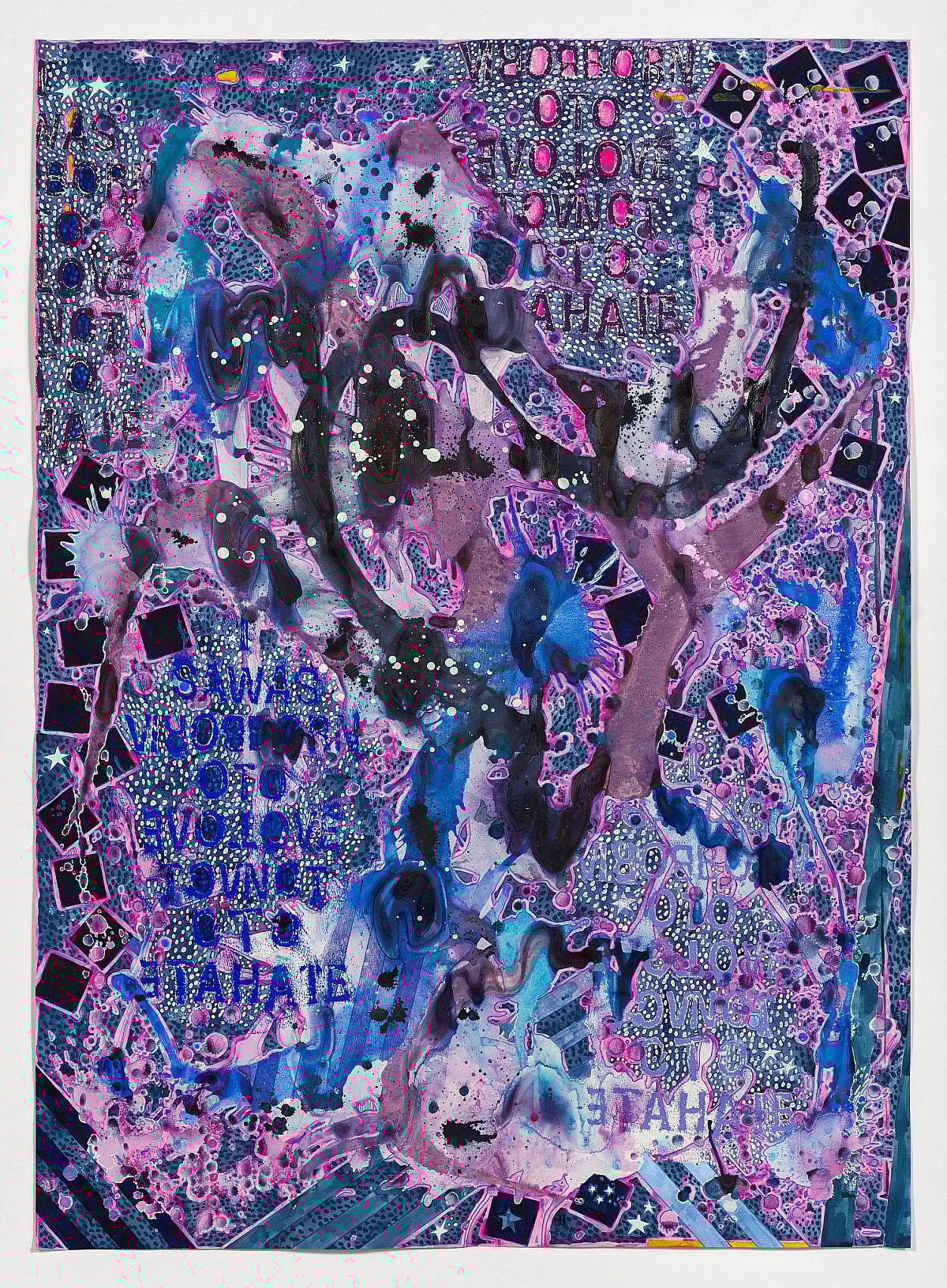
When I look at Alexandra Grant’s Supernova (2022), it aligns most closely with the stage of acceptance. A supernova marks both an ending and a beginning, suggesting transformation rather than absolute loss. Her painting bursts with energy and intensity, feeling simultaneously vibrant and chaotic. The palette is dominated by a rich spectrum of blues and pinks fading into purples, set in contrast against areas of white and black, with occasional, sparing drops of yellow that catch the eye. The composition is dense, a cosmos of forms both astrological and algebraic. Tiny stars cluster along the edges, framing the work. Squares zigzag unpredictably across the canvas, bending left or right. Stripes run diagonally, refusing the symmetry of a static horizon.
Interwoven within this energetic work are letters that spell out the phrase “I’m born to love, not to hate,” a line referencing Grant’s previous work and the moral weight of Sophocles’ Antigone. Some letters are reversed, as if viewed in a mirror, and the Os are filled with lighter colors than their contours. Little white dots surround the letters, emphasizing their importance in this cosmic, energetic field and adding conceptual depth.
The overall effect is a painting that vibrates with life and thought. It is both a visual and intellectual experience, carrying the enduring power of love and moral clarity. The soul seems set free into orbit, becoming something magnificent, a new sparkle that offers a great deal of solace. Viewed in the context of this grief exhibit, Grant’s Supernova also recalls her 2015 documentary Taking Lena Home, in which she restored a tombstone to its community, demonstrating the same profound respect for the dead.
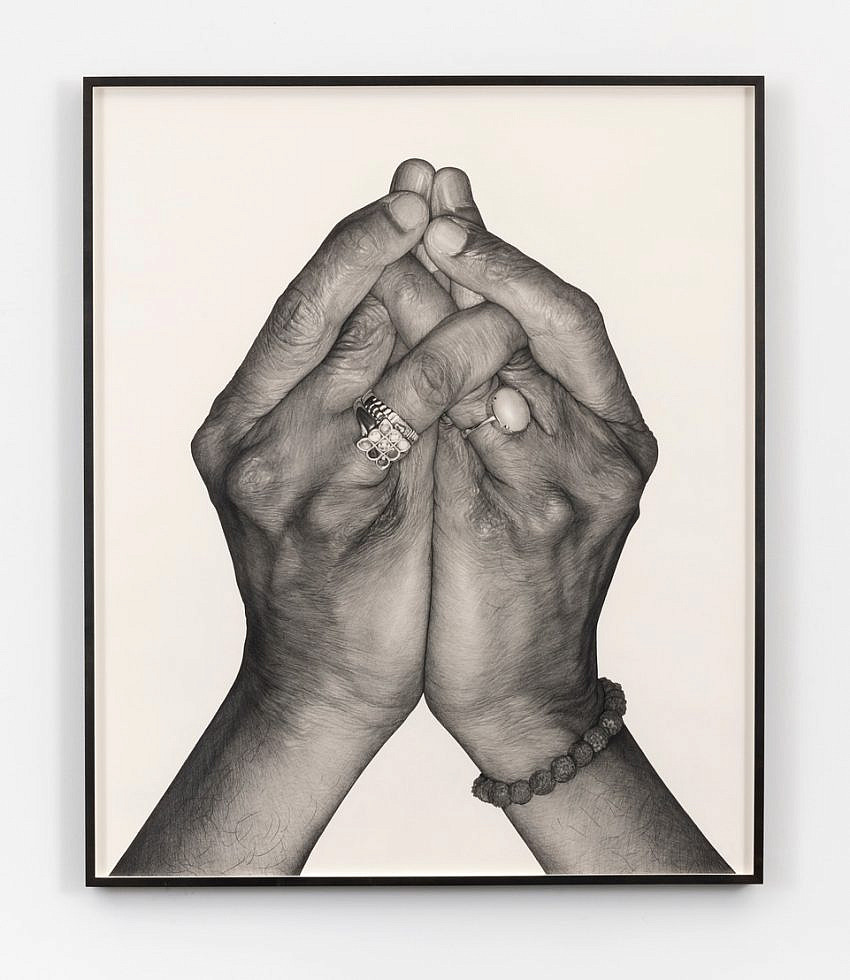
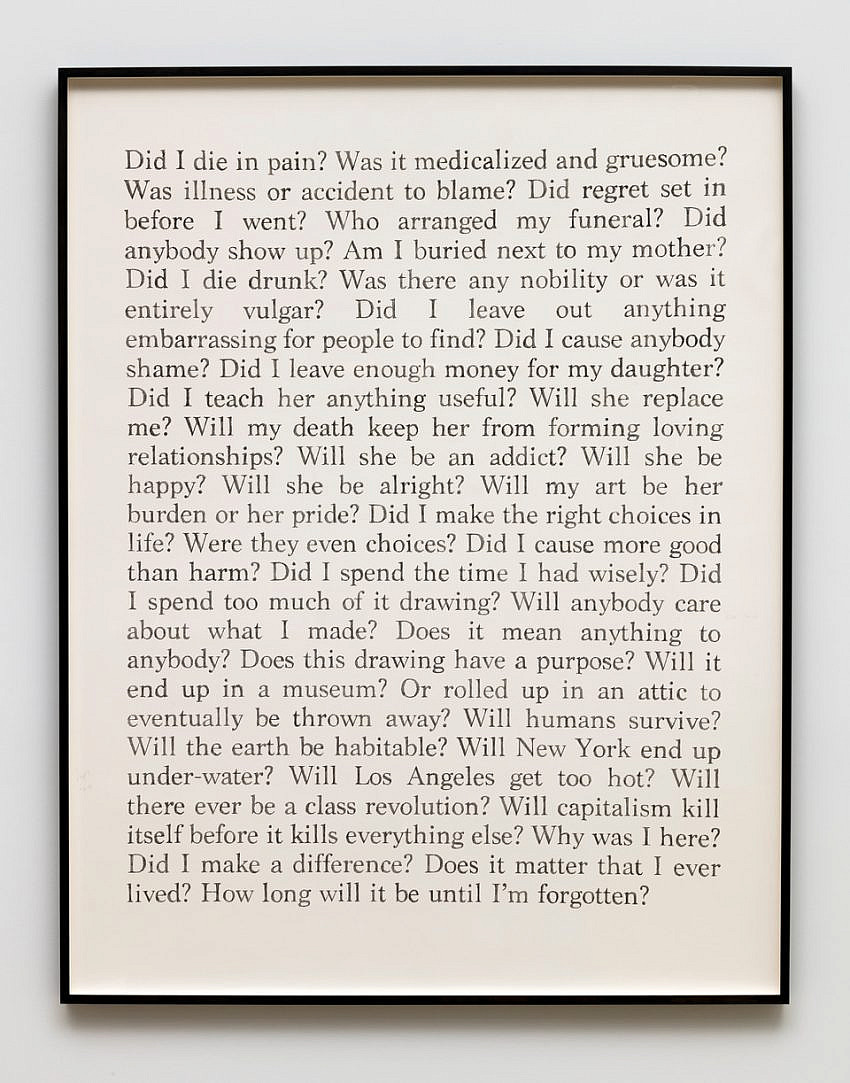
The stage of bargaining is best captured in Karl Haendel’s Praise New York B, part of his Praise New York series exhibited at Mitchell-Innes & Nash in 2022. In this series, Haendel created large-scale realist drawings depicting the hands of some of New York City’s most inspiring faith leaders, including Muslim, Buddhist, Hindu, Jewish, Christian, and Sikh. The works highlight the city’s religious diversity, pay homage to these leaders, and show how their spiritual practices provide community and systems of support. This particular image, with fingers crossed in an unusually interlocked way, shows the hands of Ravi Vaidyanaat Šivãchãriar of the Ganesh Temple in Flushing. In How long will it be until I’m forgotten, the artist created a text written by a fictional dead person, inquiring how he died, which he framed like a painting.
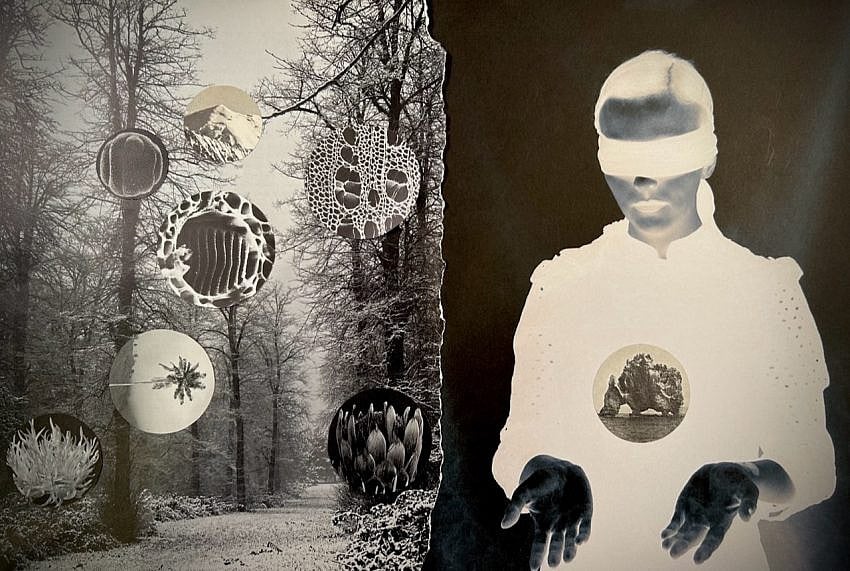
In Flora Kao’s Portal II, we see fire, which aligns best with the stage of anger. The flames convey intensity and pain through heat and turbulence, reflecting the raw emotional power of this stage of grief. This represents a more external part of the grieving process, in contrast to Lezley Saar’s Another World, a deeply introspective piece that seems to align with the stage of depression. Saar presents two scenes side by side: one depicts a forest with bubbles containing close-ups of plants and the top of a mountain, and the other shows a blindfolded woman against a black background, her hands turned outward, palms visible, with one bubble containing a close-up of a plant resting on her chest. The images suggest withdrawal from the busy and distracting world, a search for the subject or object that was lost, and a reconnection to nature.
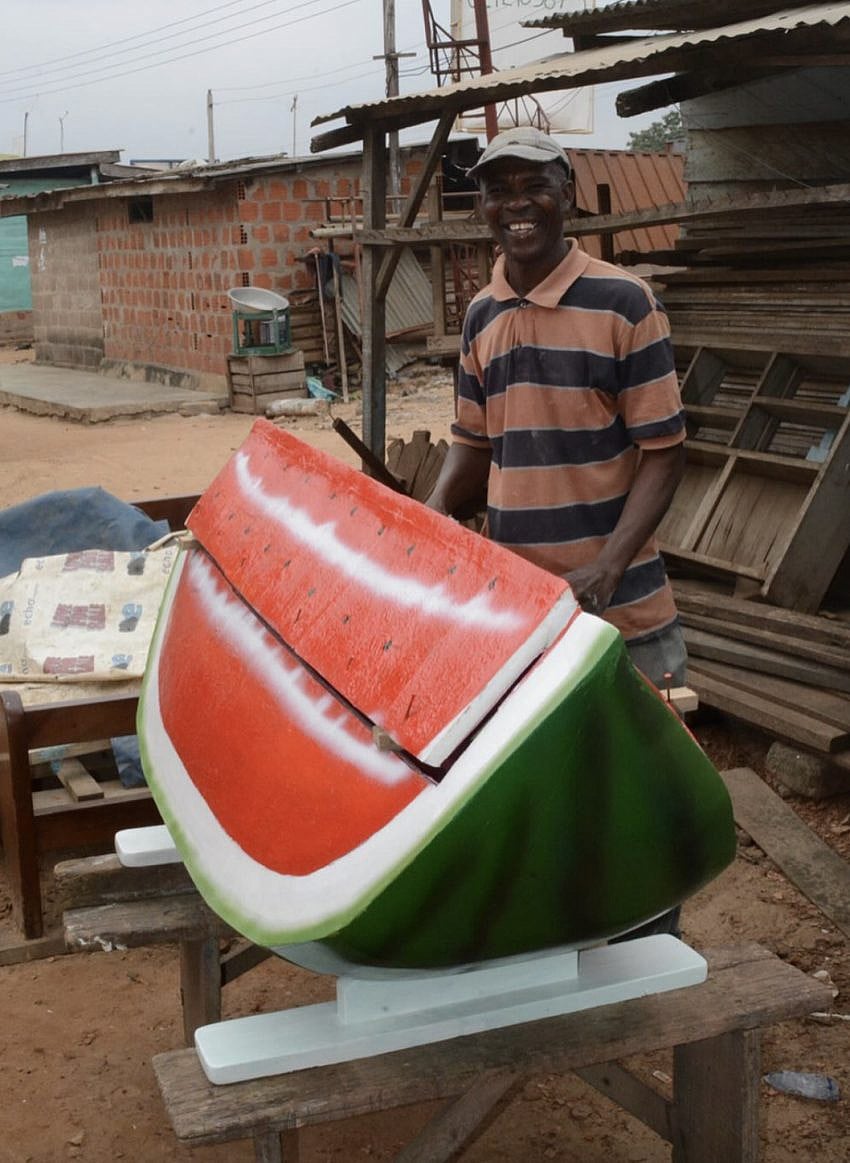
Another piece I find particularly soothing is by Benezate of Ghana, titled Watermelon FAV (Fantastic Afterlife Vehicle), made of wood, paint, and satin. It shows the artist smiling next to a coffin shaped like a watermelon. The fruit looks so fresh and sweet that one can almost taste it, and it seems to be waiting for someone to take this incredible journey to a destination we, the living, cannot imagine. This work aligns with the stages of acceptance and testing, or integration. It presents death as an accepted part of life and invites reflection on our mortality and losses, suggesting ways to experience death in a less grim, more imaginative way.
Overall, it is an exceptionally thought-provoking exhibition. It goes beyond the ordinary, offering a space to connect, reflect, and mourn together. Ultimately, grief, whether personal or collective, reminds us of our shared humanity. In mourning, we remember not only those we have lost but also the values that make life worth living: love, respect, and the courage to remember.