The Siren, The Popsicle, and the Deepfake
Recalling an afternoon of memory with Holocaust survivor Elias Feinzilberg in an era of deepfakes where seeing is no longer believing.
Today, I bowed my head in silence to the sound of a siren, joined by nine million Israelis. On Yom HaShoah, we are taught a specific kind of responsibility: to honor the memory of one person every year. To learn their name. To hold their story.
Today, I am holding Elias’s.
Ten years ago, I sat in a sun-lit living room in Jerusalem with Elias Feinzilberg, of blessed memory. He was the only survivor of a family of nine. He had survived nine forced labor and concentration camps across Poland, Austria, and Germany. He survived a death march. He had even been handed a sack by the SS and told to get inside so he could be thrown into a river.
He survived that, too.
What struck me most about Elias, beyond his iron will to survive, was his refusal to let the darkness win. In Central America, where he took refuge after his liberation, we use the phrase “ser gente”—to be truly, deeply human. In Yiddish, a mensch.
After the heavy retelling of his past, Elias didn’t dwell in the shadows. We had a deep connection rooted in my upbringing in Mexico and his years in Guatemala. He loved the Los Panchos Trio. That afternoon, he took out his old LPs, and we sang along to the boleros. That warmth in the heart singing with a man who refused to let the darkness silence stays with me.
He shared stories of his children being born in Guatemala, and shared how the establishment of the State of Israel was the light that finally brought him home to Jerusalem.
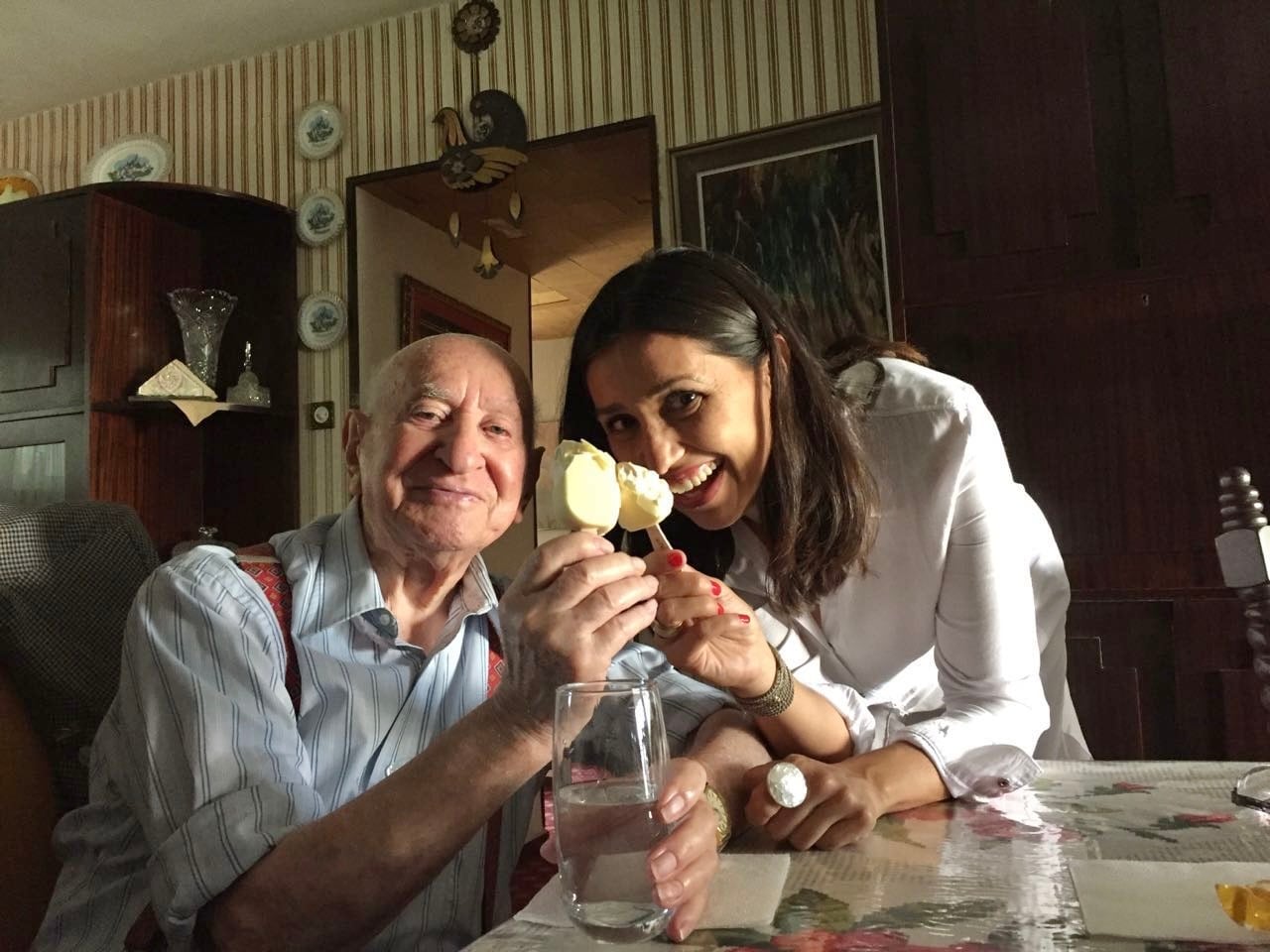
We ended that afternoon by toasting l’chaim, to life. Not with wine, but with popsicles.
As a communications strategist working in the age of AI, in Yom HaShoa I’m reflecting on Elias’s words: “If there were no pictures, no one would believe it.”
We are living in an era where a past that never existed can be AI-generated, and deepfakes run like wildfire on social media. In this new reality, the most radical act of resistance is to be a steward of the truth.
The photo of Elias and me toasting with popsicles isn’t optimized or filtered but a grainy, imperfect proof of life. It is a reminder that while technology can replicate an image or a voice, it cannot replicate the soul of a survivor who chooses joy after the unthinkable.
Our Job as Witnesses
I’ll never forget the drive back home to Pardes Hanna. Tears ran through my cheeks for most of the ride. I told myself I was privileged to bear witness, to the tragedy, but also to the triumph. Our job, as communicators, as parents, and as humans, is to bear witness to ensure history does not repeat.
October 7th in Israel showed us that the darkness is still lurking and taking precious lives. We must protect the stories that remind us that life is sacred, that antisemitism has no place in a civilized society.
More importantly, as Elias became a living proof: there is life after tragedy.
Elias Feinzilberg was gente. He understood that memory is not only a backward glance but a forward-facing defense against the erasure of truth.
May his memory, and the memory of the entire Feinzilberg family, be a blessing.