Retired Board-Certified Clinical Psychologist/Author
Featured Post
Don’t call it a ‘situation’
Israelis’ way of coping with chronic threats doesn’t work in this uncertain time between war and peace
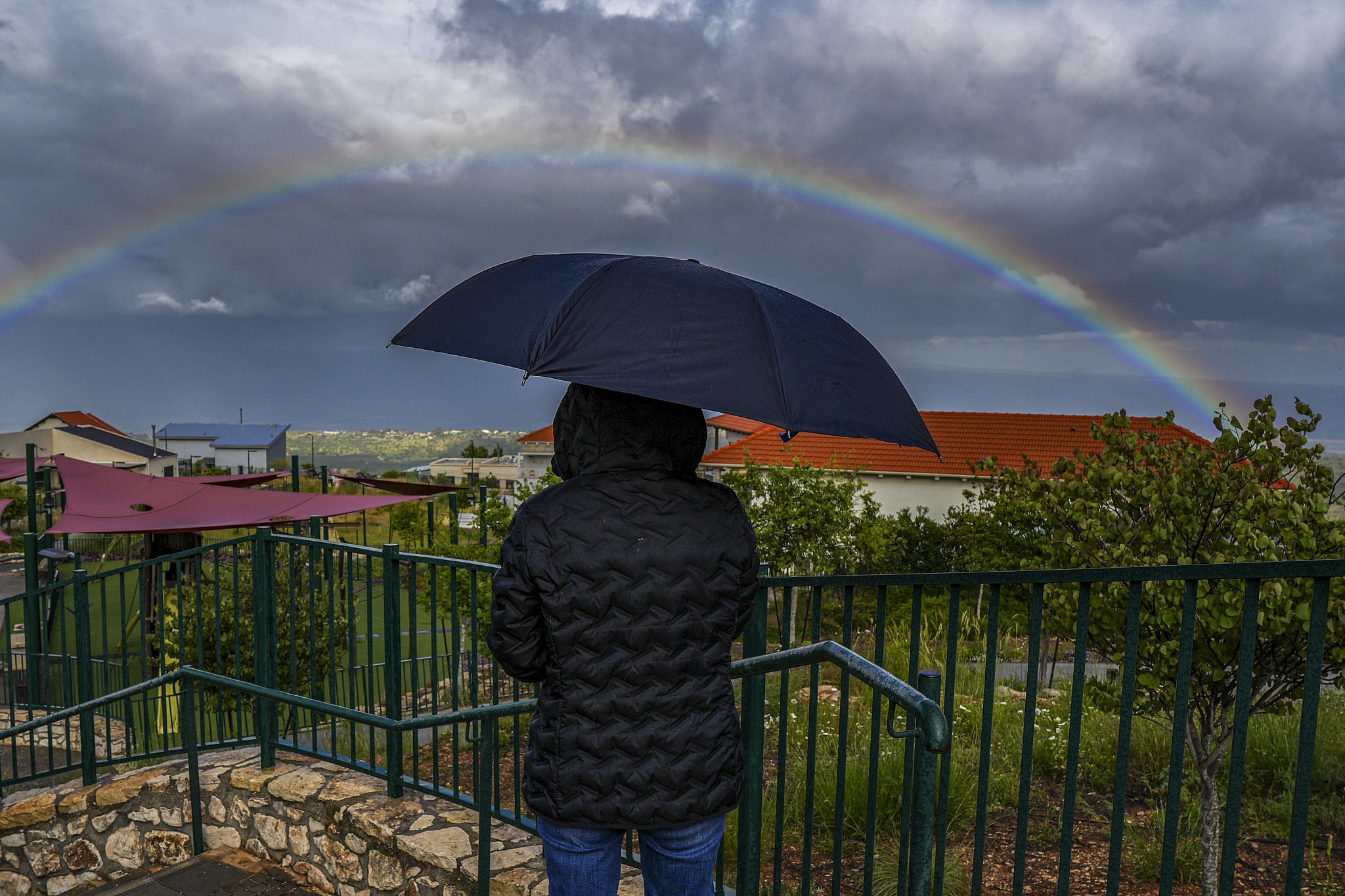
A person stands under an umbrella as a rainbow appears in the sky in the Upper Galilee, northern Israel, May 4, 2026. Photo by Ayal Margolin/Flash90
The hostages are home. Most reservists are back at their desks. The sirens come and go. And the war is not over.
Decades of clinical practice with trauma raise a concern about what Israel is now living through. The country expected relief. The country is not getting relief. The conditions for relief do not yet exist. Israel is in something the trauma literature handles poorly: a condition between war and peace, where the threat has eased but not ended, and the body cannot tell the difference.
Here is what the patterns look like. Marriages that have held through more than two years of war and uncertain pause are coming apart now. Mothers who functioned beautifully under rocket fire cannot get out of bed on a Tuesday. Grandparents who watched grandchildren go to war cannot let themselves feel relief, because relief feels premature. Hostage families adjusting to homecoming discover that the reunion does not look like what they pictured. Mental health clinics fill up after the fighting eases, not during it.
The country is reaching for the word it has always used for chronic threat. The matzav. The situation. The word may no longer be holding what it is being asked to hold.
The word may not be enough
The matzav has carried Israelis through wars, intifadas, and rocket fire. It has been more than a description — it has been a way of coping, a casual word that says we know what this is, we have been here before, we will be here again.
What Israelis are now living through may be more than the word can hold: vigilance without action, relief without trust, and quiet that cannot be fully inhabited as safety. The matzav before October 7 was a shared cognitive shorthand. After October 7, it became something else. The first Iran confrontation, the uncertain pause that followed, and now a second active war with Iran have changed it again. The matzav no longer points simply to what has occurred, but to what may yet unfold. It now carries the burden of indeterminacy: a state in which threat is neither fully present nor safely past.
This is not a matter of semantics. The word a person uses for what they are living shapes what they allow themselves to feel. When the matzav is used for the current condition, it carries an implicit message: that what is being experienced is the same kind of thing that has been managed before, and that the person struggling now should be able to manage it too. The casual register can also do quieter work. It can let the person say something about their experience without quite saying it. It can substitute description for engagement.
This kind of avoidance is not deliberate, and it is not failure — it is what casual words do when they are asked to carry too much. But the cost is real. The body knows what is being avoided, even when the mind has found a word that lets it not look. The word no longer contains the experience. It exposes the instability of it. The clinical work begins with letting the word fall short, and trusting that the falling short is information.
What the word cannot hold
The trauma literature offers at least three useful frames for what matzav is no longer covering. None is “PTSD” — that is a different and more specific clinical entity — and confusing them with PTSD is part of the problem.
The first is post-impact disillusionment, which matzav was never built to acknowledge. Disaster psychologists have known for decades that survivors of large-scale events go through a predictable arc: heroic phase, honeymoon phase (“we are all in this together”), and then disillusionment, when the casseroles stop coming, the flags come down, and the survivor realizes the world has moved on while their internal damage is just becoming visible. After prolonged collective trauma, these disillusionment patterns appear whether or not the acute crisis has fully ended. Matzav offers no place to put this.
The second is delayed grief, which matzav cannot give the body permission to feel. During sustained threat, populations cannot fully grieve their dead, because grief requires safety. The funerals happened. The shiva houses were full. But the deep work of mourning was suspended because the next siren was always coming, and the next siren is still possible. The grief that was deferred arrives anyway, into a body that is still on watch — and matzav, the casual word containing it all, has nothing to say about a grief that arrives this late.
The third is what I would call the ego-dystonic wound, for which matzav has no language at all. The term “ego-dystonic” is most familiar from clinical work with intrusive-thought disorders, where it describes thoughts that do not fit the self-image the person has carried until now. I am drawing the term out of its usual clinical home and applying it more broadly — not intrusive thoughts but intrusive actions, decisions, and witnessings, the things people did, witnessed, or failed to prevent that the peacetime self cannot easily file under “me.”
This is not the same as guilt or shame. Guilt says I did a bad thing. Shame says I am a bad person. The ego-dystonic struggle says: I did this, and I cannot yet see how the person I have always understood myself to be is the same person who did this. The work, clinically, is about context.
This wound is not only a soldier’s wound. It is carried by the parent whose son was in Gaza while the parent attended a bar mitzvah, laughed, danced, and now cannot quite understand how they were able to do those things. By the spouse who held meetings and made coffee while their partner was on reserve duty. By the grandmother who celebrated one grandson’s birthday while another was in uniform. By the medical worker at Soroka who made impossible triage decisions. By anyone who acted, or lived ordinarily, in a way that fit the moment but does not fit the self they thought they were. Each of them, in a context none of us are built for, did only what that context permitted — and is now carrying chapters they did not know they were capable of carrying.
Why “give it time” is the wrong prescription
The advice that comes most readily from family members and even some clinicians, after prolonged collective trauma, is some version of: be patient, give it time, you will get back to yourself. Whoever is offering this advice means well. They are wrong, and the consequences are serious. Time alone does not heal these conditions, and time is not the right variable when the threat may not fully resolve in the form Israelis hope for.
What heals is not the passage of time. What heals is what gets done during that time. And the first thing is naming. A reservist who understands that his irritability is a hyperactive amygdala doing its job too long is in a different psychological position than a reservist who thinks he has become a bad husband. A grandmother who understands that her inability to feel relief is the body still on watch can stop blaming herself for not being grateful enough.
The work that follows the naming has roughly four parts.
- Putting the experience back in its context — I did this because I was here, in these conditions, with what was available to me.
- Letting the wartime self and the peacetime self occupy the same person, without forcing one to disappear.
- Giving yourself permission to feel what you are feeling without interpreting the feeling as failure.
- And doing all of this in the presence of someone safe — a partner, a friend, a sponsor — because the work proceeds in connection, not in isolation.
Each part can be started alone, but the work cannot be completed alone. If the someone safe is not yet in your life, finding them is part of the work.
What to do tonight
The four-part work is months and years long. There are things worth doing tonight, as the first step into it. Name what you are feeling out loud, to someone who loves you. One sentence. I have not been okay. I am not myself. Something has changed in me. Whatever is true. If there is no one in your life right now to reach out to, write down what you would say if there were. Put it on paper. The naming still works, even when the someone is not yet there.
Refuse the advice to be patient. Reach out to someone you have been avoiding — withdrawal compounds, and contact interrupts it. And if you are carrying images, decisions, or silences that do not fit who you were before, the work is not to forgive or condemn yourself. You are the same person who has now lived through something most people will never have to. That is not damage. That is information your nervous system has not yet finished filing.
A possibility worth considering
I write this from the diaspora, observing rather than living what Israelis are living. But there is one idea I would put on the table for the connection the work requires, drawing on a model that has worked for decades in another context: the sponsor system from Alcoholics Anonymous, adapted for Israelis carrying the war home in different forms.
The wives and partners of reservists, the parents of soldiers who came back changed, the hostage families adjusting to homecoming — all are being told some version of be patient, give it time. Most would be better served by being paired with someone who has lived something close to what they are living, and come out the other side. And the sponsors should not be drawn only from inside Israel, or only from people who have lived the same specific experience. They should be drawn from the broader population of people who have built lives around chronic risk — the spouses and parents of police, firefighters, special forces, intelligence officers, trauma physicians. They have something to teach that no clinician can teach. The training is the kind the AA tradition has been refining for decades. Not therapy. Structured peer support with clinical oversight.
The thing I am trying to say
I am the son of two Hungarian Holocaust survivors. What I learned from them is that the “after” often does not arrive on the schedule the calendar promises. Sometimes there is no after at all, only a continuous condition of waiting that the body has to learn to live inside without breaking.
Israelis know this in their bones. The matzav. The shoe that has been hovering, almost dropping, for 77 years. What October 7 did was strip away the fiction that the shoe might not actually drop. The shoe dropped. The old word may carry some of what is happening, but not all of it — and the part it does not carry is the part that needs the most help. The work cannot wait for the war to end, because the war may not end in the way endings are supposed to happen.
The country is not broken. The country is in a known phase of a known process. The naming matters. The work matters. Whatever Israelis decide to call this — and the naming belongs to them, not to me — the first step is recognizing that matzav cannot carry it.
The body knows. It has been keeping count. The casual word has let the mind look away, but the body has been carrying what the word would not name. That carrying is what is breaking marriages, breaking sleep, breaking whatever has been breaking. The work is to stop asking the body to carry what should be named. Name it. Let the old word fall short. Find someone safe and begin. Whatever your war has been, however it reached you, the work cannot wait for the war to end. Begin now.
Related Topics