The Song That Remains When Memory Fails
HAAZINU
The Song That Remains When Memory Fails
Haazinu begins with something immense.
הַאֲזִינוּ הַשָּׁמַיִם וַאֲדַבֵּרָה
וְתִשְׁמַע הָאָרֶץ אִמְרֵי־פִי
Give ear, O heavens, and I will speak;
and let the earth hear the words of my mouth.
Moshe no longer summons Israel alone. He summons heaven and earth.
Perhaps because people die. Generations forget. Institutions change. Even written words can remain shut inside a book no one opens. Heaven and earth, by contrast, will still be there when those listening to Moshe have disappeared.
And then Moshe sings.
He offers no final explanation. He delivers no further speech. He sings.
The shirah condenses almost the whole history of Israel: origin, care, abundance, forgetting, rupture, consequences, return. Not as an ordered chronology, but as something that must be able to pass through generations. Something that enters through the ear and remains when argument no longer reaches us.
That is why the first word matters: Haazinu.
Listen.
Before understanding. Before remembering. Before acting.
Listen.
Remember — When a Generation Needs to Ask
After summoning heaven and earth, Moshe looks back:
זְכֹר יְמוֹת עוֹלָם
בִּינוּ שְׁנוֹת דֹּר־וָדֹר
שְׁאַל אָבִיךָ וְיַגֵּדְךָ
זְקֵנֶיךָ וְיֹאמְרוּ לָךְ
Remember the days of old.
Understand the years from generation to generation.
Ask your father, and he will tell you;
your elders, and they will say to you.
The sequence is strange and deeply human.
Remembering is not enough.
זכר — remember.
בינו — understand.
שאל — ask.
There are things we cannot remember because they happened before we were born. For those, we need another person.
Ask.
Biblical memory does not appear here as a private archive in the mind. It passes from one person to another. Someone knows because someone asked. Someone remembers because another person told the story. And a generation can lose something no library will ever recover if the moment comes when it stops asking.
Here Haazinu begins to reveal its real concern. It is not only sin. It is something that comes before it, and is perhaps quieter.
Forgetting.
Because when the memory of origin is lost, the way we understand the present also begins to change.
In the Desert — The Care We Barely See
The song then remembers where God found Israel:
יִמְצָאֵהוּ בְּאֶרֶץ מִדְבָּר
He found him in a desert land.
Not in a city. Not in a finished structure. Not in abundance.
In the desert.
There appears one of the most delicate images in the whole parashah:
כְּנֶשֶׁר יָעִיר קִנּוֹ
עַל־גּוֹזָלָיו יְרַחֵף
Like an eagle that stirs its nest,
that hovers over its young.
The eagle is close, but it does not fly for its young.
There is protection. There is movement too.
That balance matters. To care can mean to sustain, surround, guard ‘as the apple of His eye’. But a moment will come when what has been protected must live for itself. Care that never allows flight ends up denying the very thing it meant to protect.
Haazinu holds both within a single image: closeness and space.
Perhaps that is why the desert holds such a powerful place in Israel’s memory. There, almost nothing could be mistaken for self-sufficiency. There were not yet full granaries, cities of their own, or prosperity capable of concealing where everything had come from.
That will come later.
And that is where the problem begins.
And Yeshurun Grew Fat — The Danger That Comes When Everything Works
First comes abundance.
The land produces. There is wheat, oil, milk, honey, livestock, wine. The song lingers over that richness before uttering one of its hardest lines:
וַיִּשְׁמַן יְשֻׁרוּן וַיִּבְעָט
And Yeshurun grew fat and kicked.
It does not say that Israel forgot because it had been destroyed.
It forgot when it was satisfied.
That changes a great deal.
The failure in Haazinu does not arise only from suffering. It can arise from success as well. Something works for so long that it begins to seem natural. What was received begins to feel like one’s own. The structure that made abundance possible disappears behind the abundance itself.
Then comes the most precise blow:
צוּר יְלָדְךָ תֶּשִׁי
וַתִּשְׁכַּח אֵל מְחֹלְלֶךָ
You neglected the Rock that begot you
and forgot the God who gave you origin.
The song had demanded זכר — remember.
Now comes ותשכח — and you forgot.
There lies the fracture.
It is not merely disobedience. It is loss of origin. And when a person, a community, or a civilisation loses the memory of what made it possible, it can continue growing for a time. From the outside it may even appear strong.
But it has already begun to separate itself from its own Rock.
The Rock — What Remains While Everything Else Changes
One word runs through Haazinu again and again:
צור — Tzur. The Rock.
At the beginning:
הַצּוּר תָּמִים פָּעֳלוֹ
The Rock, perfect is His work.
Then, the Rock from which Israel turns away. The Rock that begot it. Later other rocks appear, other places of trust:
כִּי לֹא כְצוּרֵנוּ צוּרָם
For their rock is not like our Rock.
The image changes function as the song unfolds.
First it is origin. Then stability. Then it appears as something that can be forgotten. Finally, it forces the question of where trust is really placed when crisis comes.
Because every life, in the end, rests upon something.
A person may say they have no Rock. A society may say the same. But when something begins to shake, what it expected salvation from becomes visible.
Haazinu needs no theory about this. It asks a far more uncomfortable question:
Where are the gods now in whom you trusted?
When everything works, almost any rock looks solid.
When the ground moves, it does not.
The Hidden Face — When Consequences Begin to Speak
After forgetting comes one of the darkest regions of the song.
אַסְתִּירָה פָנַי מֵהֶם
אֶרְאֶה מָה אַחֲרִיתָם
I will hide My face from them;
I will see what their end will be.
The image is terrible precisely because what it describes first is not an intervention, but a withdrawal.
The face is no longer visible.
And then consequences occupy the space.
Haazinu does not allow this part to become a comfortable metaphor. It speaks of hunger, fear, sword, loss. It speaks of what happens outside and of what even enters the chambers. The song that was meant to survive generations had to contain this too. If it preserved only the happy origin, it would be useless when rupture came.
But there is a decisive detail.
Even here, the story is not abandoned to a blind mechanism.
There is observation. There is response. There is a limit.
Action produces consequences; consequences alter the situation; the new situation is seen again. The movement continues.
Haazinu does not draw a straight line from fall to destruction.
Something interrupts that line.
‘If They Were Wise…’ — Understanding Where a Path Ends
In the midst of crisis another line appears, quietly answering the beginning:
כִּי גוֹי אֹבַד עֵצוֹת הֵמָּה
וְאֵין בָּהֶם תְּבוּנָה
For they are a nation bereft of counsel,
and there is no understanding in them.
And immediately afterwards:
לוּ חָכְמוּ יַשְׂכִּילוּ זֹאת
יָבִינוּ לְאַחֲרִיתָם
If they were wise, they would understand this;
they would understand their end.
Again: understand.
But now understanding means something more demanding than knowing the past. It means looking at a trajectory and recognising where it leads before arriving there.
That may be one of the most difficult forms of intelligence.
While we are inside a process, each step can seem small. A single decision. A concession. A habit that changes. Nothing by itself seems to contain the end.
Until the end begins to become visible.
Haazinu asks for an intelligence capable of reading direction.
Not only: what is happening?
Also: if this continues, where does it lead?
That kind of understanding may still change a path.
Later, perhaps not.
I Put to Death and I Give Life — Rupture Does Not Have the Last Word
Then the song turns.
Not gently.
After so much loss comes a bare declaration:
רְאוּ עַתָּה כִּי אֲנִי אֲנִי הוּא
See now that I, I am He.
And then:
אֲנִי אָמִית וַאֲחַיֶּה
מָחַצְתִּי וַאֲנִי אֶרְפָּא
I put to death and I give life;
I have wounded, and I will heal.
The song does not erase what happened in order to reach restoration.
The wound remains named.
מחצתי — I have wounded.
ארפא — I will heal.
Healing does not mean pretending there was never a wound.
Perhaps that is the difference between restoration and an imaginary return. We do not return to the earlier point as though nothing had happened. We pass through the rupture, and something can live after it.
The song knows destruction, but it does not grant destruction the last word.
It knows distance, but neither does it turn distance into destiny.
The cycle can turn again.
The Hidden Architecture of Haazinu
Now the whole movement can be seen.
Haazinu begins with the ear.
Listen.
Then it demands memory.
Remember.
But remembering leads to a question:
Where do you come from?
The answer leads to the desert, to care, to the Rock, to what sustained when there was no abundance yet.
Then abundance itself arrives.
Yeshurun grows fat.
Forgets.
Separates itself.
Consequences begin to accumulate. The face is hidden. What seemed stable begins to move. Then comes a second demand for understanding: look at the process. Look at its direction. Understand its end.
Only then does the possibility of restoration appear.
The trajectory is not a perfect circle. The one who returns is not identical to the one who departed, because now that person knows rupture too.
Listen → remember → receive → prosper → forget → break → understand → heal → transmit.
Haazinu preserves that trajectory in a song because such a trajectory does not belong to one generation alone.
It can return.
And it does.
The Song After the Song — Setting the Heart Upon It
When Moshe finishes, the Torah does something easy to overlook.
It leaves poetry.
Moshe speaks to the people again and says:
שִׂימוּ לְבַבְכֶם לְכָל־הַדְּבָרִים
Set your heart upon all these words.
He does not simply say: remember them.
Set your heart upon them.
And immediately the next generation appears:
אֲשֶׁר תְּצַוֻּם אֶת־בְּנֵיכֶם
Which you shall command your children.
Then:
לִשְׁמֹר לַעֲשׂוֹת
Keep. Do.
The song has entered through the ear. Now it must pass into the heart, from there to the children, and finally into action.
That movement matters.
A memory preserved only as information may remain intact and yet cease to govern a life. Haazinu does not seek merely to preserve words. It seeks to make the words produce action again.
And Moshe adds something stronger still:
כִּי לֹא־דָבָר רֵק הוּא מִכֶּם
כִּי־הוּא חַיֵּיכֶם
For it is no empty word for you.
For it is your life.
Not an idea about life.
Your life.
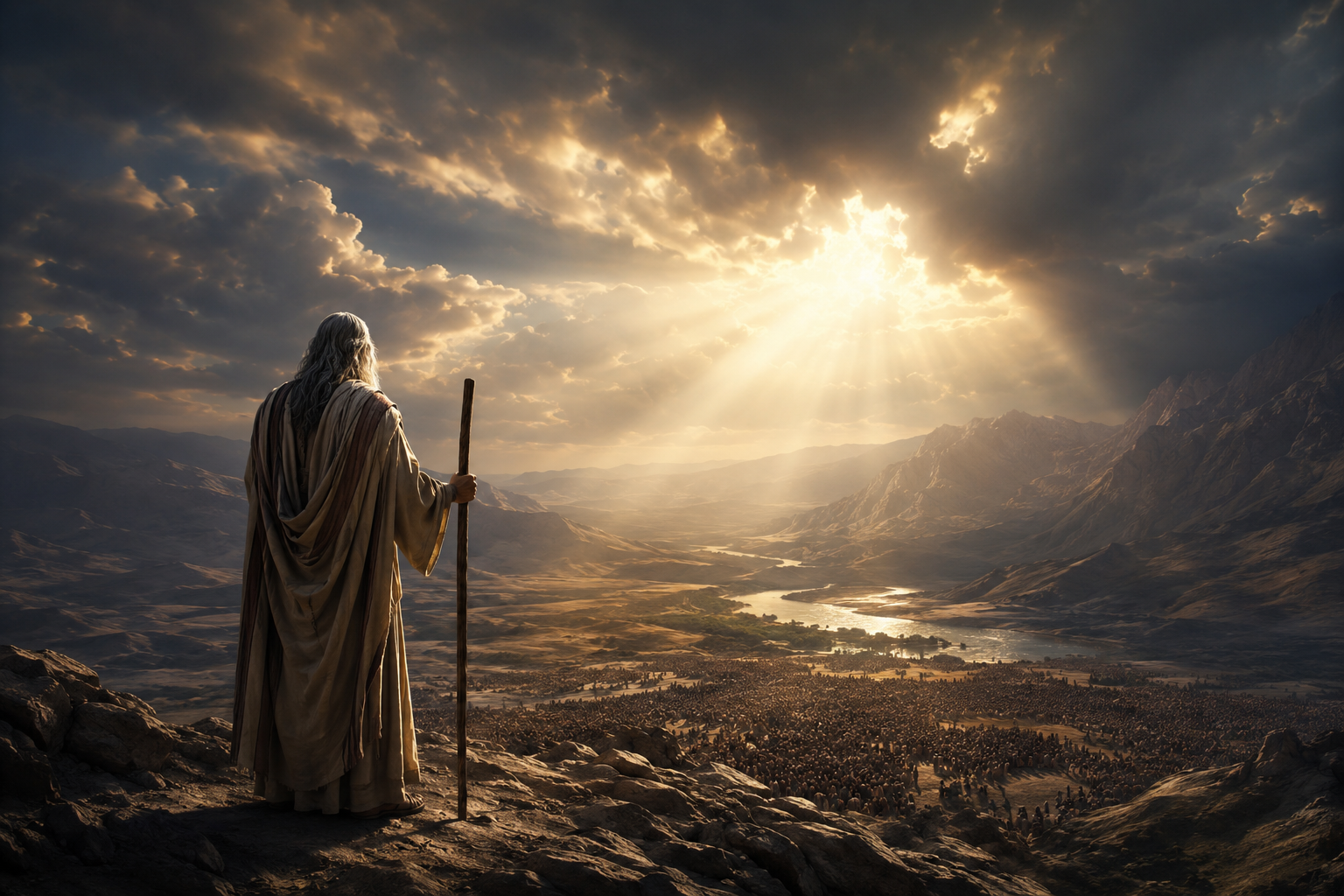
Moshe Before the Land — Seeing What One Will Not Live to See
And then, almost brutally, the Torah leaves the song.
God tells Moshe to ascend Mount Nebo.
He will see the land.
He will not enter it.
After singing of generations, memory, loss, and continuity, Moshe is placed personally within what he has just taught. He too will reach a limit. He too will have to allow something to continue without him.
The land will be there.
Israel will enter.
The Torah will continue.
Moshe will not.
There is something profoundly human in that ending. We can devote an entire life to a work whose future we will never see. We can lead others to a place we ourselves will not enter. We can sow a memory in people who will live in a time that will no longer be ours.
Moshe sees from afar.
That is all.
And yet it is not little.
Because Haazinu has just shown that continuity never depended upon one person remaining for ever.
It depends upon something being heard, remembered, and transmitted when that person is no longer there.
The Archetypes That Dwell Within Us
There is the eagle.
The part of us that wants to protect what it loves and that, sooner or later, must make space for it to fly.
There is Yeshurun.
The part that can survive hardship and yet lose itself in abundance. The part that begins to forget precisely when it believes it no longer needs to remember.
There is the Rock.
That upon which we build without thinking much about it until something begins to shake.
There is the hidden face.
Those moments when the structure that sustained us no longer feels present and we begin to experience the consequences of what we have done.
There is the one who understands the end before reaching it.
That person does not always appear in time.
And there is Moshe, standing before a land he will not enter.
Perhaps that is the most difficult archetype: accepting that something valuable can continue without us.
Haazinu in the Present Time
We live surrounded by mechanisms of memory.
Never has it been so easy to preserve a word. Photographs, archives, recordings, entire libraries that fit inside a machine.
And still we can forget.
Haazinu forces us to distinguish between storing and remembering.
A society can preserve all its documents and lose its living relationship with what they contain. A family can keep photographs of people whose stories no one asks about any more. An institution can preserve its founding principles on a wall while its daily practice moves away from them.
The archive remains.
The memory may have disappeared.
That is why Moshe does not simply say: preserve.
He says: listen. Remember. Ask. Understand. Take it to heart. Teach it. Do it.
Living memory needs movement.
Prosperity, too, retains the same ambiguity it has in Haazinu. We want to build security, well-being, institutions that work. And we should. But success contains a fragility of its own: it can erase from consciousness the conditions that made that success possible.
Then comes the moment of Yeshurun.
Not necessarily as a spectacular rebellion.
Sometimes it is enough to stop asking.
Inner Activation
Haazinu — listen.
Do not begin by explaining yourself.
Listen first.
Then ask where you are within the song.
In the desert, where you can still recognise every form of help because you know you cannot sustain yourself alone?
In abundance, when things are working and precisely because of that you begin to forget what made them possible?
At the moment when you can already perceive the consequences of something you allowed to grow for too long?
Or at that more difficult point where you begin to understand the direction — and can still change it?
There is no need to dramatise the answer.
There is a need to recognise it.
Then comes Haazinu’s second question: what do you not want to forget?
Not what do you want to store.
What do you want to remain alive?
A word. A story. An obligation. A person. Something you received that should not end with you.
Then do what the parashah does.
Listen to it.
Remember it.
Ask.
Take it to heart.
And find a way to transmit it.
Because perhaps this is Haazinu’s deepest insight: true memory does not consist in preserving the past intact.
It consists in allowing it still to act in the present.
“Haazinu hashamaim — Give ear, O heavens.”
Moshe is about to disappear.
The song is not.
Heaven will still be there. The earth too. Another generation will hear words spoken before it was born and will have to decide what to do with them.
And we are part of that generation.
Listening.