Greek Jewish roots. New York voice. Unfiltered perspective.
Ha’azinu: When The Song Doesn’t End
I have written about the parsha many times.
But I have never had to write one while sitting shiva.
My father died on Sunday.
And this Shabbat will be the first Shabbat of my entire life without him in this world.
Then I looked at the parsha.
Ha’azinu.
And I almost couldn’t believe it.
Because near the end of Moshe’s life, after all the speeches, all the commandments, all the teaching, all the leading — Moshe does something different.
He sings.
The Torah calls Ha’azinu a shirah — a song.
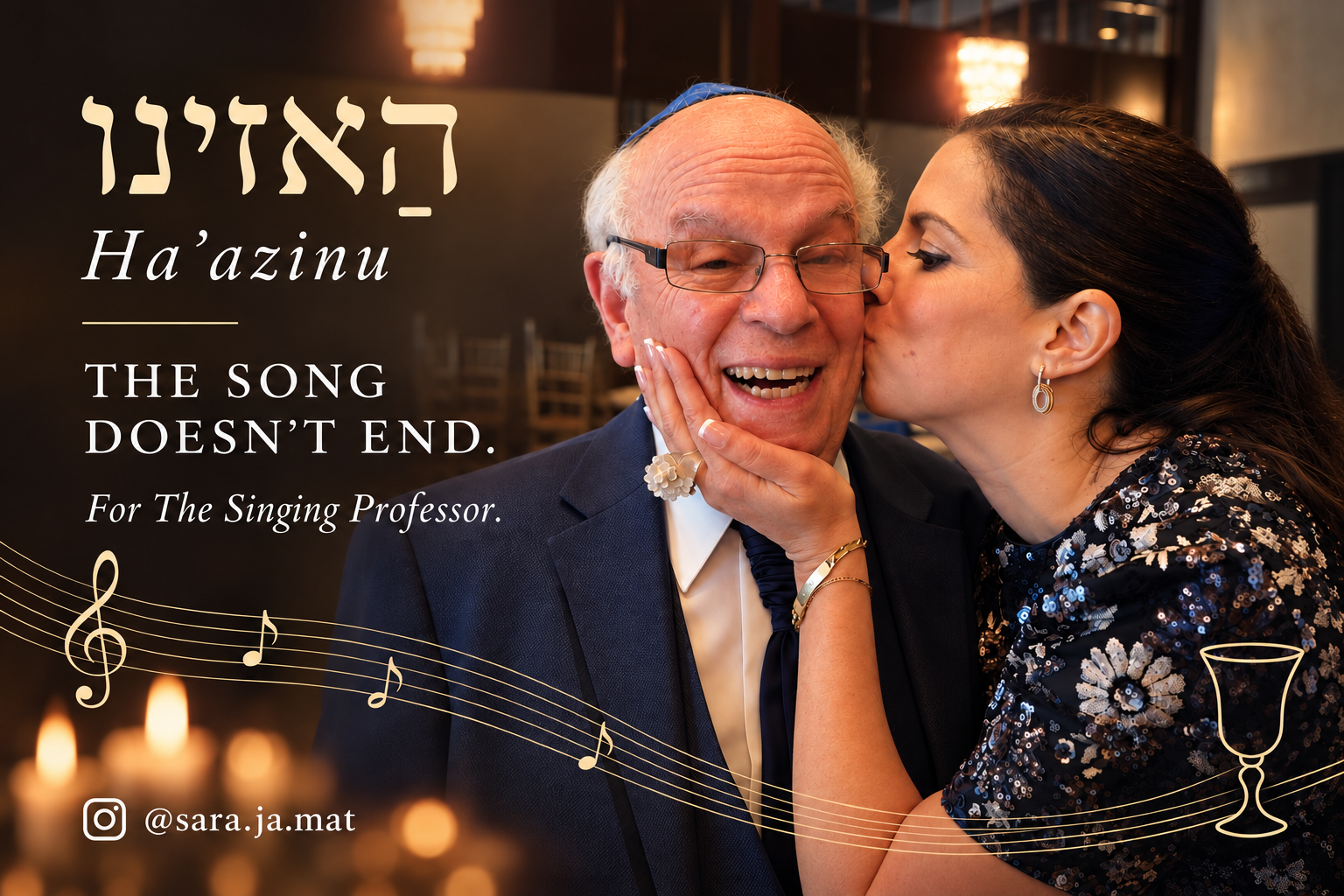
And my father was known as The Singing Professor.
Of course he was.
My father sang everywhere.
He sang at home.
He sang in the car.
He sang walking into a room.
He sang at the Shabbat table.
Sometimes you wanted him to sing.
Sometimes you absolutely did not.
He sang anyway.
And every Friday night, there was Kiddush.
His voice.
The same words.
The same melody.
Week after week. Year after year.
I don’t remember learning that melody.
I simply know it.
Because some things are taught to you, and some things become part of you because you have heard them so many times that eventually you no longer know where the other person’s voice ends and yours begins.
And now I have to figure out how to make Shabbat without hearing his.
I don’t know how.
I don’t know what it will feel like when we stand at the table and the moment comes when my father is supposed to begin Kiddush — and he doesn’t.
There will be a silence where his voice has always been.
Maybe that is why the first word of this week’s parsha is suddenly breaking me open:
Ha’azinu.
Give ear. Listen.
Listen.
I have spent this entire week listening.
Listening to people tell me stories about my father.
People who knew him for decades.
People who met him once.
Students.
Friends.
Neighbors.
People whose names I don’t know telling me that somehow, my father made them feel as though he knew theirs.
That was his gift.
For a man who loved to use his voice, he had an extraordinary ability to make other people feel heard.
He saw people.
He looked for the good in them.
He smiled at them.
He remembered them.
He made the person standing in front of him feel, for those few minutes, like there was nowhere else he needed to be.
Maybe Ha’azinu isn’t only an instruction to listen to words.
Maybe it is an instruction to listen for the human being standing in front of you.
My father did that his entire life.
And there is something else in this parsha that I cannot get away from.
Moshe knows he is going to die.
And what does he leave behind?
A song.
Not because there is nothing left to say.
Perhaps because there are things too large to remain only words.
A song is different.
You can repeat a song after the person who taught it to you is gone.
You can teach it to your children.
They can teach it to theirs.
A voice can disappear from a room and somehow its melody can remain.
And suddenly I understand something about my father that I didn’t understand when he was here.
Maybe he was teaching us his song all along.
Not only the songs he actually sang.
The way he entered a room smiling.
The way he believed another person was worth talking to.
The way he could turn a five-minute trip for coffee into a relationship.
The way he told his story again and again because he believed memory carried responsibility.
The way he looked for goodness.
The way he loved my mother.
The way he loved his daughters.
The way he adored his grandchildren.
The way he lived Jewishly and proudly and loudly.
That was his shirah.
And now it belongs to us.
There is a beautiful cruelty in realizing that the first Shabbat after losing the man we called The Singing Professor is the Shabbat on which we read the song Moshe leaves behind near the end of his life.
I would have preferred a different lesson.
I would prefer my father.
I would prefer him standing at the head of the table, holding the Kiddush cup, singing too loudly and taking too long.
I would give anything to hear it again.
But Judaism does not ask us to pretend that loss doesn’t hurt.
It asks us what we will do with what remains.
And this week Torah answers me with one word:
Ha’azinu.
Listen.
So this Shabbat, when we reach Kiddush and my father’s voice isn’t there, I will listen.
Maybe through the silence, I will hear him anyway.
Because I know the melody.
My children know the melody.
We know the words.
And perhaps that is one of the miracles of a life well lived:
The person can leave this world.
The song does not.
My father, Professor Asher J. Matathias, The Singing Professor, died this week.
But he left us his song.
And now it is our responsibility to keep singing it.
Shabbat Shalom, Dad.
For the first time, I won’t hear you sing Kiddush.
But I promise you…
We will sing.
Related Topics