
Documenting Hidden Jewish Histories and Legacies
The Star That Remains: Mourning Vanished Synagogues This Tisha B’Av
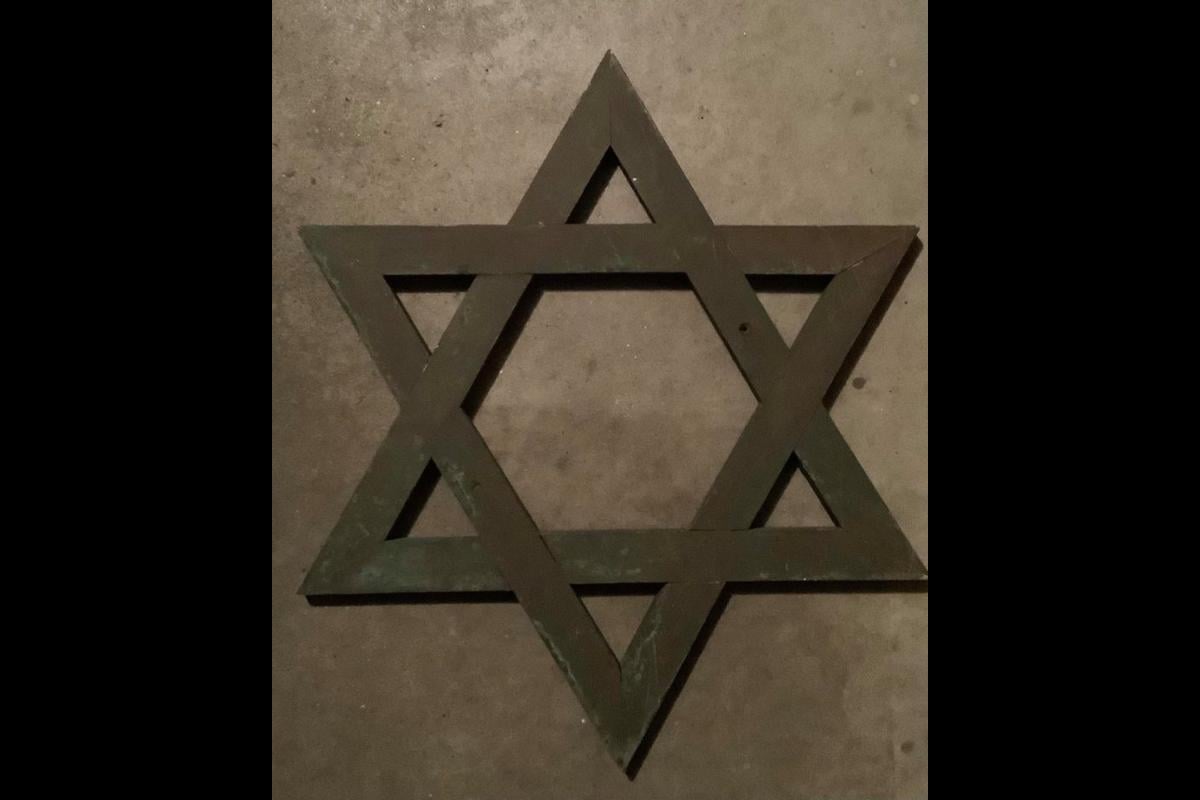
A star that remains. This fragment was salvaged by a community member before New Philadelphia’s Jewish center was torn down in 1968. It remains one of the few physical traces of Jewish life in this corner of Ohio. (Photo courtesy of Columbus Jewish Historical Society.)
A synagogue once stood on Fair Avenue in New Philadelphia, Ohio. For three decades, it held life’s celebrations, life’s sorrows, study, and song. Today, that building is gone—razed in 1968 to make room for a parking lot. All that remains is a Star of David, salvaged before the demolition and kept safe for decades by a local family. Now, through a connection made during my ongoing research into Jewish life in small-town America, this surviving fragment has been entrusted to the Columbus Jewish Historical Society—one of the last physical reminders that Jewish life once pulsed in this Appalachian town.
The synagogue was officially known as Beth El, but more commonly called the Tuscarawas County Jewish Center. It began in 1937, during a time when Jewish communities dotted small towns across Ohio. At its height in the 1950s, nearly one hundred members gathered regularly for religious services, Hebrew school, and community events. Children attended daily classes. A Sisterhood organized card parties, bake sales, and a popular nursery school. Holocaust survivors taught interfaith lessons, and synagogue members lit Hanukkah lights in a public park beside a Christmas tree. The congregation was active in civic life, contributing to the founding of the Little Theatre, the local hospital, and other public health services. For a time, the Jewish Center was a vital and visible part of Tuscarawas County.
By the late 1960s, though, the congregation had dwindled. Many families moved away. The rabbi took another position. The last bar mitzvah was held in 1965. In 1968, the building was sold and demolished. By 1975, the legal entity that once represented Jewish communal life in New Philadelphia was formally dissolved.
The story of this community is just one chapter in a much larger elegy. Other small towns in the region—Alliance, East Liverpool, Steubenville, Zanesville, and my own hometown of Lancaster—have seen their Jewish congregations shuttered, sold, or demolished. Some have been gone so long, their very names are forgotten—until someone goes looking.
Neighboring states have seen similar losses. Weirton, West Virginia’s synagogue closed in 1990. The building was sold to a nonprofit that hoped to turn it into a soup kitchen—but repairs were never made, and after several harsh winters, the roof collapsed. Amid the wreckage, one stained-glass window remained intact. It bore the words of Isaiah 56:7: “For my house shall be called a house of prayer for all people.” That window is now preserved at the Weirton Area Museum & Cultural Center—the last surviving piece of the town’s synagogue.
In nearby Steubenville, two older synagogue buildings now stand in disrepair, the Star of David still visible—but damaged—on one. The town’s last synagogue, dedicated in 1966, is now a senior center. When a small-town synagogue disappears, it often means the loss of a community’s only organized non-Christian religious presence. It also marks the loss of a particular kind of pluralism that once quietly thrived in America’s smaller places.
I mourn not only the loss of Jewish visibility, but also the Judaism that lived inside these synagogues—the kind practiced by everyday people in places often overlooked by larger Jewish communities. In cities, I often meet Jews who are surprised to learn that Jewish life once flourished in towns like New Philadelphia or Steubenville. Some even doubt that a Jew could come from such a place.
But Jewish life was lived fully in these communities—across a range of observance, from Orthodox to Reform. Everyone had a role to play, and compromise wasn’t just a value—it was a necessity. People prayed together even when they didn’t agree. They built bridges with their neighbors. Who now, in these small towns, will invite Methodist children into a sukkah? Will Lutheran Sunday School students still learn about Judaism from a local rabbi—or only from books?
These communities weren’t perfect. But antisemitism did not cause their collapse, as some assume. Their decline mirrors broader American trends: the loss of manufacturing jobs, the migration of young people to cities, and the aging of religious and civic institutions. Often, it wasn’t a failure of recruitment. It was the absence of people.
For generations, Tisha B’Av has been a time of mourning. We remember the destruction of the Temples—and the tragedies that followed. But I believe this day also invites us to grieve the losses that are less well known: sanctuaries lost to fire, to economic shifts, or to slow forgetting. We mourn not only the history that’s been lost—but the understanding that disappeared with it.
The Star of David from New Philadelphia is no longer attached to a building. But it endures. It reminds us that memory—and the lessons that live within it—can be preserved, if we are willing to do the work. It tells us that stories matter—especially when they are from places where many now assume Jewish life never existed.
This Tisha B’Av, I mourn what we have lost in so many small towns across eastern Ohio and beyond. I remember the sanctuaries that once stood. I remember the people who built them—and I carry forward their legacy of hospitality, charity, and Jewish pride.
To explore more of these stories from overlooked towns, visit my personal archive, where I share histories from places like New Philadelphia, Weirton, and Lancaster, Ohio.
Related Topics
Related Posts