
The Stench of Judicial Overhaul Propaganda
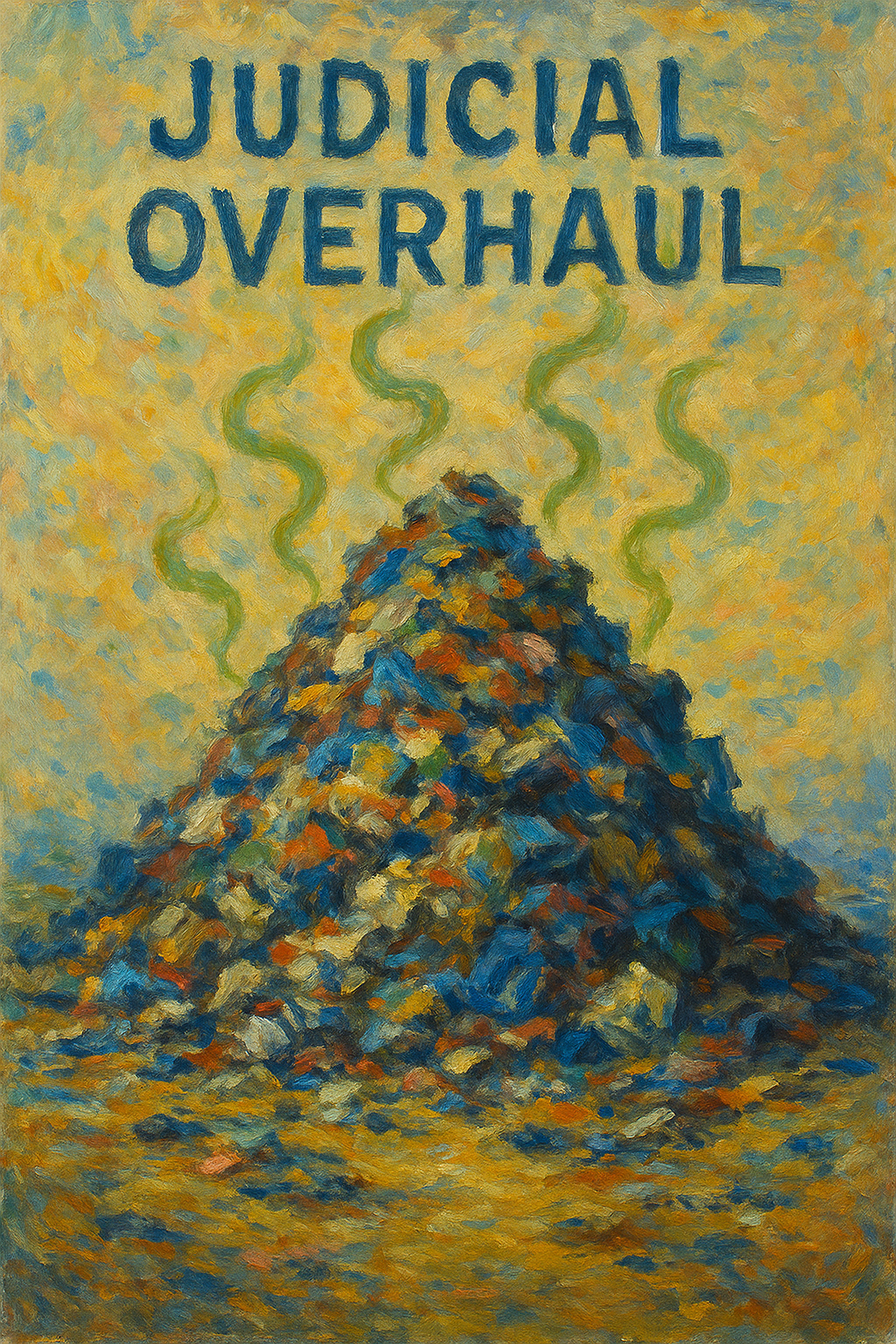
The campaign to “restore the will of the people” isn’t about democracy. It’s about capturing the courts for one camp and keeping them there.
The sales pitch for Israel’s judicial overhaul has always sounded almost innocent:
We just want the courts to reflect the will of the people.
It sounds democratic. It’s also a lie.
The real project is not to make the courts reflect the people in any broad, pluralistic sense. It is to make the courts reflect one particular camp: a tight ideological bloc that is
- for permanent right–religious rule,
- for unfettered settlement expansion and creeping annexation,
- for weakening unions, regulation, and the social safety net,
- and firmly against robust minority rights and strong judicial review that might interfere.
That camp has a strategy, a funding stream, a network of institutions, and a political salesman: Justice Minister Yariv Levin.
The real authors of this “people’s revolution”
Behind the slogans stands a very specific ecosystem:
- Kohelet Policy Forum – the Jerusalem think tank that spent a decade attacking “judicial activism” and producing blueprints for coalition control of judicial appointments, an override clause, limits on judicial review, and the gutting of independent legal advisers.
- Israel Law and Liberty Forum – a project of the Tikvah Fund, modeled on the American Federalist Society, grooming a cohort of conservative jurists committed to shifting power from courts to politicians.
- The Tikvah Fund – a US-based conservative Jewish foundation bankrolling a web of Israeli projects that share a nationalist, anti-liberal legal vision.
- Misgav Institute for National Security and Zionist Strategy – a newer outfit with overlapping personnel and agenda, widely seen as a continuation or rebranding of the same project.
Investigative reporting has traced much of Kohelet’s funding to a tiny circle of ultra-wealthy American donors. One of them, Arthur Dantchik, reportedly covered the lion’s share of Kohelet’s budget before publicly cutting off support in 2023, citing concerns for Israeli democracy. This is not a spontaneous uprising of “the people.” It is a long-term, well-funded campaign by a narrow ideological elite.
Yariv Levin, propagandist in chief
At the political level, the face of this project is Justice Minister Yariv Levin.
For years, Levin has railed against Aharon Barak’s “constitutional revolution,” accusing the Supreme Court of stealing powers from the Knesset and blocking the popular will. When the current government took power, he finally got his dream job – and within days unveiled the most sweeping judicial power grab in Israel’s history.
Levin’s package was not a minor adjustment. It aimed to give the coalition:
- control over judicial appointments,
- an override clause with a bare 61 MKs,
- near-immunity for Basic Laws, however casually enacted,
- and political control over the attorney general and ministry legal advisers.
This was not scribbled in the margins of a coalition agreement. Levin’s long-term relationship with the ideological network behind the overhaul is well documented. Kohelet’s legal architect Dr. Aviad Bakshi and others met with him repeatedly while the plan was being shaped, including hours before it was unveiled. Levin has since pushed to elevate Kohelet-linked jurists to the very Court they have spent years attacking.
War in Gaza, unprecedented national trauma, mass reservist protests – none of that has shaken his holy grail. For Levin, subordinating the judiciary to the coalition is not a bargaining chip. It is the mission.
For which “people,” exactly?
The overhaul’s backers insist they are simply aligning the Court with “the will of the people.” But in practice, “the people” in this story means:
- the right–religious bloc they assume will rule indefinitely,
- the settlement and annexation camp that wants legal barriers erased,
- economic libertarians and anti-union activists who see the Court and legal bureaucracy as obstacles.
Those pointedly not included in this definition of “the people” are:
- Palestinian citizens of Israel,
- refugees and asylum seekers,
- secular and liberal Jews who rely on the Court for protection from religious coercion,
- women, LGBTQ Israelis, and other minorities whose key gains have come through legal challenges.
This is not about making the Court representative of Israel’s human mosaic. It is about making the Court safe for one ideological mosaic – and removing the only serious check on that camp’s ability to govern without interference.
The dog that never barks: a real constitution
There is one especially telling omission in all the rhetoric about “restoring democracy” and “balancing the branches”:
Nowhere in the overhaul program is there a serious call for a formal constitution.
If this project were truly about balance, stability, and representation, the obvious move would be to:
- enshrine a clear bill of rights,
- define and limit the powers of each branch,
- and do so through a broad, cross-camp process that any future government would have to respect.
That is what real constitutional reform looks like: rules that bind everyone, including the camp you personally favor.
But the bodies driving this agenda show no real interest in that. Instead, they focus narrowly on who appoints judges and how easy it is to override them, without tying anyone’s hands with entrenched rights or procedures.
Why? Because they do not actually oppose judicial power. They oppose judicial power in the wrong hands.
They are perfectly happy for the Court to remain strong, decisive, and far-reaching – as long as it is their judges, appointed by their coalition, reading vague Basic Laws through their ideological lens. What they cannot abide is an independent judiciary that might say “no” to them.
In plain language:
They don’t hate a powerful Court.
They hate a powerful Court that isn’t theirs.
What if “the people” choose someone else?
Here is the simplest test of whether this is about democracy or entrenchment:
Would these same forces support the overhaul if a future Labor or centrist government took power, claiming to represent “the will of the people,” and then used the new system to appoint its own judges, neuter the attorney general, and insulate itself from robust review?
No serious person believes they would.
If a moderate government tried to “align” the judiciary with its values, the very same think tanks and politicians would suddenly rediscover the sacred importance of checks and balances, judicial independence, and strong legal guardians. They would run to what remains of the Supreme Court and beg it to restrain the “dangerous radicalism” of the new majority.
That tells you everything you need to know. This is not a neutral constitutional design that one could live with under any government. It is a one-way ratchet: power flows from the Court to the current camp, and the system is engineered to make reversing that shift far more difficult.
Populism as a wrapper for elite capture
Israel absolutely needs a serious conversation about the Court, the Basic Laws, and the balance between elected and unelected institutions. A real constitutional process would be open, inclusive, and aimed at creating durable rules that restrain every coalition, left or right, and protect individuals and minorities from all of them.
The judicial overhaul is the opposite.
It is:
- A project of a small ideological elite in think tanks and philanthropic networks, many funded from abroad;
- A tool for a political elite to strip away the last serious constraints on its power;
- A propaganda campaign that uses “the will of the people” as perfume to disguise a straightforward attempt to capture the courts.
If its authors were honest, they would say:
“We want to capture the judiciary, not reform it.
We want our camp to rule with minimal legal interference.
We will tolerate a powerful Court only when it is our Court.”
Instead, they denounce anyone who defends judicial independence or calls for a real constitution as anti-democratic.
What betrays the people is not the demand for checks and balances.
What betrays the people is handing the keys of the justice system to a single camp and calling that democracy.
That is the true stench of the judicial overhaul.