Bridging faith. Defending truth. Confronting hate
The Theological Problem at the Heart of Iran’s Islamic Republic
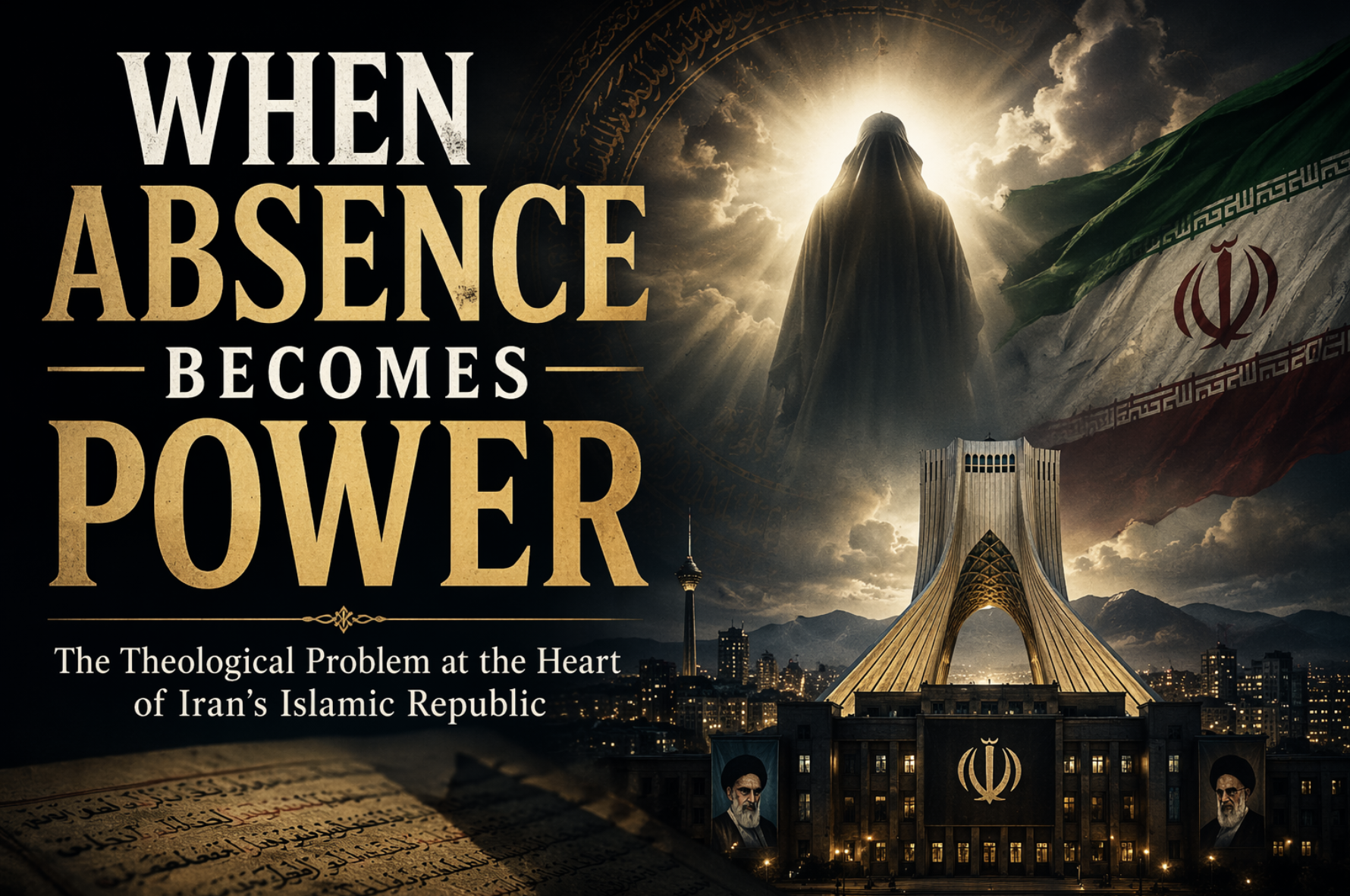
Image created from ChatGPT by Tim Orr
Eventually, referring to the Islamic Republic as a complicated political system in and of itself misses the point. You can analyze its strategy, its regional behavior, and its internal factions, but that only gets you so far. At the center of the system is a claim about authority that is not only political; it is theological, and it shapes how the regime actually functions. If you leave that out, you’re not explaining the system; you’re describing what’s on the surface.
Everything turns on the problem of occultation. In Twelver Shiʿi thought, the Imam hasn’t disappeared in the ordinary sense. He’s still there, but he’s not available. His authority hasn’t lapsed, but no one can exercise it the way he could. That leaves you in a bind. The law is still supposed to govern, but the one person who has the right to enforce it isn’t present. So you’re stuck between two things that don’t quite fit together. You can’t abandon the law, but you also can’t straightforwardly claim that someone else has taken the Imam’s place.
This is where wilāyat al-faqīh comes in. Ruhollah Khomeini’s move was to say that the jurist has to take responsibility for maintaining the system by protecting the law, enforcing it, holding things together. On one level, that sounds like a limited, even cautious claim. The jurist is not the Imam. Everyone says that. The distinction is built into the theory.
But when you look at how the system actually operates, that distinction doesn’t hold up very well. Once authority is built into institutions—courts, security forces, oversight bodies—it stops being theoretical. It becomes something real and active. It makes decisions, enforces rules, and shapes outcomes. And over time, it settles into something stable. Scholars like Said Amir Arjomand and Asghar Schirazi have shown how this works in practice. The Supreme Leader is not just offering guidance. He governs. The Guardian Council does not just interpret the system. It determines who is even allowed to take part in it. Whatever limits the theory is supposed to impose, they are hard to see in how the system actually functions. It operates as an established authority, not a restrained or temporary one.
That is where, from a Christian perspective, the concern becomes clear. Christianity has always insisted on keeping a firm line between God’s authority and human authority, and it does that for a reason. Human beings cannot carry divine authority without distorting it. That is why all human rule is meant to be limited and accountable, which is why its never supposed to present itself as ultimate. When a political system begins to act as if it has that kind of final legitimacy, it has already crossed into dangerous ground.
What makes this more serious in Iran is that this is all being done in the name of God. Authority is not just exercised—it is given a sacred frame. That changes how the system holds together. Opposition is not just disagreement because it can be treated as defiance of a moral order. And once you get there, it becomes much harder to challenge power without also being cast as opposing something higher. That is how systems protect themselves. They stop being just political.
There is an irony here. Occultation is supposed to be limiting. It says that the highest authority is not accessible, so no one can really claim it. But occultation does not end up being limiting at all. It does’t hold the system back. It creates room for the system to grow so that occultation doesn’t create a void. The void is filled, sometimes cautiously and circuitously, but enough so that the system can flourish. The tension remains, but as just that: a tension, not an impasse. This is built into the operation of the state.
This same dynamic can be seen in the Islamic Republic’s approach to sacrifice as well. The system is often described as having a preference for death over life, but that is too reductive. It has figured out how to make suffering productive. So much hinges on the experience of the Iran-Iraq War, which made sacrifice and endurance central to the self-conception of the regime. That did not dissipate after the war. It endured, and became integral. Endurance becomes weighty; it becomes more than simply a necessity. It becomes difficult to write off the hardship as a price paid; it becomes a justification in itself. When that happens, the price is not simply counted as a loss.
It becomes part of the logic that sustains the system.
None of this means Iran is uniquely corrupt or that other systems are immune to similar problems. Any system can start to overreach, especially when it ties itself to something ultimate. But in this case, the theological claim is not secondary. It is built in from the beginning. The system does not just use religious language. It depends on it.
This is the core issue. The entity professes to operate under God’s authority, but it operates in a way that almost levels divine and human authority; it does not explicitly claim to represent that authority fully, but the way it operates makes that distinction nearly meaningless. Therefore, it is not simply a matter of policy or strategy; it is a theological problem: what was meant to be a doctrine limiting human authority is used to aggrandize it, and when you have that kind of distortion, it is not accidental; it is part of the system.
Related Topics
Related Posts