A Mermaid in Jerusalem
The Torah is near, but never simple
I was late to my rabbis’ and comedians’ Torah study session on Sunday.
And not like a whimsical fifteen-minutes-late, where you sweep in with floaty scarves and jangling beads and a dramatic apology. No — I burst through the doors of our usual café like literally one minute after everyone had left.
So I sat outside in the warm Elul sun, texting the group that I was there for a cup of coffee if anyone wanted to join. Five minutes later, my friend Rabbi Barry Leff appeared with his laptop and notes.
(He is an excellent note taker.)
“We talked about ovens,” he said.
“Wait, what?”
And then he told me the story from Bava Metzia 59b — the Oven of Achnai, when the rabbis argued about whether a strange oven could become impure. Rabbi Eliezer insisted he was right, and miracles came to prove him: a tree uprooted, a stream reversed, even a heavenly voice thundered that the law followed him. But the other rabbis stood firm. Rabbi Yehoshua rose and said: “It is not in heaven.” And with that, the Torah was declared to belong to human beings, to our arguments and our wrestlings, not to voices from above. God smiled and said: “My children have bested Me.”
And the very fact that I’m studying this now is proof that Torah is meant to be accessible.
I don’t come from a strong textual background. I stumble over the language — even in English. I lean on others to explain the fine points. And yet I’ve been welcomed into this chevrusa. One of the rabbis even came back after the class ended, sat down beside me, and shared the notes so I wouldn’t miss out.
If Torah were locked in heaven, or across the sea, I’d never touch it. But here it is — near enough for me to argue with, near enough for me to love.
The Torah IS he King / Queen in the fields we sing about during Elul.
And davka this week in Nitzavim, the Torah insists: “It is not in heaven… it is not across the sea… the word is very near to you, in your mouth and in your heart, so that you may do it.”
Near, yes — but never simple.
Torah itself is a book of contradictions. One verse calls us to love the stranger, another to wipe out Amalek. It commands us to bless and to curse, to sanctify kingship and to restrain kings. It is not neat; it is tangled, paradoxical, alive.
And maybe that’s the point. Jacob wrestled through the night until dawn, wounded and blessed all at once, and from that struggle came the name Israel. To be Israel is to wrestle — with God, with one another, with ourselves — and still to hold fast.
The rabbis captured this in a midrash about creation itself. Before making humanity, God convened the angels for a vote. Peace said: Do not create them — they will bring conflict. Justice said: Create them — they will build fairness. Mercy said: Create them — they will love and forgive. And Truth said: Do not create them — they will lie, deceive, and twist reality.
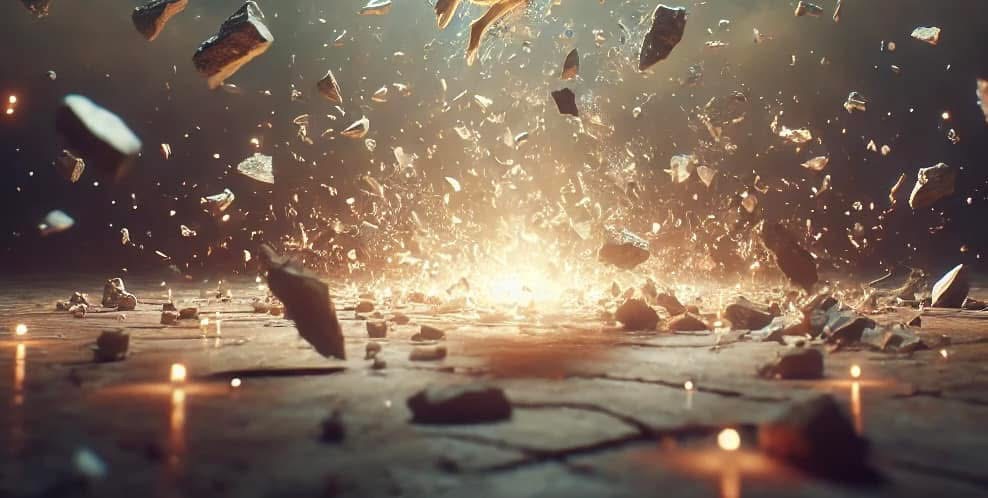
So God did something unexpected. God cast Truth down to the earth, shattering it into countless shards. Humanity would be born, but no one person would hold the whole. Each of us carries only a fragment — jagged, incomplete. Sometimes it cuts us, sometimes it catches the light just so. Alone, it is never enough. Together, perhaps, the pieces reveal something larger.
And I think of this when I look at the news — at the way lies metastasize, at the way rage festers, at the way another man with a microphone ends up gunned down in the street. Charlie Kirk’s assassination isn’t a victory for truth, it’s another shard of violence added to the pile. His words may have wounded, but bullets don’t heal. They only leave more fragments for us to trip over, more broken glass for our children to cut their feet on.
That’s the brilliance — and the terror — of the design: we were created incomplete, so that we would have to seek completion in one another. If Truth had remained whole, if a single person could hold it all, there would be no need for others. But instead, God ensured that unity would be a choice, not a given — a wrestle, not a miracle.
And this connects back to Torah’s rhythm in these weeks. In Ki Tavo, the words were to be inscribed clearly, in seventy languages, so that all could see. In Shoftim, even kings were commanded to write their own scrolls, to remember humility. In Nitzavim, Torah insists it is near — not hidden in heaven, not locked across the sea, but here, waiting to be spoken, wrestled with, lived. And in Bava Metzia, the rabbis dramatized that same truth: it is not miracles or heavenly decrees that make Torah alive, but our willingness to argue, to listen, to hold our shards of truth together.
The Torah is not neat, and neither are we. But it is near — in the hospital where a nurse steadies a frightened child, in the shuk where voices rise in many languages, in the laughter that breaks through after a night of sirens, in the argument across a table that still ends in shared bread.
And perhaps the Torah itself is a love story, told in fragments. It begins with the breath of creation, carries us through slavery and Sinai, exile and return, and it continues here, now, in Jerusalem and across the land. Like any great love, it is full of conflict and reconciliation, heartbreak and renewal, absence and return.
So here we are, each of us holding a shard of Truth. We can keep it clutched tight, pretending it is the whole. Or we can bring it forward, jagged edges and all, and place it beside another’s. Together, in the collisions and reflections, we might see more of the picture, more of the love story, more of what God hoped for us from the beginning.
The Torah is not far. It is here — in our mouths, in our hearts, in our fragments of truth and our grappling for wholeness. And once again, it asks us: Choose life. And choose to engage and wrestle with it.
Related Topics
Related Posts