
Crisis Communicator, Droll Dragon
How Podcasts Became the Same Club They Replaced
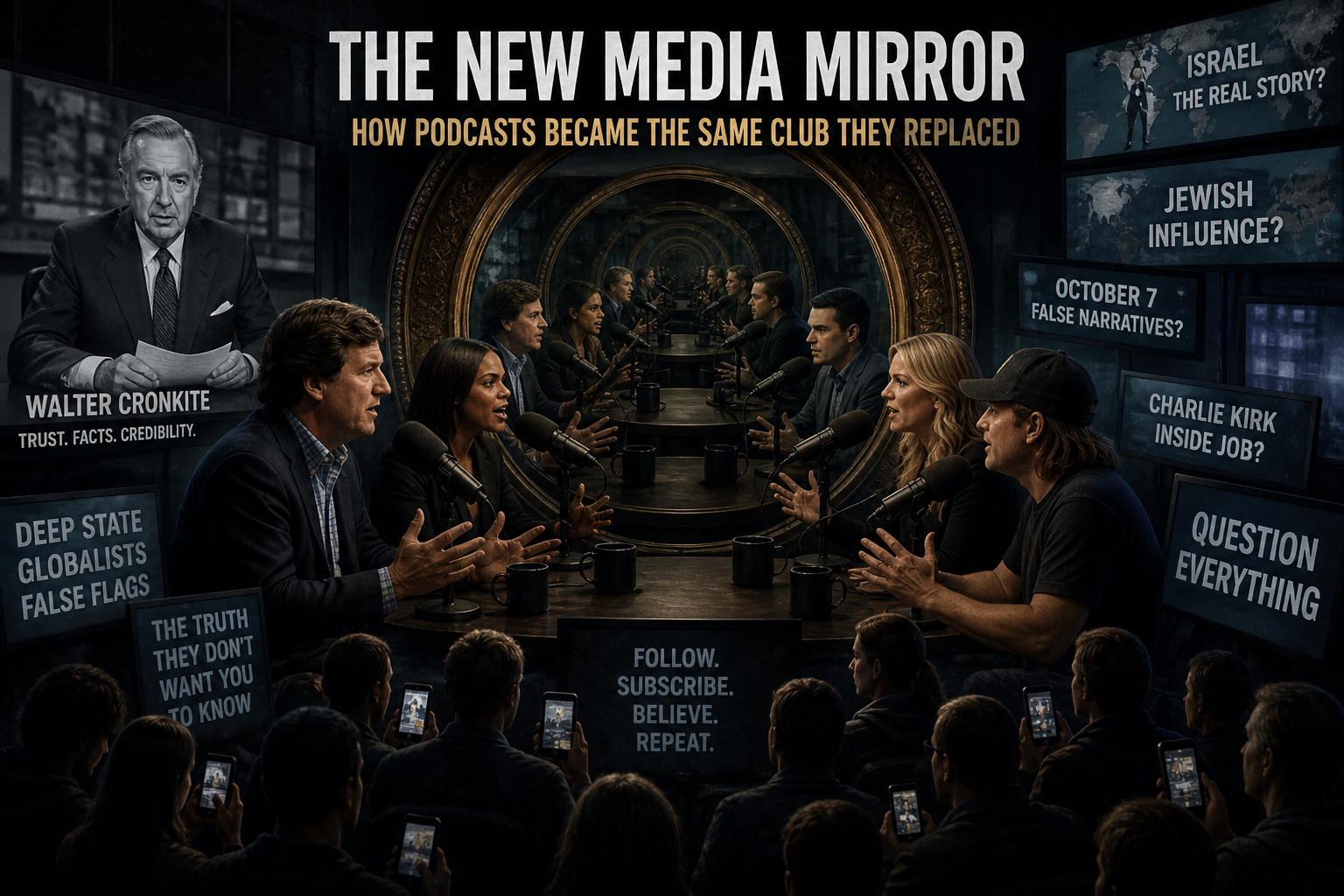
(Image courtesy of author)
The New Media Mirror
I pay attention to media for a living. In crisis work, there is no luxury of ignoring what people are saying or where narratives are forming. My clients live inside those narratives whether they like it or not. I watch, read, and listen constantly because understanding the environment matters as much as understanding the facts.
That includes podcasts.
Over the last few years, I have spent more time than I would like to admit listening to them, not for entertainment, even though they are entertaining, but to understand how ideas are shaped and spread. What people believe does not come out of nowhere. It is influenced, reinforced, and repeated until it feels like common sense.
Nowhere has that been clearer than in how Israel has been discussed since October 7, 2023.
I have written about Israel for years, including my views, my support, and my disagreements when I have them. The current moment is different. It is not just criticism. It is inversion.
Hamas, Hezbollah, and even the Ayatollahs of Iran are framed, implicitly or explicitly, as resistance fighters. Israel, and at times America, is cast not simply as flawed, but as the villain, aggressive, colonial, and indiscriminate. Complexity disappears. Context disappears. What remains is a simplified story that is easy to consume and easy to repeat.
This narrative is not limited to obscure corners or progressive mainstream news ideologies. It comes from some of the largest voices in the podcast space.
I have listened to Tucker Carlson reduce Israel to something crude and unrecognizable. I have heard long conversations from Candace Owens and Theo Von that raise questions about influence, loyalty, and power while rarely offering grounded answers.
I keep listening, not because I agree, but because understanding what people are hearing matters. Younger audiences are forming their views in real time. Those views shape attitudes, policy debates, and increasingly the comfort level of Jews in public life across the United States, Europe, and beyond.
This leads to the larger point.
New media built its brand on one simple idea: We Are Not Them.
Not the networks, not the legacy papers, not the pundits repeating the same lines. Podcasts and independent platforms positioned themselves as the antidote, unfiltered, unafraid, and unbothered by the pressures that shaped traditional news.
That outsider identity made them powerful. It also makes what is happening now worth paying attention to.
Podcasts did not rise by accident. They filled a vacuum.
For years, mainstream media drifted. It became predictable, partisan, and often more invested in narrative than in reporting. Viewers, especially younger ones, lost trust. The old model, once defined by figures like Walter Cronkite, Ted Koppel, and Mike Wallace, where credibility itself was the product, gave way to something louder, faster, and more ideological.
The same forces that broke trust in traditional media, overreach, self-referential coverage, and narrative over substance, are now showing up in the platforms that claimed to replace it.
What was supposed to expand the conversation is now narrowing it.
Instead of bringing in new voices, original reporting, or ordinary people with real-world experience, many of the largest podcasts operate inside a closed circuit. The same names rotate from show to show. The same arguments are made, challenged, reframed, and recycled. One appearance feeds another. One controversy becomes content for multiple episodes across multiple platforms.
It is an ecosystem talking to itself.
The biggest names in podcasting are no longer expanding the conversation. They are recycling it.
Tucker Carlson appears with Theo Von. Candace Owens builds segments around disputes with Ben Shapiro. Shapiro focuses on Carlson, Von, Owens, and Kelly. Megyn Kelly weighs in on those same disputes, and on occasion, Joe Rogan chimes in.
They respond to each other, then react again.
This is not journalism. It is a loop.
The subject is no longer the world – it is each other. The tone reflects that shift. Confidence without restraint. Certainty without accountability. A self-righteousness that assumes not only that they are right, but that they are the only ones asking the real questions.
What they hope we don’t get is that asking questions is not the same as providing insight.
What repeats across these platforms are questions that raise suspicion, challenge motives, and chip away at established facts without resolution. The audience is left with doubt rather than understanding, with a sense that something is wrong but no clarity about what is true.
This is not accidental. It is structural.
Controversy drives engagement.
Engagement drives growth.
Growth rewards the most provocative and most certain voices, especially those willing to keep narratives open rather than resolve them with facts.
The loop continues.
Podcasters host podcasters. They respond to, critique, and elevate each other. In doing so, they create the impression that their conversation is the conversation.
It is not.
It is a performance of importance, sustained by audience size and reinforced by repetition.
On most days, this is not reporting. It is a reaction layered with speculation and, at times, conspiracy. It is not about informing the public. It is about maintaining an ecosystem.
When that ecosystem turns to something as serious as Israel, or even events like the murder of Charlie Kirk, and reduces complex realities to provocative talking points, it does more than misinform. It shapes perception in ways that are difficult to unwind.
This is not a coordinated conspiracy. It does not need to be. It is a business model. Like the media system it replaced, it works until people recognize what they are consuming.
We know that the demand has not changed. People do not want endless questions.
They want clarity!
Related Topics