
A Midwestern Jewish Politico
The U.S. and Israel Just Proved They’re Not Serious About Peace
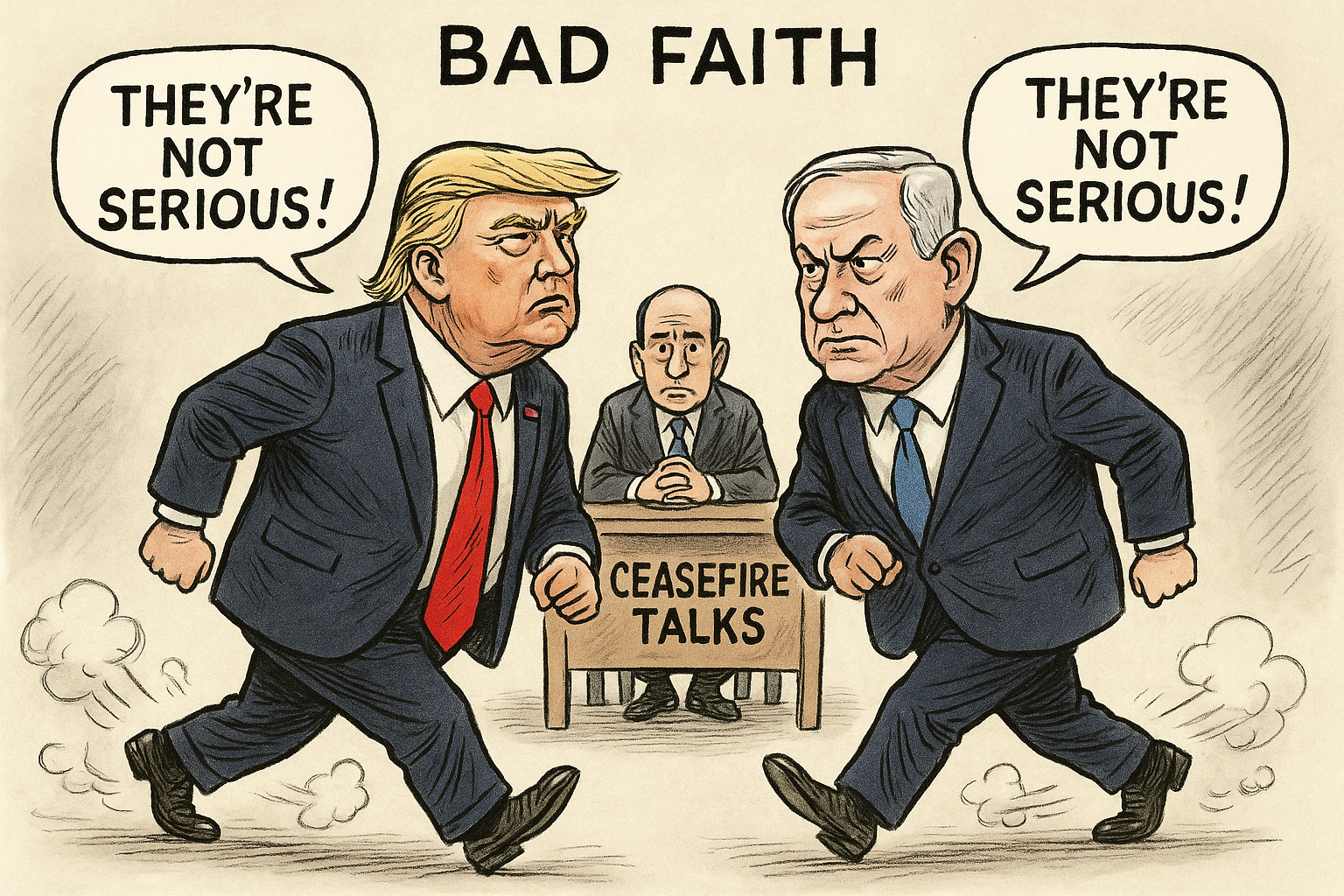
Well, the masks are off. Again.
For months, we’ve been told — in solemn tones by U.S. diplomats and shouted from Israeli government podiums — that they’re doing everything they can to “bring the hostages home” and “end this war.” That if only Hamas would agree to a ceasefire, if only they’d stop using civilians as shields, if only the militants would release the kidnapped — then, and only then, Israel and its faithful sidekick Washington would finally do the right thing.
And yet… here we are. The U.S. and Israel just backed out of ceasefire negotiations. They blinked. And in doing so, they’ve made it painfully clear who’s actually playing games — and who’s paying the price.
Let’s be brutally honest: this whole charade has never really been about peace. It’s been about leverage. Optics. Spinning escalation as “security” and political convenience as “moral clarity.” Israel, led by an increasingly far-right and domestically embattled government, and the U.S., terrified of alienating donors or voters, have both revealed they’re not just ambivalent about ending the war — they’re afraid of it.
Why? Because a real ceasefire — one that involves mutual concessions, the release of hostages, a halt to bombing campaigns, and actual international accountability — would mean stepping off the high horse. It would mean recognizing the legitimacy of others at the table. And for Netanyahu and Trump alike, that’s apparently more dangerous than letting the violence drag on.
Let’s talk hostages. If “bring them home” is the mission, you don’t walk away from a deal that does exactly that. You don’t scuttle talks just because the terms weren’t drafted entirely on your letterhead. The lives of those hostages — Israeli, American, and others — should not be PR assets or bargaining chips to be shuffled when the headlines get too hot. Yet that’s exactly what just happened. Instead of grinding out the hard, imperfect, necessary diplomacy, the U.S. and Israel pulled the plug.
And yes, Hamas is a deeply flawed and violent actor. This isn’t about absolving anyone. But what’s crystal clear is this: the people with the power to stop the bombing, to let aid in, and to secure hostages’ release, chose not to. They’re choosing to prolong the war — and the suffering — while pretending their hands are tied.
Let’s dispense with the spin: if Hamas walked away from talks, we’d see wall-to-wall coverage painting them as irredeemable terrorists. But when the U.S. and Israel hit pause? Suddenly it’s “complicated.” Suddenly it’s about “security concerns” or “not the right moment.” Translation: we prefer the current stalemate — one where we dictate the terms, ignore civilian consequences, and delay any outcome that might involve compromise.
The Trump administration, to its credit, talks a good game. They say they want to reduce civilian casualties, they say they’re urging restraint. But at the end of the day, they continue to greenlight arms shipments, block international resolutions, and now — walk away from the very talks they claimed to be facilitating. It’s classic diplomatic doublethink: we support peace, just not the kind that requires actual accountability or shared control.
Meanwhile, Gaza remains devastated. Not because one side is innocent and the other evil, but because modern warfare in densely populated areas always results in disproportionate civilian impact. That’s not an excuse — it’s a reality. And the longer this goes on, the more innocent people — children, families, people who just want a life — will suffer for it.
What’s even more galling is how predictable this all is. The moment ceasefire negotiations get serious, the excuses start rolling in. “It’s too soon.” “The terms are unrealistic.” “We can’t reward bad behavior.” All of which might sound reasonable — until you realize it’s the exact same script that’s been used to stall every previous attempt at de-escalation.
The result? More bodies. More destruction. More pain. And fewer chances at long-term security for anyone — Israeli or Palestinian. Walking away from a deal that could free hostages and save lives isn’t just a missed opportunity. It’s a decision. A cold, calculated one.
The idea that the U.S. and Israel are “good-faith actors” has always relied on selective memory and a lot of PR. But even that facade is cracking now. Their actions — not their statements — are telling us who they really are. And what they’re telling us is this: they’re more comfortable with endless war than with a ceasefire that demands compromise.
So spare us the lectures about “shared values” and “defending democracy.” If those values don’t include the courage to negotiate, the integrity to compromise, and the will to prevent further bloodshed, then what exactly are we defending?
This isn’t about blame for its own sake. It’s about consequences. Real people are dying while world powers posture. Hostages are languishing in captivity while politicians hold out for better headlines. Peace has become a political liability — and that’s a damning reflection of the leadership we’re dealing with.
They blinked. And now, the rest of us — especially those on the ground — are left to live with what happens next.
Related Topics
Related Posts