
The UK’s decision on Palestine: Flawed beyond recognition
After weeks of speculation, the first reports emerged on Tuesday morning that the UK Government was set to come out and formally announce that it would give conditional recognition to a Palestinian state.
Given just how many statements the UK Government has made about the numerous basic conditions that must exist before a state of Palestine is recognized, and how at pains Prime Minister Sir Keir Starmer has been to stress that this would only be an advanced step on a roadmap to peace, I wager that absolutely none of us – skin in the game or well outside of it – could have predicted that those conditions were actually going to be placed on Israel.
It is not just the cardinal political sin of announcing recognition of a state without even saying how it will meet the legal requirements for statehood. The lack of any attempt to articulate even the borders or the single governing entity of a future Palestinian state – both basic legal ingredients under the Montevideo Convention on the Rights and Duties of States 1933 – was always the main concern over any prospect of France and the UK announcing recognition of Palestine under pressure.
Neither is it the basic moral objection (or at least, what should be a basic moral objection) that you cannot recognize a state while its territories are currently governed by a group your own country calls terrorists, and by a hideously corrupt entity that, to this day, still pays the salaries of prisoners that your own country calls terrorists.
And nor is it that recognition undermines the UK Government’s repeated and sober insistence, especially these past few weeks, that recognizing Palestine should only be deployed at the time of greatest impact.
It is the fact that Sir Keir, with Tuesday’s announcement, has driven a coach and horses through all these things in a way that has managed to shock and infuriate absolutely everybody concerned, all at the same time. The decision is so elementally flawed that Israelis, Palestinians and even uninterested observers simply cannot understand, as a matter of pure objectivity, how it has been reached.
France’s recognition
For all its own flaws, France’s highly controversial decision to recognize Palestine last week at least acknowledged the most obvious and enduring of problems with achieving a two state solution. This was that – war in Gaza or not, settlements and violence in the West Bank or not, agreeable Israeli government or not – a Palestinian state could not simply be willed into existence without (at least) root-and-branch reforms to its governing entities.
President Emmanuel Macron at least remained cognizant of these universal truths – albeit that he reconciled them by accepting written commitments from the Palestinian Authority’s Mahmoud Abbas and reaffirming that Hamas must disarm and leave Gaza.
And so, as rumors began to surface of the UK’s own imminent decision to recognize, it was widely expected that Sir Keir would follow France with the same or substantially similar conditions; not least because these were conditions that had been stressed for years on end by his own government and its predecessors.
The UK’s decision
What did we get instead? A decision that, for all of the controversy accompanying France’s move, appears to go even further than the French had managed. No conditions on the Palestinian Authority. None whatsoever on Hamas. And all of them, instead, on Israel.
If just this broad outline of the UK’s announcement were to have been leaked out a few hours beforehand, without doubt the backlash would have been as strong, albeit that it would have come more from one side than the other.
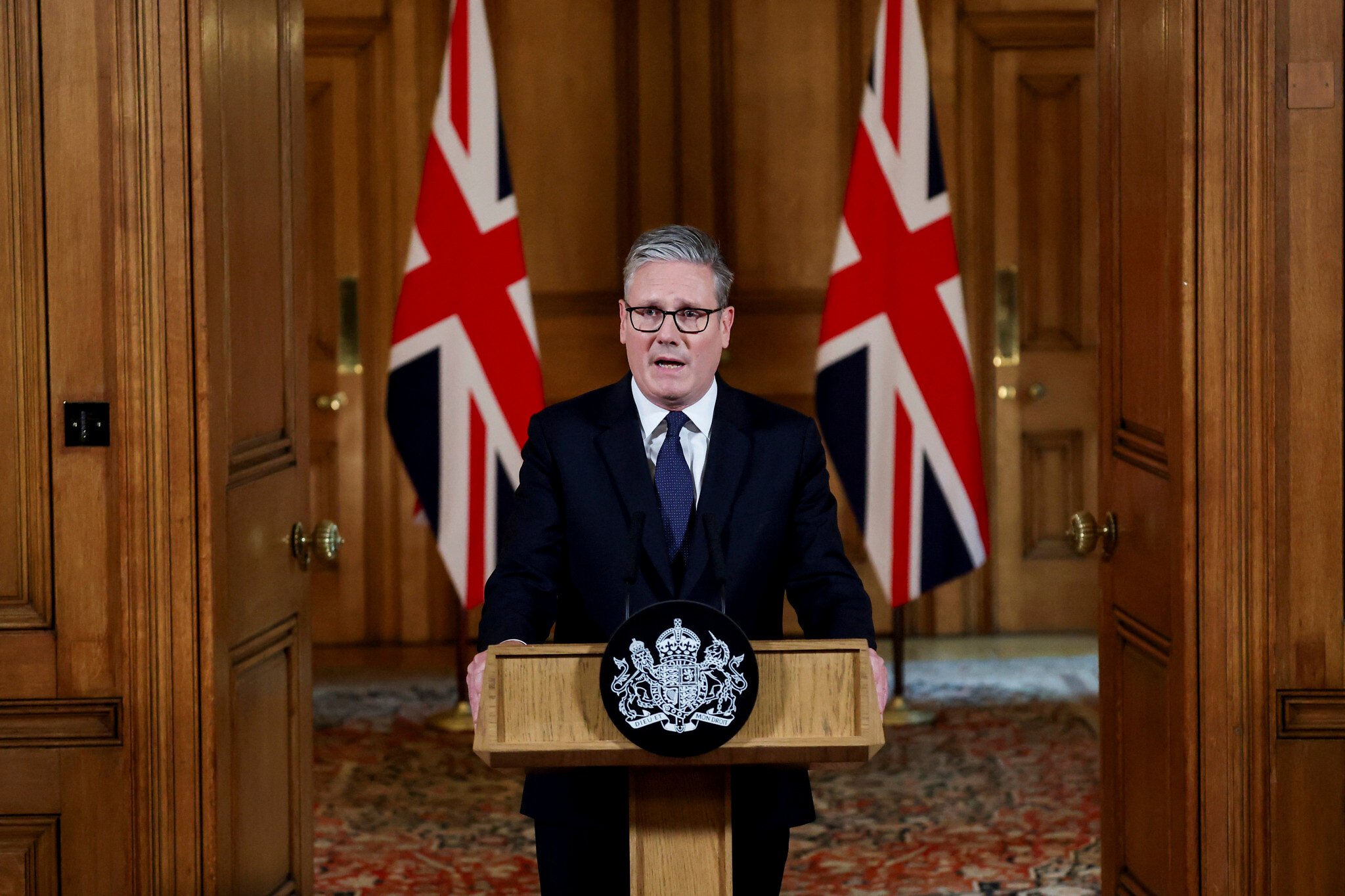
Unfortunately, however this wasn’t even the worst bit, as Sir Keir came out and took to the podium inside Downing Street, and we learned of the conditions themselves. The UK would recognize Palestine in September unless Israel:
(1) agrees to a ceasefire and ends the war in Gaza;
(2) commits to a long term sustainable peace, reviving the two state solution;
(3) allows the UN to restart the supply of aid; and
(4) makes clear that there will be no annexations in the West Bank.
A logical omnishambles
It took hardly any time at all to work out the immediate logical consequences of the conditions the UK had just slapped on Israel:
- If Israel does not comply with all the conditions: the UK will recognize a Palestinian state in September, despite it lacking key legal ingredients for statehood, while Hamas is left in power and the war in Gaza still rambles on.
- If Israel does comply with all the conditions, including ending the Gaza war and committing to a two state solution: the UK will not recognize a Palestinian state in September.
There was a side mention of Hamas, as Sir Keir repeated the UK’s empty demand (but not a condition) for the terror group to release the remaining hostages and accept no future role in Gaza.
A logical omnishambles is how you describe this. Sir Keir Starmer has, somehow, turned what he calls an “inalienable right” of Palestinians into a threat against his own ally, a mere strategic ploy, a stick with which to beat Israel. And out of nowhere, he has linked it specifically to the end of the war in Gaza, where, if he was paying any attention to negotiations, he would have seen that Hamas were already putting forward new and impossible obstacles to a temporary ceasefire due to mounting pressure on Israel.
The unmitigated failure of logic in the UK’s strategy can be summed up in two very simple, mutually-reinforcing sentences. If recognition of Palestine was that obvious and that urgent, Sir Keir wouldn’t have needed to condition it on the end of the war in Gaza. And if ending the war in Gaza was that obvious and that urgent, Sir Keir wouldn’t have needed to make it a condition on which the UK would recognize Palestine.
According to Sir Keir, the UK Government’s “primary aim” in all this is to immediately improve the situation on the ground in Gaza. But upon re-reading his conditions, we can only scratch our heads. If this was indeed the main aim, one can only wonder why the UK Government adopted, as its tool of choice, a purely symbolic act that, if it takes place at all, won’t even take place until September.
If you are Israeli, whether a citizen, a member of the government, an ex-hostage or a relative of one within the Hostages and Missing Families Forum, you cannot understand how the UK has threatened its own ally while simultaneously demanding nothing from Hamas or its allies. If you are Palestinian, you are left wondering how on earth your “inalienable right” to statehood in the UK’s eyes is now, apparently, conditional on another country doing something else.
The mind boggles to no end.
Vanished incentives
Israel’s government, for its part, presently has no interest or desire in achieving any of these conditions, other than to get a temporary ceasefire signed and to have some of its precious hostages returned to it from Hamas captivity, including half of those still believed to be alive.
Hamas, by contrast, are now transparently on notice of the conditions Israel needs to meet. And inevitably, having been given no incentive whatsoever by the UK other than to sit by and carry things on just the way they are, while they continue to place their own civilians in harm’s way and deprive them of much-needed humanitarian aid, Hamas will now make it even harder for Israel to achieve these conditions.
For as esteemed an organ of state as the UK Foreign Office to have not seen any of this coming is nothing short of scandalous. Had it even properly directed its mind to the issue for just a few minutes, it would have realized very quickly that such a decision would give neither party any other incentive but to continue the war in Gaza.
One need only have looked for a few seconds at the BBC News live feed that evening (29 July) to understand this brutal reality, as an update stating: “BREAKING: Israel accuses UK of harming efforts to secure Gaza ceasefire” (18:18 BST) was consecutively followed by one that read: “BREAKING: Hamas says ceasefire negotiations halted” (18:46 BST).
It gets worse. As of last night (31 July), Hamas is reported to have cut off contact entirely with the mediators and says it is not interested in negotiating, out of concern not over plans for the IDF to encroach even further into Gaza, but – wait for it – humanitarian aid. One of the very conditions set for Israel by the UK, with no such demand for Hamas. Aid that Hamas has stolen from its own population this whole time to feed itself and its prized bargaining chips, the Israeli hostages. Aid whose distribution system is one over which Hamas is so obviously desperate to reprise control from the Gaza Humanitarian Foundation.
If last night’s development tells you anything, it is how even more demonstrably insane the UK’s recognition plan is. Hamas began the month by saying it won’t agree to a ceasefire due to the aid situation, and now ends it (thanks to the UK’s actions this week) by saying it won’t even negotiate a ceasefire due to the aid situation.
Senseless statecraft
What happens next? If Israel complies with all but one of the conditions, will Sir Keir now back down and refuse to recognize Palestine, or will he part with his word and press ahead with recognition anyway due to unrelenting pressure from his backbenchers? If Israel, as expected, complies with none of the conditions, will he recognize Palestine while Hamas remain in power?
So incoherent has this decision been that journalists were queuing up to ask the Government to clarify, and confirm if it really was going for conditional recognition of Palestine but with the conditions only on Israel. When asked to confirm the position that evening, Number 10 confirmed (29 July, 19:40 BST) that the Prime Minister’s statement was “clear and correct“, and that “The position was stated exactly as Keir said.”
The following morning, it became clear to everyone but the UK Government itself that Sir Keir’s announcement had backed his administration into one hell of a mess, as he sent out the Minister for Services, Small Businesses and Exports on the media round to bat away these basic questions.
One can only have felt some sympathy for that minister, who repeatedly refused to confirm to Sky News (31 Jul, 08:04 BST) that Hamas must release the hostages before the UK recognized Palestine: “I’m not going to get into a ‘what if’ or whatnot. We’ve set out our position on recognition of the state of Palestine. But we have also been always clear, and I’m happy to be clear again today that we want the remaining hostages released, by, by Hamas.”
Make no mistake about it. The UK Government, for all its historic international and diplomatic prowess, has just made a decision that is up there with the most objectively senseless pieces of statecraft in modern times, leaving even France’s step looking like an intellectual and diplomatic masterstroke.
What an utterly sorry state of affairs.