
The Unapologetic Reality of Israel: From Fantasy to Adulthood
Israel did not come into the world to be liked.
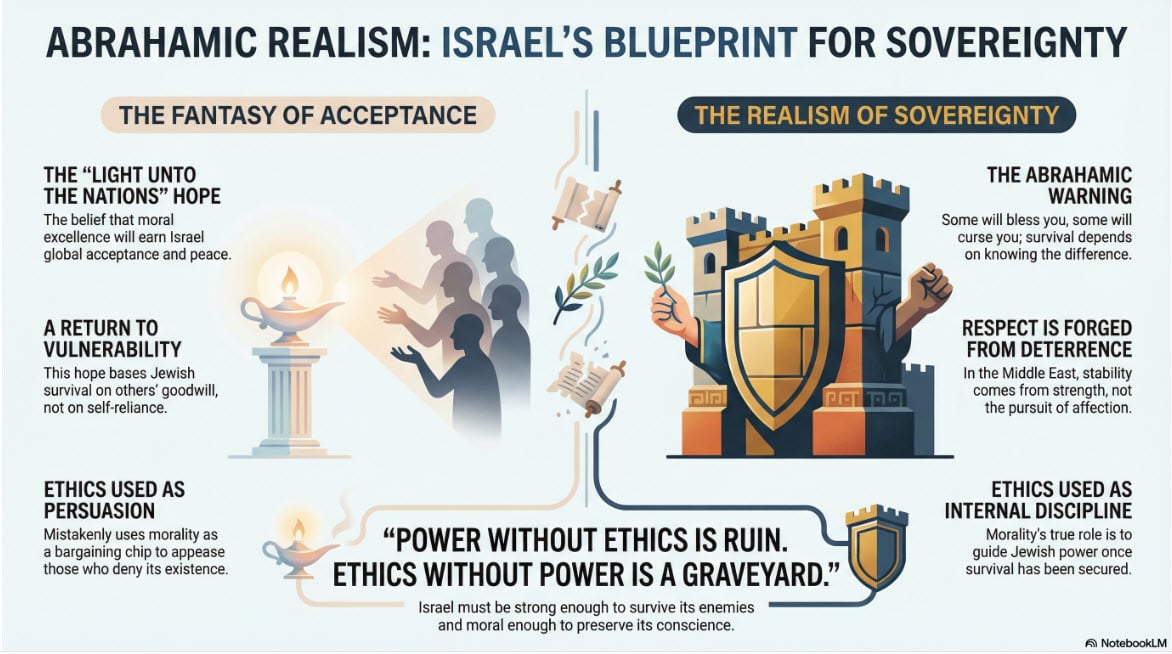
That sentence unsettles many Jews, especially those raised on a gentler hope: that Israel would be a moral exemplar, a “light unto the nations,” whose fairness and restraint would earn acceptance and ultimately peace.
I cherished that hope. I also believe it became dangerous the moment it forgot an older lesson—one given to Abraham at the very beginning of the Jewish story.
When God called Abraham into covenant, He did not promise universal admiration. He offered something far more bracing: “I will bless those who bless you, and those who curse you I will curse.”
That was not poetry. It was a strategic briefing.
From the outset, the Jewish people were told that the world would divide—not between good and evil in neat lines, but between those who would accept Jewish existence and those who would oppose it. The covenant did not deny morality; it denied naïveté. It named reality before history had the chance to do it brutally.
Zionism did not invent this realism. It rediscovered it.
Zionism was not a romance. It was a diagnosis.
For nearly two millennia, Jews lived as minorities whose safety depended on the goodwill of host societies—sometimes tolerant, sometimes generous, sometimes indifferent, and often, suddenly, murderous. The deeper lesson of Jewish history is not that goodwill never exists. It is that goodwill is not a security policy.
Zionism was the refusal to build Jewish survival on the hope that the world would finally behave better.
It was the political expression of the Abrahamic warning: some will bless you; some will curse you; your survival cannot depend on confusing the two.
A people without sovereignty lives at the mercy of others’ moods. A people with sovereignty can plan, defend, and endure.
Israel was born to end Jewish structural vulnerability—not to end Jewish ethics.
A state that seeks God’s favor still needs borders and an army.
There has always been a second strand within Zionism—religious and secular alike—that insisted the Jewish state must be worthy, not merely strong. Law over chaos. Justice over impulse. Care for the vulnerable. Dignity for the stranger.
I believe this aspiration remains essential. A Jewish state that abandons Jewish moral grammar will eventually hollow itself out.
But here is the adulthood test: morality is not a substitute for security.
The Torah never suggests that ethical behavior neutralizes enemies. Abraham himself is told that opposition is part of the terrain. Jewish ethics were never meant to purchase acceptance; they were meant to discipline Jewish power once survival was secured.
Confusing those two roles—ethics as internal obligation versus ethics as external persuasion—has repeatedly led Jews into danger.
Israel’s morality is its covenant with itself, not a bargaining chip offered to those who deny its right to exist.
The coexistence fantasy collapsed on a civilizational refusal.
We can speak carefully and still speak plainly: across much of the surrounding Muslim world, opposition to Israel is not merely political. It is foundational.
This is not fundamentally about borders or settlements. Those arguments come later. Beneath them lies a refusal—rooted in history, theology, and culture—to accept permanent Jewish sovereignty in territory understood as belonging to Islam.
This refusal has been consistent:
- Rejection of every partition plan
- Wars launched for eradication, not compromise
- Educational systems that sanctify “resistance” over coexistence
- Movements whose charters openly call for Israel’s destruction
One can acknowledge Palestinian suffering. One can support Palestinian dignity and self-determination. And one can still face this truth: most in the region do not want Israel corrected. They want Israel gone.
That is not a misunderstanding. It is a stated position.
Abraham was warned about this pattern before there was a Jewish people, a land, or a state. Ignoring it now is not compassion. It is denial.
Adulthood is not cynicism. It is clarity.
Israeli adulthood means abandoning the belief that acceptance is the prize at the end of moral effort.
It means recognizing that:
- Restraint can be ethical without being persuasive
- Concessions can be humane without being reciprocated
- Strength is not a failure of values, but the condition that allows values to survive
Israel can pursue treaties, normalization, and regional partnerships where interests align. It can—and should—seek quieter borders and wider circles of cooperation.
But it must stop promising peace as a foreseeable horizon with actors who define their identity in opposition to Jewish permanence.
The realistic goal in much of the region is not affection. It is respect—and in the Middle East, respect is inseparable from deterrence.
Respect means adversaries may hate and scheme, but they calculate. They refrain because they know the cost of attacking Israel exceeds the benefit. That is not romantic. It is stabilizing.
Power without ethics is ruin. Ethics without power is a graveyard.
Israel must hold two truths at once:
- It must be strong enough that those who curse it cannot destroy it.
- It must be morally serious enough that Jewish power does not erase Jewish conscience.
This is the reversal of exile. Jews are no longer powerless victims. We are sovereign actors. That introduces temptations—arrogance, cruelty, indifference—that Jewish law anticipated precisely because it understood what power does.
So yes: protect minorities. Uphold law. Treat the stranger with dignity. Constrain cruelty. Refuse collective dehumanization.
But also: do not confuse moral obligation with magical thinking. The belief that Israel can be so good that it will be forgiven for existing is not ethics. It is a return to diaspora dependence—the hope that Jewish safety flows from other people’s approval.
The covenant never promised that.
The call: stop exporting fantasies—and stop apologizing for reality.
If you love Israel, stop demanding that it perform a comforting story.
Do not require it to ignore what its enemies say about themselves. Do not teach the next generation that safety comes from being perceived as virtuous. Teach them the harder, truer lesson Abraham received at the beginning:
Some will bless you. Some will curse you. Your task is to know the difference—and live accordingly.
Israel exists so Jews can live as Jews without asking permission—and so Jewish ethics can be practiced with strength, not helplessness.
That is not a fantasy.
It is adulthood.
And it is time we embraced it unapologetically.