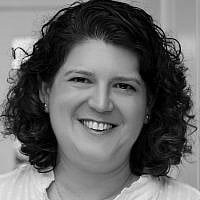
Solicitor & foreign policy adviser
The UN’s most protected weapon: Francesca Albanese
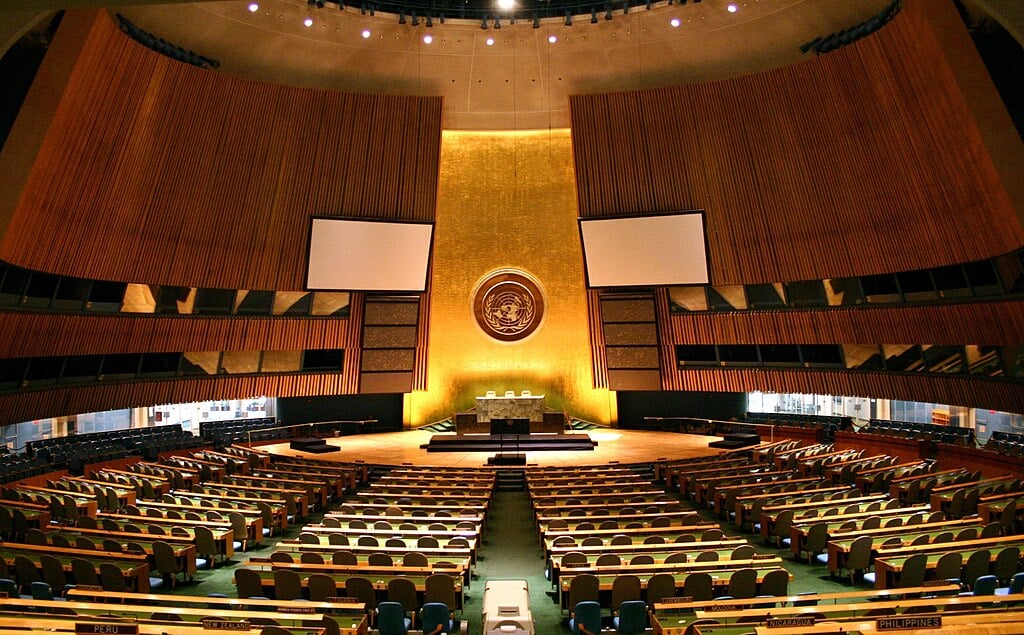
UN General Assembly (Photo by Patrick Gruban on Flickr)
If the UN Human Rights Council were a theatre, Francesca Albanese would be its most method actor. Except the lines are self-written, the critics pre-cancelled, and the villain always the same. Her latest performance, delivered in Geneva on July 3, aimed to indict Israel for genocide, again. But this time the script fell flat. When Hillel Neuer, Executive Director of UN Watch, asked why her 25-page report on Gaza included no reference to Hamas, Hezbollah, Iran, or the minor historical footnote of October 7, Albanese sidestepped like a practiced defendant. When Neuer pressed further:
Ms. Albanese, who funded your travel to Australia and New Zealand, and why won’t you disclose it?
she parried with indignation. Evasion, misdirection, and that familiar choreography of grievance posing as scholarship.
This wasn’t a blunder. It was the strategy. Albanese has made a career of selective outrage. Appointed Special Rapporteur on the occupied Palestinian territories in 2022, she entered the role with a social media trail already ablaze: tweets accusing the U.S. of complicity in Israeli “apartheid,” framing the Jewish state as the permanent aggressor, and characterising its war of survival as a colonial project. No one in Geneva seemed to mind. In fact, that was part of the draw.
Her July 1 report, released just before the Geneva hearing, declared that Israel is committing genocide in Gaza, and called for sweeping sanctions, arms embargoes, and prosecutions. She named over 60 companies allegedly complicit in these crimes, 20 of them American. Her demand that Western states deny Netanyahu’s plane access to their airspace bordered on diplomatic sabotage. It was a legal brief dressed as policy recommendation, minus the law and the policy.
Then came the American response—belated, but decisive. On July 9, U.S. Secretary of State Marco Rubio announced sanctions on Albanese under Executive Order 14203, the Trump-era framework originally designed to block ICC action against U.S. and allied officials. The sanctions include an entry ban, asset freeze, and visa restrictions. In a blunt statement, Rubio accused Albanese of “unabashed antisemitism,” and of manipulating the international legal system to legitimise terrorism and criminalise Israeli self-defence.
“Albanese’s campaign of political and economic warfare against the United States and Israel will no longer be tolerated,” Rubio posted on X. “We will always stand by our partners in their right to self-defense.”
UN rapporteurs are supposed to be independent experts. Albanese, by contrast, has lobbied governments to enforce ICC arrest warrants, campaigned for arms embargoes, and pushed reports indistinguishable from activist pamphlets. When Neuer asked who funded her fieldwork abroad, it wasn’t a cheap shot, it was a necessary inquiry. Especially after a 2024 UN internal memo raised questions about her ties to groups that had publicly praised Yahya Sinwar.
None of this is shocking. What is shocking is that it took until now for a major Western government to act. The UN’s refusal to discipline Albanese, despite her documented bias, refusal to disclose financial backers, and consistent erasure of Palestinian armed violence, is part of a broader institutional pathology: a system that outsources morality to individuals unbound by accountability. The Human Rights Council has never had a credibility surplus, but in Albanese, it has reached a new level of gall.
She will wear the sanctions as a badge of honour. Her supporters will cry censorship and martyrdom. But the facts are plain. This isn’t a silencing. It’s a boundary-setting. The United States has drawn a line where the UN would not. Albanese crossed it, repeatedly, and turned a UN title into a political weapon.
The question now isn’t whether Francesca Albanese can still function as a rapporteur. It’s whether the UN can still function as anything but a liability.
Related Topics
Related Posts