
The Watches and the Lute
The Watches and the Lute
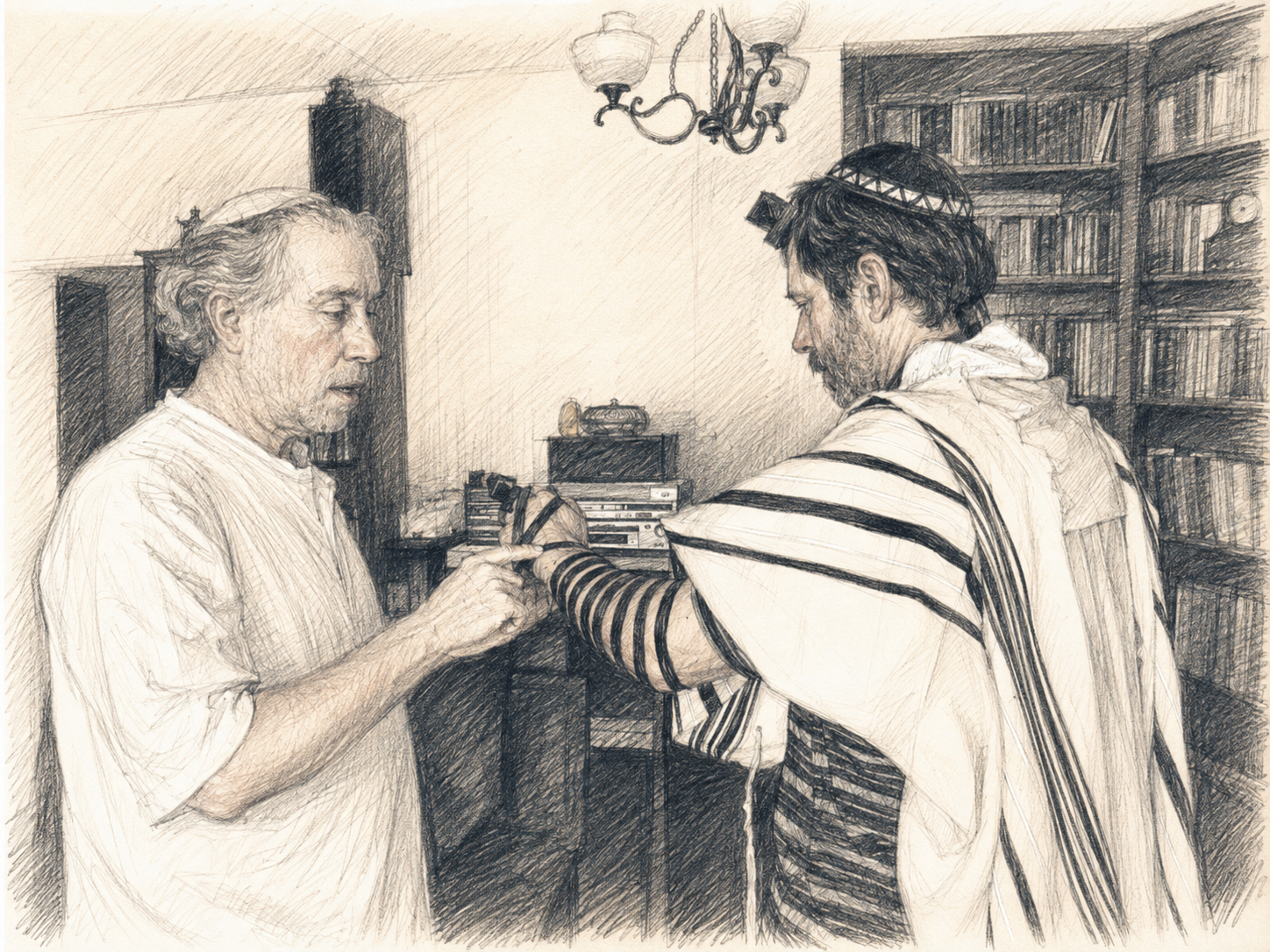
In Levi’s home in Rehovot, time appeared in two forms. It rested behind glass in rows of wristwatches, each mechanism dividing the day with exquisite precision, and it returned through the strings of a lute, where no measure could become music until someone had first learned how to listen. I have often thought that something of Jewish life begins between these two forms of time.
Books were everywhere. They were not decoration, nor evidence arranged to establish the learning of their owner, but the living geography of the house: on shelves, tables and chairs, in stacks that opened passages between languages, centuries and commentaries. Levi had studied at the Sorbonne, yet his erudition carried none of the ceremonial superiority that sometimes accompanies academic distinction. Knowledge did not bring a conversation to an end. It made the next question unavoidable.
We spoke about Jewish mysticism, about the Zohar, letters, divine names and meanings that do not surrender themselves to the demand for immediate clarity. Mysticism was not, for us, a cabinet of secrets or a refined religious ornament. It was a discipline of attention, a way of resisting the assumption that the visible exhausts reality or that a word has completed its work once its first meaning has been identified.
In the mornings, we prayed together. I remember Levi standing beside me among the books, helping me with the tefillin. There was nothing theatrical in the scene. Jewishness was not being declared, defended or explained. It was present in the gesture itself: in leather, fabric, memory, breath and the quiet concentration required to repeat an ancient act without reducing it to repetition.
Prayer did not erase the differences between us, and it did not require us to hear every word in exactly the same way. It gave us a shared direction of attention before speech began and before each of us returned to his own questions. Perhaps that was why disagreement never seemed to threaten the relation. It did not have to decide who belonged and who did not.
On Shabbat, the conversation continued around the table, carried by food, blessing, books and the intervals in which no one felt obliged to rescue a question from remaining open. Hospitality did not abolish disagreement. It gave disagreement a place in which it did not have to become a verdict.
Our conversations resembled the lute more than the watches. They were not arranged to produce agreement efficiently. A difficult thought could remain between us without becoming an embarrassment, and a question could alter its shape before either of us attempted to answer it. The time of conversation was not wasted simply because no conclusion had been reached.
Years later, writing to Levi for Rosh Hashanah 5781, I tried to name what had remained with me from those visits. I wrote of letters carried by the wind and letters impressed upon paper, and of the silence between them. I did not mean emptiness. I meant the easily missed interval in which presence has not disappeared merely because speech has ceased.
I also wrote to him: “Your unwavering devotion to study entered me as a challenge that had to be accepted.” At the time, I was moving slowly through Sefer Yetzirah, Sefer ha-Bahir, Sha’arei Orah and the Zohar. Again and again, while reading, I found myself asking: what would Levi say?
It was not a search for permission, nor an attempt to surrender judgment to another person. The question meant that the conversation had survived distance. Levi remained present not as an authority whose answer would spare me the labour of thought, but as a resistance to haste, a reminder that the first reading is often only the first.
What remained with me was therefore not merely a list of books to be read. It was a way of reading: slowly, in the company of another voice, with enough patience to suspect that a word may know more than we presently know how to ask of it. The books did not replace conversation. They carried it elsewhere.
We did not always agree, and neither of us seemed surprised by that. The books around us had already taught a quieter lesson: disagreement need not end a relation. A page of Jewish commentary rarely resembles an empty room. It is crowded with voices that survive not because their differences have been resolved, but because resolution was not allowed to erase them.
There is nothing automatically noble about dispute. It can be vain, cruel or sterile. Its value lies elsewhere: in whether the other person remains present after the argument has become difficult. A relation is not preserved by pretending that differences do not matter, but by refusing to treat difference as sufficient reason for disappearance.
In Levi’s home, neither of us had to represent everyone. He was not “Israel,” and I was not “the Diaspora.” We were two Jews whose memories, experiences and relations to tradition were not identical and did not need to become so. That freedom from representation was not an evasion of responsibility. It allowed responsibility to become personal again.
When every sentence must defend a community, justify history or establish loyalty, language becomes armour. One begins to speak from positions that must be protected rather than from questions that may still change us. In Levi’s house, I encountered another possibility: speech that did not need to win in order to matter.
The mystical texts we discussed belonged to the same discipline. They did not teach that every interpretation is equally valid, nor that obscurity is wisdom. They taught that responsible reading requires time, attention and a certain modesty before what exceeds us. A human being, like a word, is not exhausted by the first name imposed upon him.
Perhaps this is why the room itself mattered. The books, the morning prayer, the Shabbat table and the lute formed no grand system. They created a space in which another person did not have to become harmless, innocent or identical to us in order to remain near. Hospitality suspended the demand that every encounter produce a victor.
I do not remember those visits because we solved the questions of Jewish identity, Israel, memory or history. We did not. I remember them because the questions were allowed to remain alive, and because neither of us had to disappear for the conversation to continue.
When I wrote to Levi about the letters carried by the wind and the letters impressed upon paper, I thought that silence stood between them. I understand that silence differently now. Not every interval marks the end of a conversation. Sometimes it is where the words of another person begin their deepest work.
In Levi’s house, the watches measured time. The lute made room for it. The books did not allow the conversation to end.
Yochanan Schimmelpfennig