
An Aging Jewish Feminist
The Wilderness Scream: Leadership, Loss, and Loneliness in Hukat
Like modern-day Israelis, the ancient Israelites were constantly on the move. We are used to rushing from safety to shelter and back again, jolted from ordinary moments by sirens. Many of us have relocated to other countries. And many of us are coming on Aliyah as they feel unsafe in their own countries. Last week’s Torah portion described Korach’s rebellion and the specter of civil war. In a disturbing parallel, we are witnessing a modern-day intifada—from within. Extremist Jewish settlers are attacking soldiers and police, and they are not being treated as enemy terrorists would be. The authorities are not responding as decisively as Moses and God did in the wilderness to rebels from within. These Jewish terrorists are being treated with leniency by a right-wing government that sees them as kin.
What makes this week’s Torah portion, Hukat, even more unsettling is its opening: the ritual of the Red Heifer. Some may recall the TV series Dig, in which Jewish and Christian fundamentalists transport a red heifer to the Temple Mount—symbolizing an apocalyptic ambition shared by some in our time. Minister Ben Gvir’s repeated visits to the Mount feel like a lit match near dry tinder.
In Parshat Hukat, the Israelites journey through the wilderness of Zin, encamp at Kadesh, skirt Edom via the Sea of Reeds, and traverse the land east of the Jordan. No hotels, no rest stops—just a relentless trek across an unforgiving landscape.
And then:
“The Israelites arrived in a body at the wilderness of Zin… and the people stayed at Kadesh. Miriam died there and was buried there” (Numbers 20:1).
No mourning, no tribute. The woman who saved Moses as a baby and led the women in song after the Sea crossing disappears with barely a word.
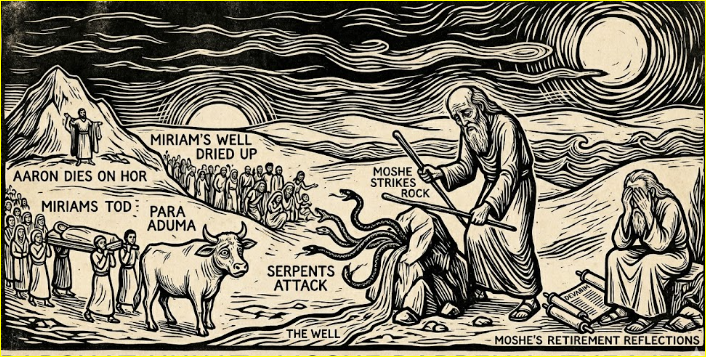
But silence can speak volumes. The sages could not accept this erasure. The Midrash in Bamidbar Rabbah 1:2 and the Talmud in Ta’anit 9a imagine a miraculous well that followed the Israelites thanks to Miriam—and dried up at her death. She may have held no title, but she nourished the people in body and spirit. Second Temple authors such as Josephus gave Miriam a proper and detailed funeral. Without her, the people thirsted—and chaos followed. God instructed Moses to speak to a rock to bring forth water. Instead, in grief and frustration, he strikes it—twice—and shouts:
“Listen, you rebels (ha-morim), shall we get water for you out of this rock?” (Numbers 20:10)
A moment of rage and a consequence: Moses is barred from entering the Promised Land. Then comes another blow. God commands Moses to bring Aaron up Mount Hor, strip him of his priestly robes, and witness his death. The people mourn Aaron for thirty days—unlike the silence that greeted Miriam’s passing. Moses is now utterly alone. We’re reminded of an earlier lament, when Moses broke under the weight of leadership:
“Did I conceive all this people… that You should say to me, ‘Carry them in your bosom like a nurse’? … If this is how You treat me, kill me now” (Numbers 11:12–15).
A midrash in the Sifrei highlights Moses’ deep despair, his feminized metaphors of bearing and nursing the people. He envies the dead and longs for release. The portion continues with complaints, battles, and divine victories. But the cost to Moses is starkly personal. And let’s not forget the serpents (Numbers 21: 4-9) unleashed on the people. Talk about adding insult to injury.
Imagine him reflecting, perhaps in retirement:
Where should I begin? I was working off some excess energy by jousting with my fellow princes, when I heard screaming in the Hebrew language my nursemaid used to sing. I went out to investigate, and saw that the fight was uneven. I saw one of our guards striking one of the slaves. The guard told me to mind my own business, but I made it my business. I still had the jousting stick in my hand and struck the guard, who dropped dead at my feet. After looking around, and seeing no one, I buried him in the sand. But word got around and I had to flee.
I met my wife, also as a result of a fight, this time with some shepherds, and she was so impressed that she invited me to her home. My future father-in-law suggested that I use up my excess energy by taking his sheep out for long walks in the wilderness. One day, God found me there and convinced me that I was the right person to save all those slaves in my homeland.
I thought He was out of His mind to choose me. I had no qualifications whatsoever, except perhaps a quick temper—which I guess could be handy in an emergency. I ended up going back to my homeland to save His people, the slaves. The people weren’t too happy to see me. To convince them, and the owner of all those slaves to let them go, that I was worthy of leading them, I performed miracles with the help of my brother and our magic rod. After a few false starts–too, too many terrible plagues on God’s behalf–we left my homeland to go out into the desert to worship God. Even though we lied to the slave owner, and said we would be back, the newly freed people had no intention of returning. At least that was what I thought.
But whenever there were setbacks, the people complained that things were better back then, in their homeland, and even though they were slaves, there, they never ran out of food or water. They were always complaining about the food and water shortages. It got to be too much for me, and I found that I was losing it—the problems I used to have with controlling my temper were returning with a vengeance. God would speak to me every now and then and advise me to cool off and not take it too seriously—His attempt at Anger Management– and He would then threaten the people and punish them, to show them that He was on my side. That would get them to behave for a while.
Every week there would be a new crisis: first, no food; then the food they got was boring; then my sister and brother ganged up on me. My father-in-law came and gave me sound advice about how to manage my time, but then he left me to my own devices. People were rebelling left and right and it got so that I was ready to quit. Right after my sister died, we had a serious water shortage and the people started screaming at me. “Do something—why did you bring us here to die? We were better off in our homeland, where we had watermelons and all sorts of goodies.” Watermelons? Were they out of their minds—there was no such thing.
I got up and started screaming at them in return. God told me to cool it, but I had had it with these people and maybe even with this God who told me to watch my step. God told me to speak to a rock and then enough water would come out for the entire people. That was ridiculous. In the past, he had told me to use my rod to hit rocks, and it worked and water came out. Also, I really needed to hit someone at this point, so rather than kill another Egyptian–where were real enemies, when I needed to express my anger? –I hit the rock, not once, but twice and water gushed out. I yelled at the people, calling them names, accusing them of rebelling. My display of impatience apparently angered God who told me that because I didn’t believe in Him, He was not going to let me enter the so-called promised land—and that someone else would take over from me. That would be my punishment.
In truth, I was so wound up at the time, that I didn’t think it would be so bad to end my career as a leader right then. Why wait until we got to the promised land. To be honest, like my new compatriots, I was ready to return to my homeland. Life was easier for me too in the good old days, when I roamed the palace and didn’t have to deal with these people’s problems. Some leaders stay too long. They forget they’re human. Forget the people aren’t theirs to own, but God’s to guide. They think they’re irreplaceable. I wasn’t. Neither are they
Why do I tell you all this? Recently, it has come to my attention that in the future there will be some leaders in the world who would like to stay in power forever. Based on my own experience—I would die at age 120—it’s not a good idea. If you think about it, 40 years is a bit too long a time for one leader to run a nation. I was 80 years old at the time God chose me and God’s decision was correct. He chose another to replace me. I realized I had a good run. I didn’t fight it. I was tired and it was good to stop pretending.
Retirement has its perks. I sleep in. Tell stories. Write memoirs. Offer advice no one asked for—that’s my right as an elder. I’m working on a new book: it will be called Devarim, or Deuteronomy. It will disappear until King Josiah’s time, but will then be added to the four books of the Torah.
If I have one message, it’s this:
My dear friends in the future promised land and abroad, it is time to step down. Leadership is service, not possession. Even God delegated—to judges, elders, prophets. So must we. Make room. Step aside. The wilderness teaches many things—but most of all: No one walks forever.
Sincerely, Moses, aka Moshe Rabbenu
And Shabbat shalom from the past!
Related Topics
Related Posts