
Creator of Hiking the Holyland
Featured Post
The worst deal I make every year for the oldest harvest in the land
After last year's poor olive yield, we were somehow certain this year would be plentiful. And so we hunted (and hunted) for the best trees for our oil
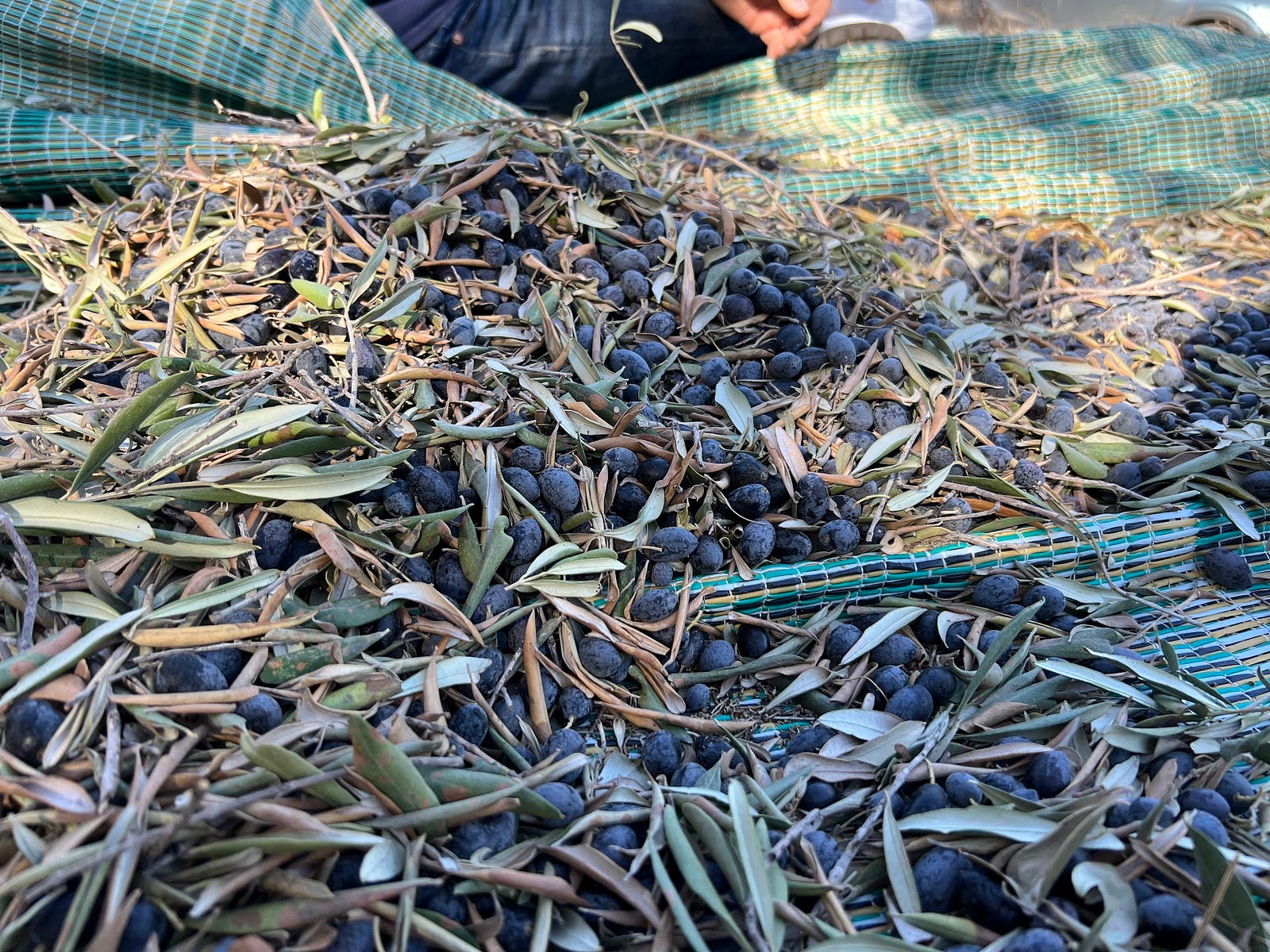
Olives aplenty. (All photos courtesy of the author)
It is still dark when we pull out of the driveway, the tarps and the bags and the long extendable rake shifting around in the back every time we take a turn, and I am already running the numbers I will spend the rest of the day trying not to think about: an hour to the forest where we pick every year, then four hours of shaking branches, a 20-minute drive to the press, and running underneath all of it the comfortable certainty that by now, after four years of this, we know exactly what we are doing.
After a few minutes of this mental arithmetic, I shift my attention to what is outside the window: the slowly lightening sky, slightly hazy, which is unusual for this autumn. We drive down from the Judean hills, through the lowlands, golden and dry and thirsting for the winter rains, and then north toward a KKL park in central Israel.
“Last year, there was nothing there,” I remind my husband, Avi, who is driving. Olives, we’ve learned, have on and off years. One year, a tree produces abundantly, the next only a fraction of its full crop, and last year’s poor showing was made worse by a winter with very little rain. We didn’t pick at all last year.
“But this year there will be,” he replies, and we are both certain, non-experts though we still are after four years in the field, that we finally understand the rhythm of the olive’s year. With our early start, we are going to pick enough for several five-liter jugs of that beautiful green oil.
Hours awake before sunrise: 1.5
* * *
The forest where we always pick is fenced off when we get there, closed for rehabilitation after the fire, and the strange part is that the olive trees on the other side of the fence look perfectly fine, which somehow makes it worse. The signs make it clear that we are not going into this forest today.
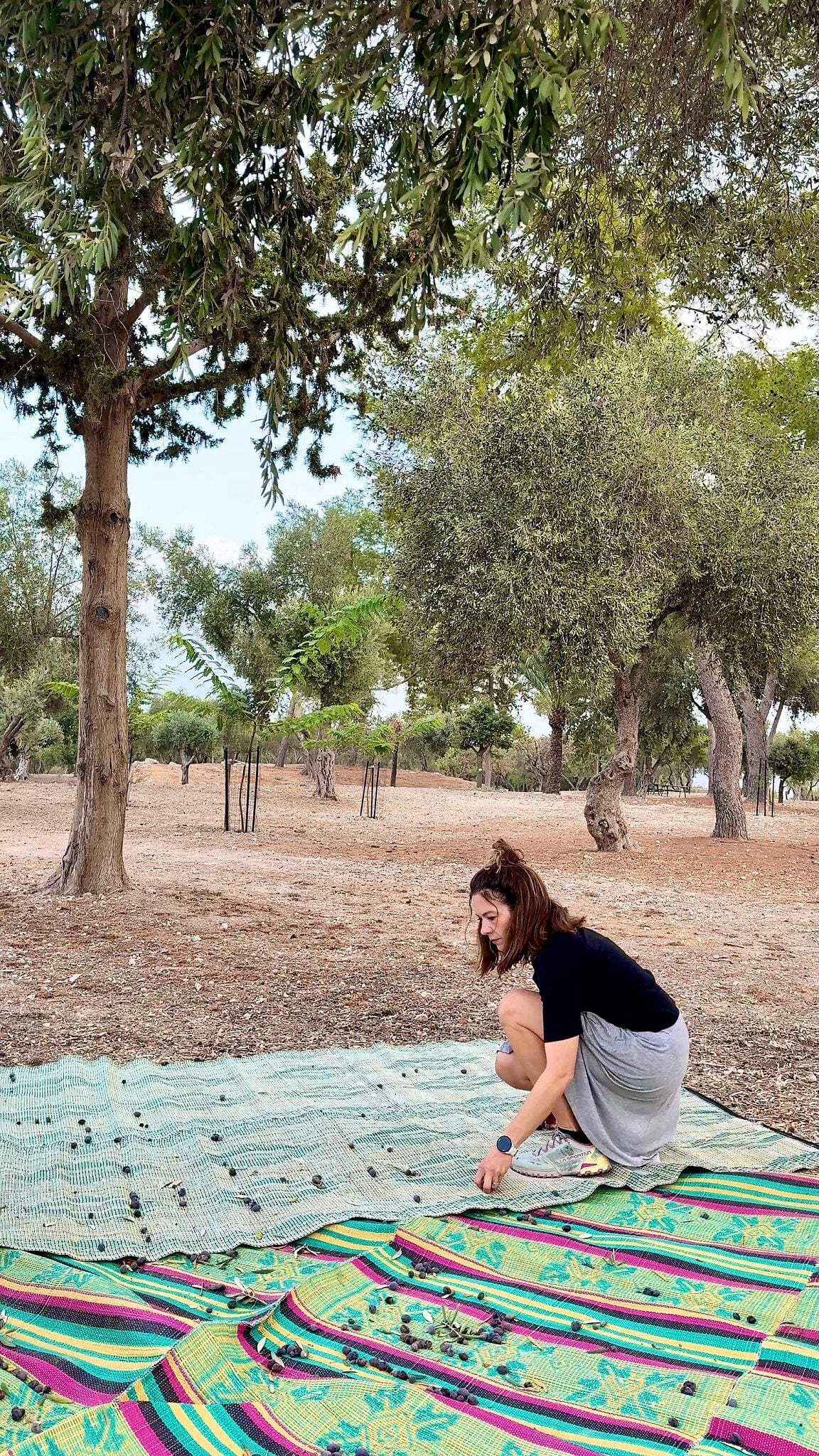
Just across the road is a large, open picnic area full of olive trees. We’ve never picked there, because the trees are tall and the whole place feels rather exposed, but having already risen before dawn and driven an hour, we go over to scope it out. There are so many trees that it is easy to find ones that are both full and within reach, so we park the car, and I unload the equipment while Avi wraps himself in his tallit and tefillin, which he wasn’t able to do before dawn.
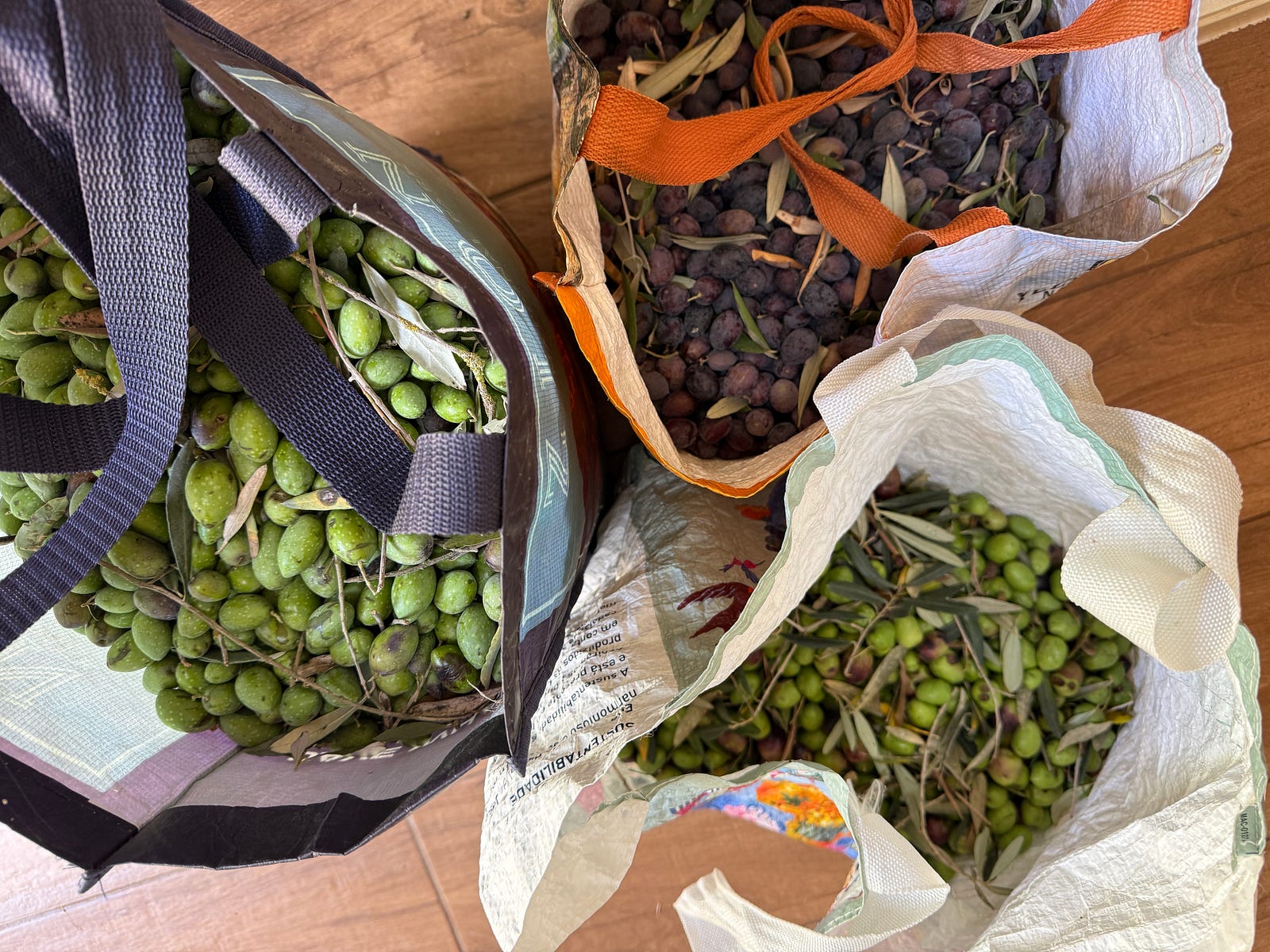
Soon we are picking vigorously, shaking the branches with our rakes and watching the purple olives pour down in a shower with a percussive beat. Before long we are gathering, lifting the edges of the mat and pouring the olives through a giant colorful funnel into the bags we brought from home. We’re still not professionals, so we don’t have crates yet, but at least our bags speak of time outdoors: they’re from Yellowstone, Zion and Mount Rainier.
We are shifting our mats around to the other side of this single tree when a white pickup truck pulls up. It’s a man from KKL, the head of the park, he tells us, and he asks, as nicely as anyone has ever asked me to do anything, whether we would mind not picking here, because this is a public area and they would rather leave the fruit to fall than have the picnic area turn into a picking party.
As we fold our mats and load everything back into the car, I’m wishing we had woken up even earlier, three hours before dawn, because one more hour in this spot would have given us a magnificent haul. As it is, we have about 20 pounds of olives from half an hour of work.
Hours driving: 1. Trees picked: 1. Kilos: About 9.
* * *
After that, the morning turns into a tour of places that were supposed to have olives. There is the spot where Avi dropped a pin when we hiked there last winter, where, after 20 minutes of walking uphill, there are trees and no olives at all, and then the grove where we have picked before, where the trees are standing exactly where we left them and are, for reasons nobody can explain, almost empty.
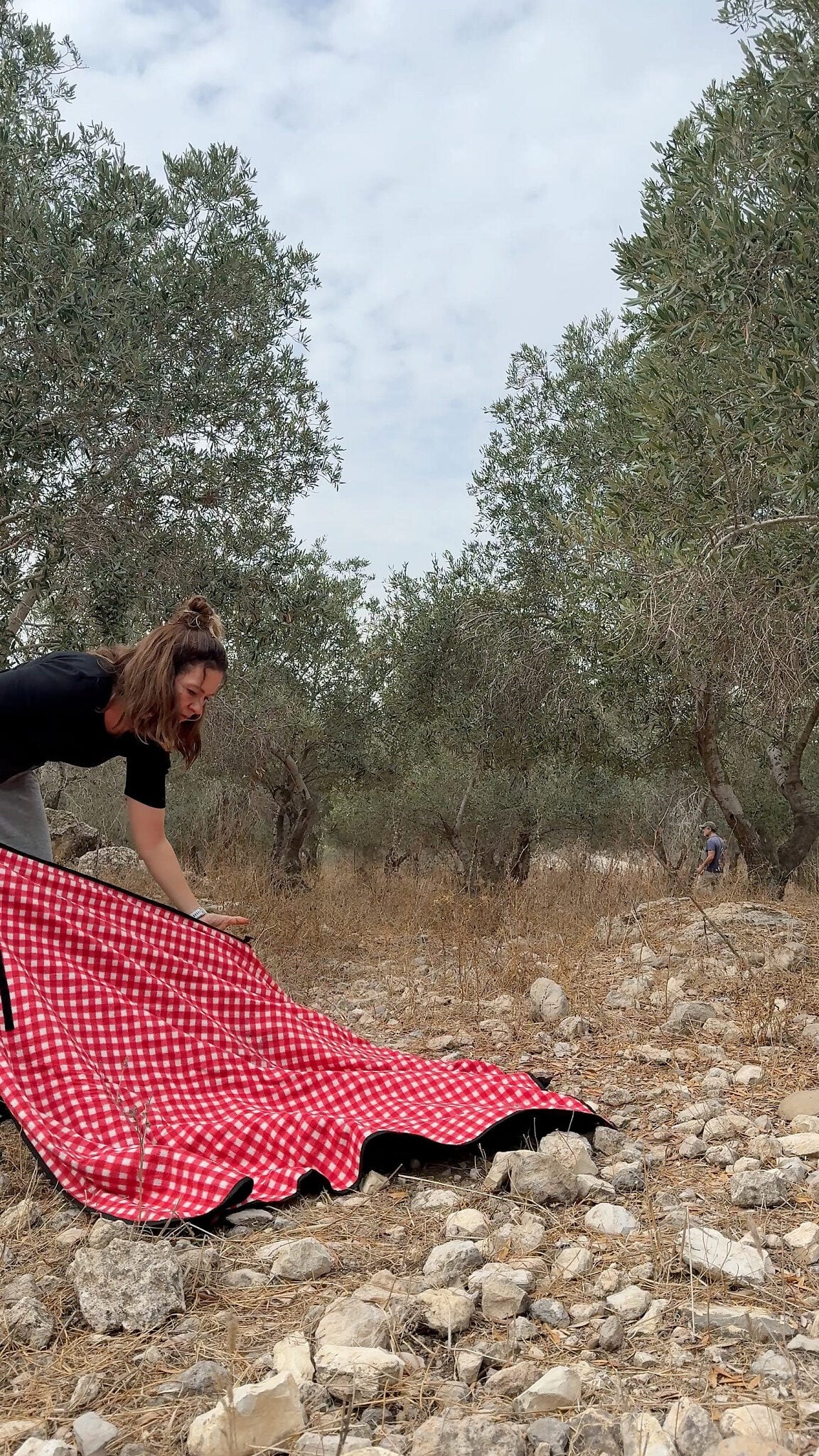
That’s where we stop for breakfast. We may not have picked many olives, but it’s already 10:30 and I’m desperate for coffee, so we spread out our red-checkered picnic blanket and unpack what I’ve brought: muesli and apple slices and even some toast and egg whites, and pour our black coffee into tin mugs. I’m determined to enjoy the quiet beauty of this old grove. A little bird with a red belly perches on a gnarled branch beside us, then flies off deeper into the trees.
After we’ve eaten, we’re back in the car and on the hunt. Avi has many gifts, but a nose for olive trees is not among them, and so I point us one way and he drives, slowly and thoughtfully and for a very long time, in another, peering out the window at the carobs and oaks in search of the right trees while I sit in the passenger seat practicing being the kind of person who has lots of patience. We drive further down into the valley, away from where I think the olive trees might be, and I give myself over to the disorder of the day.
Hours on the road so far: 5. Places tried: 4. Olives found: Almost none.
* * *
In the end, the trees are where I thought they would be all along, which would be more satisfying if they had anything on them. They are sparse and scraggly compared to the one tree we managed earlier in the morning, and we spread the tarps under them anyway, shaking the branches and watching the little olives fall a few at a time.
The bags do start to fill, very slowly. And then, just when I’m ready to give up, Avi finds the tree.
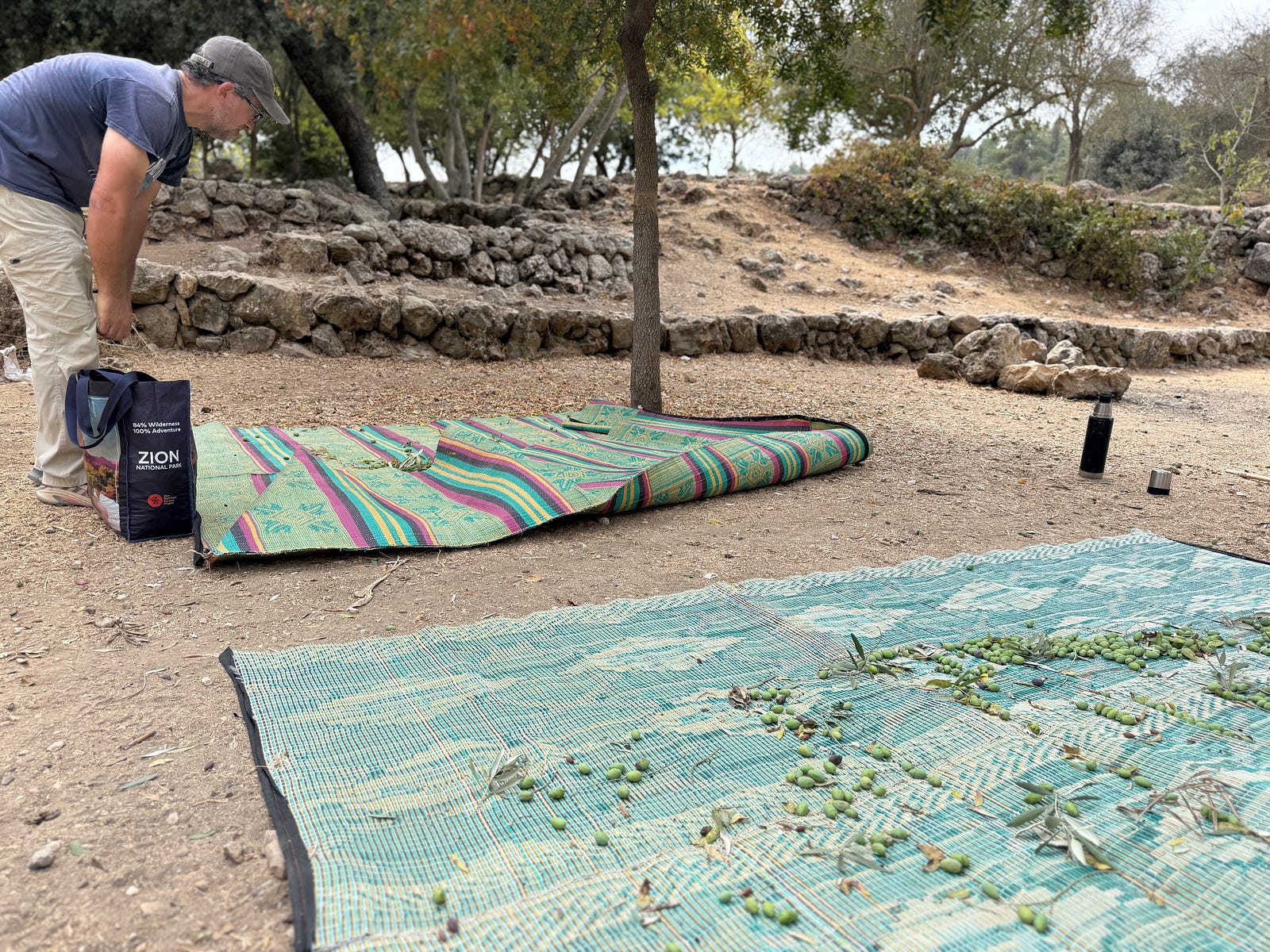
It’s a beautiful tree, large and twisted, with a perfectly symmetrical canopy and flat, bare ground beneath it, and most important of all, it is absolutely covered in olives. They’re green rather than the purple ones we’ve been collecting all morning, but they are large and plentiful and we are going to gather every one of them. We spread out our mats one more time and fall into the rhythmic beating we’ve grown used to, and the olives pour down like candy from a piñata, and soon we are gathering and pouring and filling our bags and lifting them to test the weight.
A young religious couple walks by and stops to admire our work, asking about the process, and we answer with all the hard-earned knowledge of olive-picking amateurs. They compliment us and continue on their walk.
Within half an hour we have picked the whole tree and our bags are completely full, and after a tree like that, the sparse trees around the park no longer seem worth the trouble. We leave them as they are, and as we pack up the mats I think of the verse in Deuteronomy that describes exactly what we have been doing all day: “When you beat down the fruit of your olive trees, do not go over them again; that shall go to the stranger, the fatherless, and the widow.”
Trees picked: 5. Bags full: All of them. Blisters: 1.
* * *
When we finally turn into our own street, the car heavy with bags and the morning long gone, there are olives in our neighbors’ yard. We knew this, of course, but we preferred the quiet and plenty of the forest we were expecting at dawn, and by now we have given up on anything going as planned.
We ask our neighbors, and they are very happy for us to pick their tree, since it means less fruit going to waste on their artificial grass. We’re dead tired by mid-afternoon, but we find the stamina for one last tree. We’re old hands by now, the work goes fast, and it’s actually quite beautiful in their yard.
Distance to the first forest: 1 hour. Distance to the best tree: 25 minutes. Distance to the neighbors’ yard: 3 minutes.
* * *
You’re supposed to take your olives to the press the same day you pick them, but we’re forced to give up on that dream. The press is an hour away, close to the first forest, and our youngest son, Benzi, needs us at home.
After separating tithes on the olives we picked from our neighbors’ tree, I take a long shower and get a good night’s sleep. I set out the next morning for Melo HaTeneh, a small hobbyist’s press near Tel Gezer, enjoying the silence of the drive even if I don’t really have time for it. When I get there, they pour our olives into big plastic crates. Our two look modest beside everyone else’s, but they weigh in at 27.5 kilograms, about 60 pounds. At this press, you pay for 50 kilos whether you bring 50 kilos or not, which is the kind of arithmetic you stop arguing with after the first year, and most of the big presses wouldn’t even take a quantity as small as ours anyway.
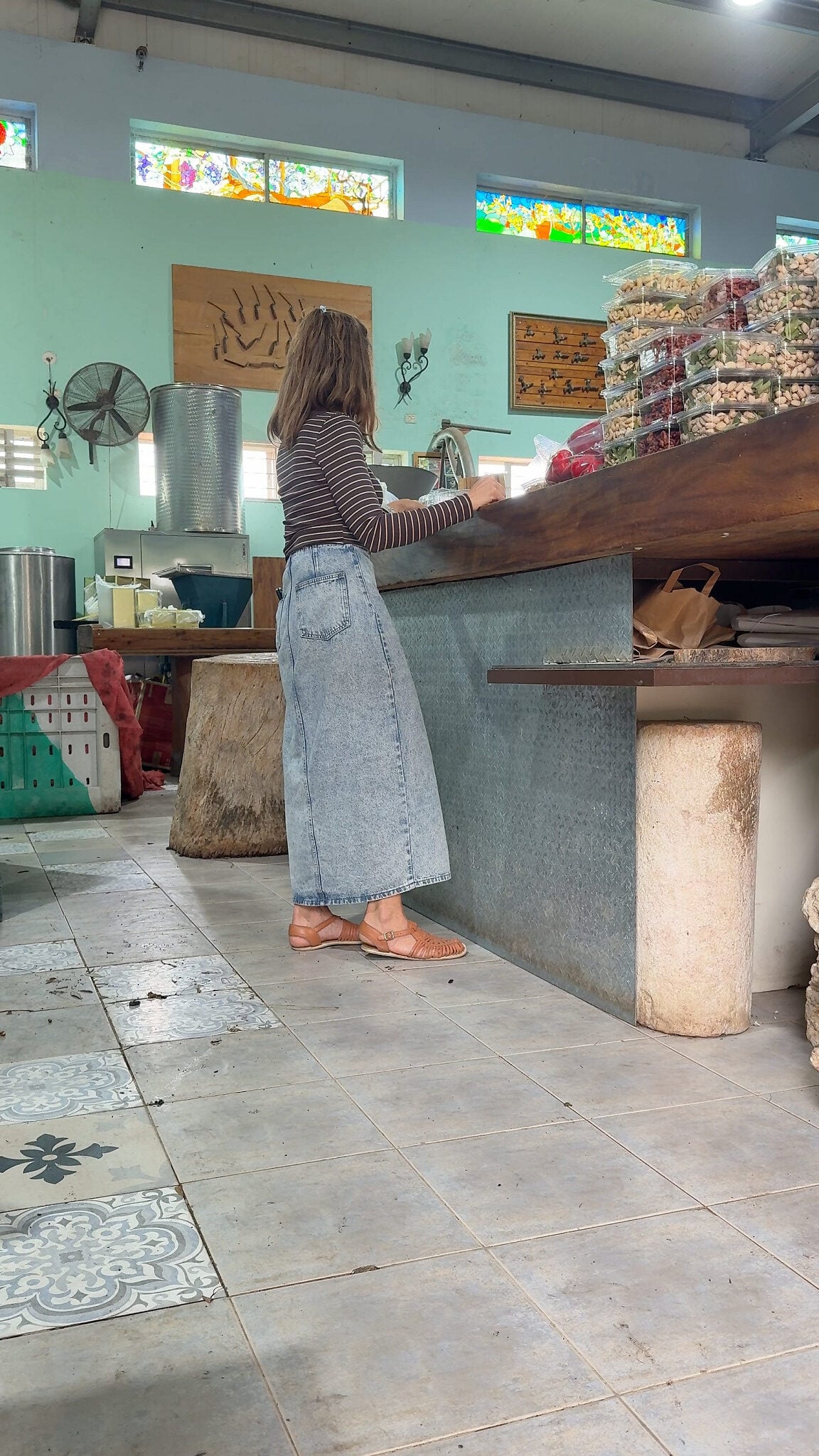
I linger. I love the smell and the noise of the machinery and the vast crates of olives, and they sell organic produce here too, picked on the farm that morning. I stop to watch someone else’s oil come out of the spout, and it isn’t the vigorous gush I had imagined but a slow, steady pour.
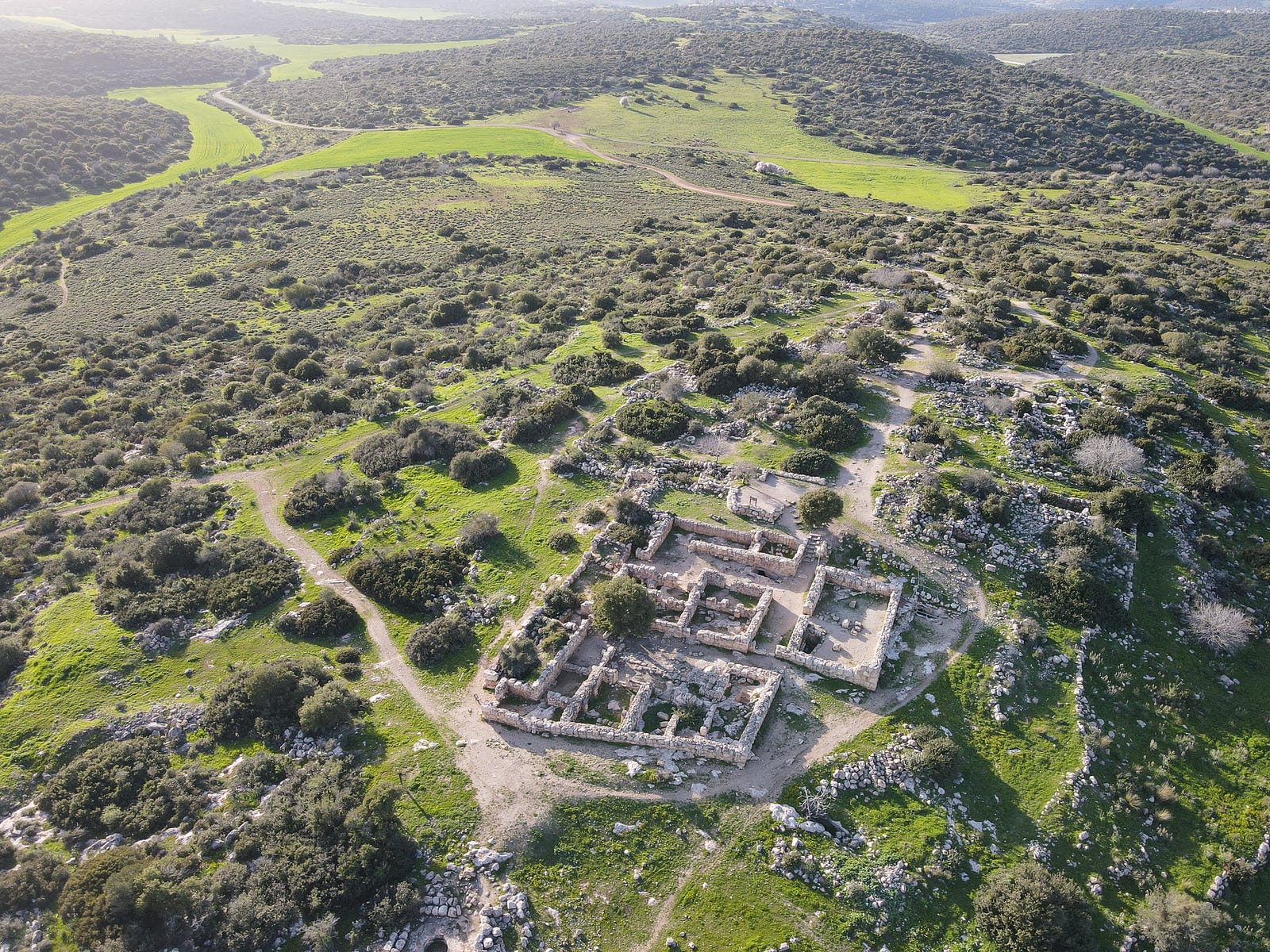
Watching that thin green stream, I think of the other presses, the ones cut straight into the bedrock. It’s a particular kind of stone you start to notice after enough years of hiking here – a round basin with a channel running out of it – and once you know what it is you see it everywhere, on trails where you would never expect anyone to have lived, let alone pressed oil. I think of one in particular at Horvat Itri, the ruins of a Second Temple-era town in the Adulam Nature Reserve, where a perfectly preserved press sits among the small homes and gathering places and ritual baths, as ordinary a part of the town as any of them. Beneath the town run tunnels where Jewish rebels hid from the Romans, and carved into their walls are little notches that once held oil lamps to light the way.
Archaeologists at the site found coins and pottery and even weapons, and they also found olive pits, from trees that have been part of life here for thousands of years, and whose descendants are still standing on these hills. Somewhere in all that driving, this is what I keep coming back for: one day a year, standing where our ancestors stood, doing exactly what they did.
Avi will have to come back later in the day for ours, another long drive for the sake of this maddening project, so I buy some fragrant tomatoes and curly lettuce and get back in the car without my olives.
Kilos brought: 27.5. Kilos paid for: 50. Shekels: 225. Liters: 5.
* * *
On the drive home, I think over our olive escapades. Oil, at least, asks only for a day and a few long drives. Curing requires months. The first year I cured olives, I made a few jars almost by accident. We were hiking a trail, saw ripe wild olives, and just started filling our pockets. I soaked them and salted them, waited for months and then brined them, and after six months of love and some rosemary and garlic, we had the most incredible olives I’d ever tasted. We ate them with our breakfasts for a year.
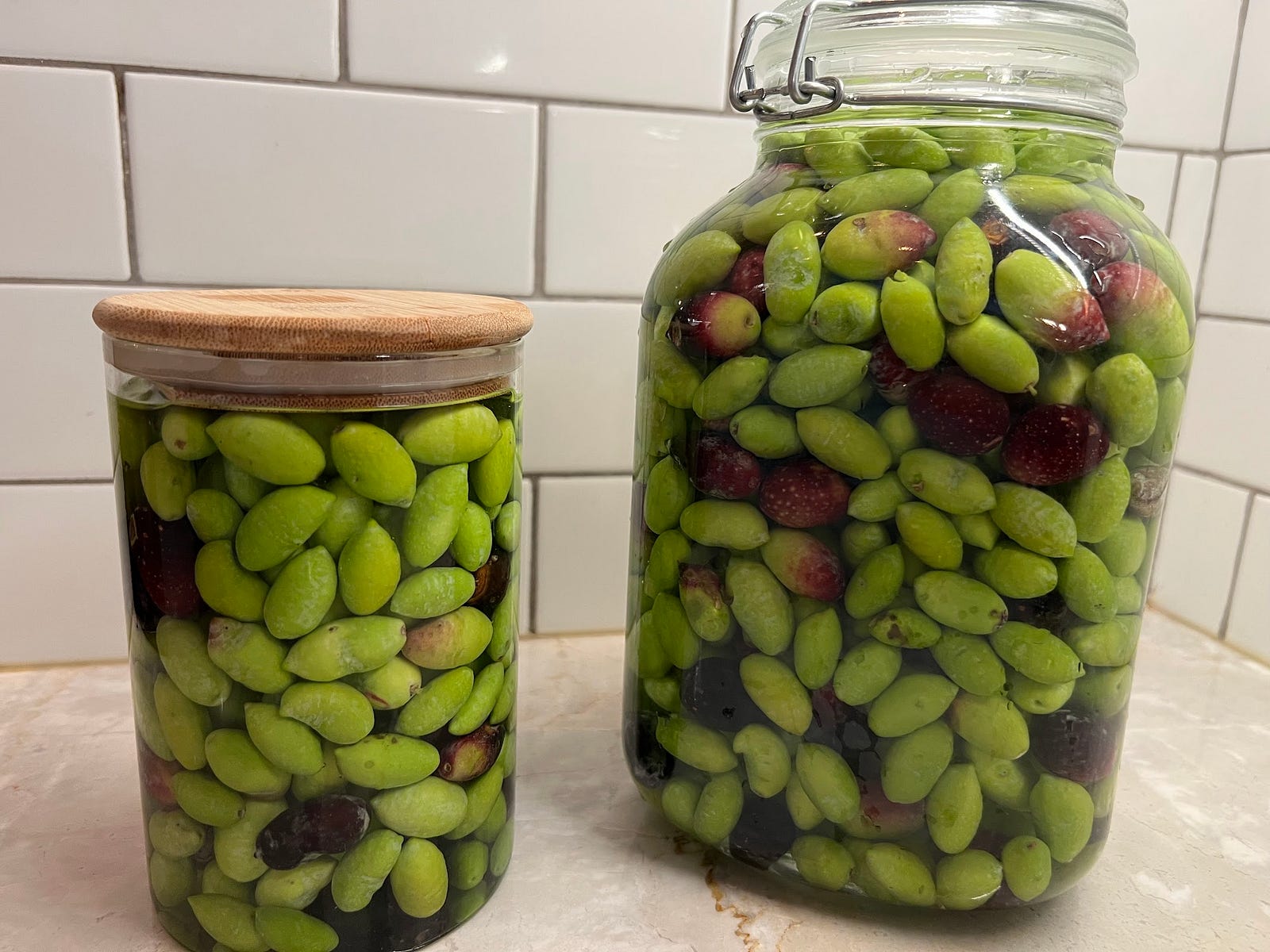
They were so good that the following season I did what anyone would do with a small success and tried to make it a large one. We went picking and gathered buckets and buckets of olives, and bought a dozen large glass jars to hold them all. What I failed to foresee was the work that comes with soaking and salting such a tremendous quantity. I kept at it for a while, soaking and salting and pouring off and doing it all over again, until eventually I gave up, and the jars loomed around the kitchen, waiting for attention that never came.
Days of changing the water: 14. Months of waiting: 6.
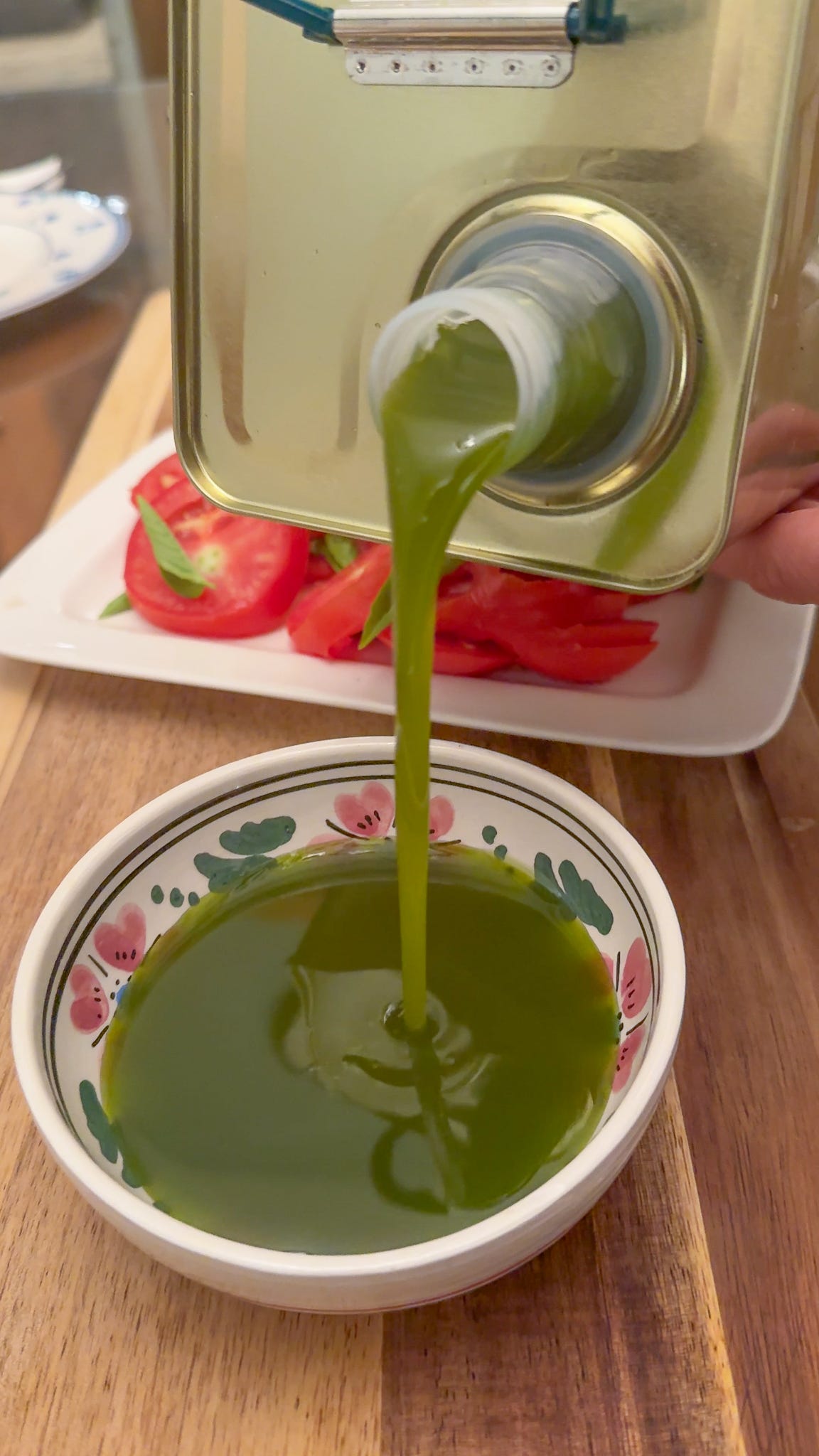
Late that evening, Avi returns with our prized jug, and I assemble our feast. The oil is poured into the bowl with the painted red flowers, beside a plate of sliced tomatoes with basil from our yard, a fresh salad with the curly leaf lettuce, and a loaf of sourdough bread that does not stay whole for long. It’s just Avi and me and Benzi, at our wooden kitchen table. After saying the blessing, Benzi takes the first bite, a piece of bread soaked and then savored for a good three seconds before the sharp kick of freshly pressed olive oil hits his throat and he starts to cough. We laugh at the intensity of his reaction, and dip our own bread, savoring that deep and earthy taste of fresh, green oil.
Two glasses of red wine, and we have a meal fit for a king. Bread, wine, and olive oil – staples of the land.
Related Topics
Related Posts