
Crisis Communicator, Droll Dragon
They’ve Always Hated Us. That’s Still No Excuse
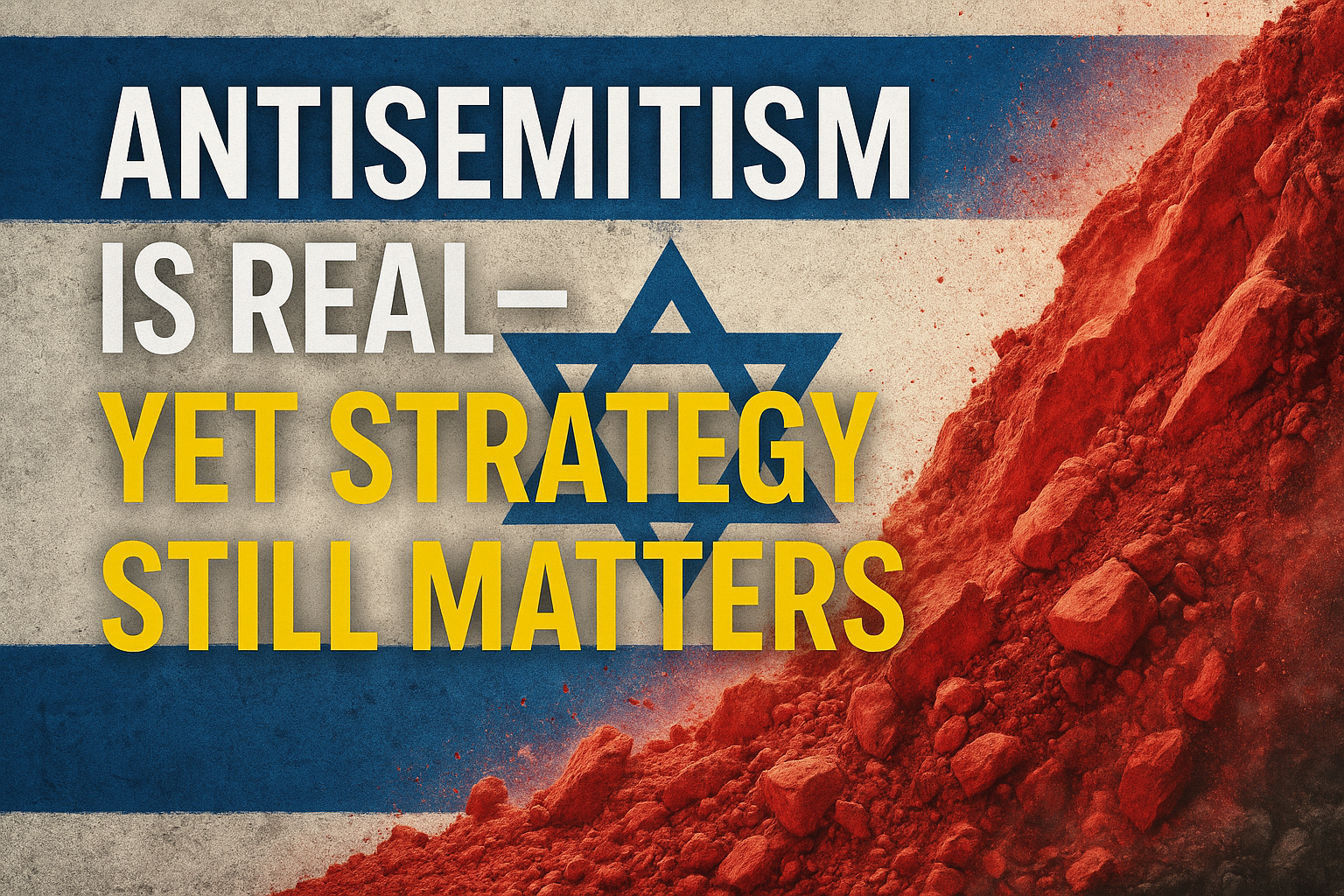
It is a fact: antisemitism is a constant. It is the background noise of Jewish history, the virus that keeps mutating, the irrational hate that doesn’t need a reason. Yes, it is absolutely a factor in the world’s rush to blame Israel for every tragedy that unfolds in Gaza.
Still, antisemitism alone cannot explain how or why Israel is losing the war of perception. If the only explanation for Israel’s collapsing public image is, “They’ve always hated us,” then we have already surrendered the battlefield that matters most in today’s global landscape.
That is the message political strategist Howard Wolfson delivered in a recent conversation with Daniel Gordis. His words were urgent and sobering: “Quite simply, the war for hearts and minds has been lost.” Not slipping. Not under strain. Lost.
The numbers are devastating. In 2014, 70 percent of Democrats held a favorable view of Israel. Today, that number is down to just one-third. Among independents, support is under 50 percent. Among young Republicans, sentiment has flipped—more disapprove than approve. This is not merely a polling problem. It is a national security crisis.
It sounds preposterous to say, but support from the United States—the military aid, the intercepts, the diplomatic cover—relies heavily on public opinion. That opinion is no longer being shaped by facts or context. It is being shaped by images, narratives, and repetition.
“Put aside what’s fair. Put aside what’s accurate,” Wolfson said.
“It’s not about fairness and accuracy. It’s about effectiveness and about impact.”
He is right. The most circulated images of this war are not of Hamas atrocities. They are of starving children and shattered buildings. Repeated endlessly and stripped of nuance, these images have turned a falsehood into a dominant narrative: that Israel is committing genocide.
We are witnessing, in real time, a modern application of Goebbels’ rule: repeat a lie often enough and it becomes the truth.
Despite this, too many in our community continue to rely on moral certainty as if it were strategy. There remains a belief that being right is enough. That if we explain the facts just one more time, the world will understand. Yet facts do not go viral. Emotion does, and right now, Israel’s story is being told by its critics—in memes, in reels, in soundbites that travel faster than an Iron Dome interceptor.
This problem is not limited to Israel. It begins at home, within the American Jewish community itself. In a column I wrote earlier this year, I argued that American Jews need a wake-up call. That message is even more urgent now. Too many progressive American Jews, uncomfortable with the complexities of power and conflict, have retreated from Zionism altogether. They have embraced a version of Jewish identity that rejects sovereignty, defense, and moral complexity. In doing so, they have ceded the narrative to those who distort it most.
At the same time, some (politically) conservative Jews assume that evangelical or Republican support will serve as a permanent firewall. That, too, is a dangerous illusion. Support is not static. It must be earned and protected—not taken for granted.
Some in Israel have begun to shrug it off. I was told today by an Israeli advocate writing from the war zone that the new announcement of a Gaza occupation signals Israel’s attitude: “We don’t give a flying f*** anymore about opinions.” That view is becoming more common. After nearly two years of tragedy, loss, and compulsory restraint, many Israelis feel too burned to care what the world thinks. I understand that fatigue.
Still, we cannot afford to stop caring.
Nor can we fall into fatalism. I was also reminded of a warning: “Secular German Jews circa 1933 believed the hateful rhetoric wasn’t geared at them—but at the provincial shtetl Jew. Boy, were they gravely mistaken.” The danger of denial is real. However, recognizing antisemitism should not mean surrendering to it. Just because people hate us does not mean we stop trying to shape how we are understood.
That is precisely what Wolfson emphasized when he added a third war aim to Israel’s current mission: Defeat Hamas. Rescue the hostages. Do not lose the United States in the process.
Losing America would mean losing the munitions that have kept Israeli families alive. It would mean losing the interceptors that stopped Iranian missiles midair. It would mean losing the last superpower that still sees us as an ally worth defending. We cannot allow that to happen—not because we are tired, not because we are angry, and certainly not because we are self-righteous.
The truth is, we are not fighting this war strategically. Hasbara isn’t just broken—it has practically ceased to exist. Just about every minister, every MK, every spokesperson says what they want, how they want, when they want. There is no party line, no centralized message, and no emotional intelligence guiding the global conversation. Even those who say the right things are saying them in isolation—disconnected, disjointed, and strategically ineffective.
Meanwhile, our adversaries are masterful storytellers. They know how to frame the conflict in fifteen seconds or less. They know how to make moral monsters look like victims, and they know we will likely respond with lectures, citations, and indignation.
This is no longer a moral debate. It is a strategic emergency.
Israel’s leaders must wake up to the scope of this collapse. American Jewish institutions must stop reacting defensively and start communicating offensively. Those who care about Israel must stop assuming that historical suffering is a shield. It is not. It is a warning.
Antisemitism may fuel much of the hate—but we still have to fight to shape the narrative. We can hold onto our historical pain and still work to ensure that perception does not become our undoing. We can combat propaganda not just with facts, but with strategy, storytelling, and unity.

The newspaper Yedi’ot, Wolfson, and Gordis called it what it is: an avalanche.
It is not coming. It is here. Whether it buries us or wakes us up depends on what we do next.
Related Topics