The views expressed herein are solely mine.
This Is How America Wins in Iran and Weakens China
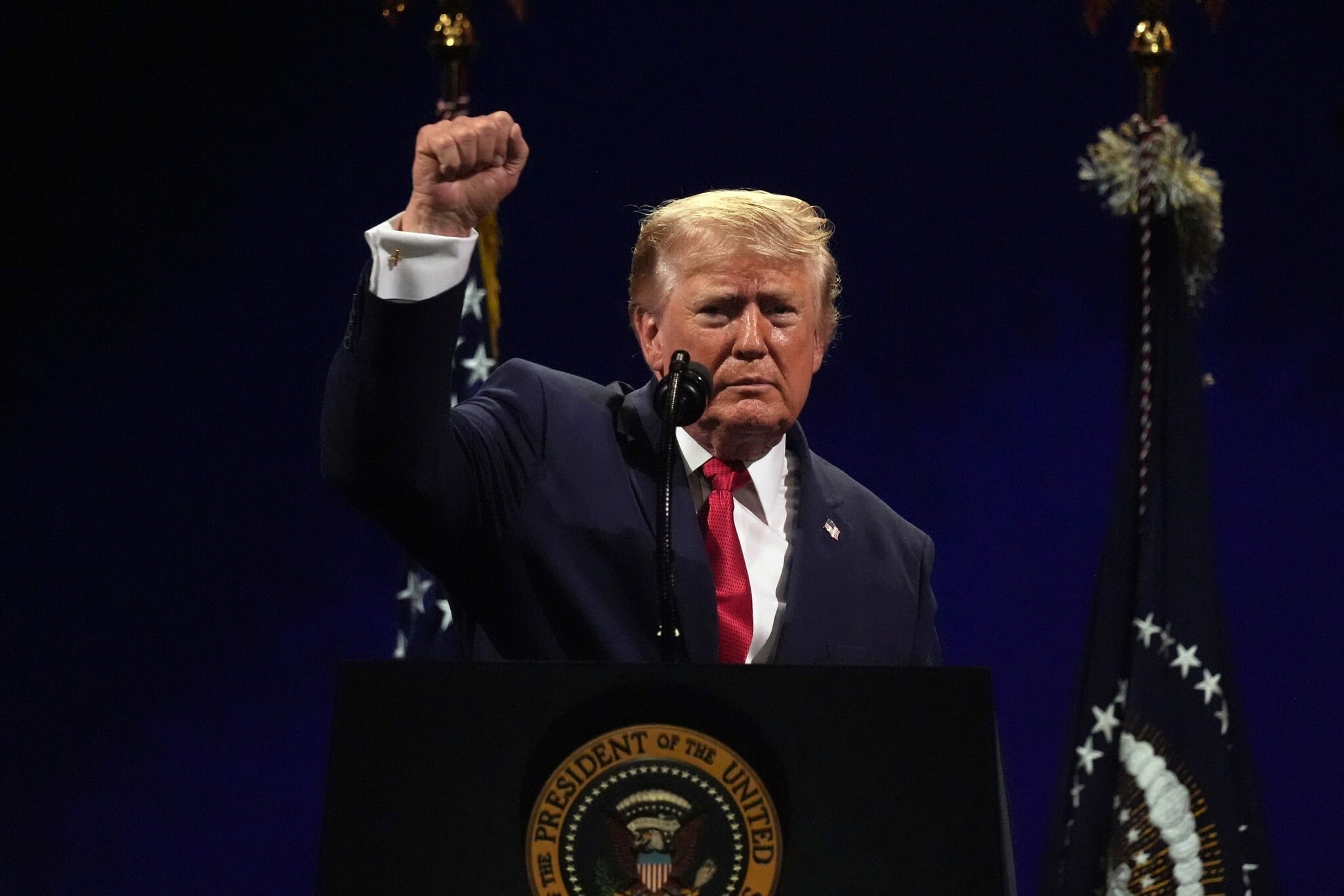
US President Donald Trump gestures at the conclusion of his speech during Salute to America, an Independence Day event honoring the nation's 250th anniversary, Saturday, July 4, 2026, on the National Mall in Washington. (AP Photo/Mark Schiefelbein).
In the last two weeks, Iran’s Islamic Revolutionary Guard Corps (IRGC) has repeatedly claimed responsibility for missile strikes on several oil tankers in the Strait of Hormuz, branding the vessels as “offending supertankers that ignored warnings, turned off their navigation systems, and attempted to traverse a mined route.” The IRGC attacks, paired with accusations that Washington incited the vessels and threats of a global energy crisis if the strait remains disrupted, give the United States and its regional partners a clear opening to break Tehran’s energy blackmail.
By starving the regime of its last hard-currency lifeline, forcing China—the buyer of 85% of Iran’s discounted crude—to absorb direct costs, degrading the physical infrastructure that sustains both oil exports and domestic gas production, eliminating surviving senior leaders, and creating the conditions for internal opposition to finish the job, America could regain the upper hand.
Kpler data show that Iran moved 1.61 million barrels per day of crude exports over the past year, with 1.52 million barrels per day—94 percent—transiting through the single Kharg Island terminal, which has roughly 31 million barrels of storage capacity. Permanent denial of Kharg and adjacent Qeshm hubs would slash revenue streams sustaining the IRGC and its proxies while ending Tehran’s capacity for prolonged Hormuz disruption. As aforementioned, China purchases the overwhelming share of these discounted, sanctions-evading barrels via Iran’s shadow fleet operating from Malaysia and Singapore. Therefore, coordinated denial at these nodes imposes direct costs on Beijing’s refiners while the regime loses its key economic support.
At the same time, the United States Strategic Petroleum Reserve holds sufficient volume to buffer Western and allied markets through any short-term disruption. Calibrated releases tied to verified Iranian mining or closure attempts in the Strait of Hormuz—which carries roughly 20 percent of global oil trade—would protect regional partners and isolate China, making it the main victim of price and supply pressures.
South Pars, the world’s largest gas field shared with Qatar, accounts for 70 to 80 percent of Iranian gas production. The Mullahs awarded $17 billion in contracts in 2025 to sustain output amid sanctions-driven technology shortfalls. Thus, precision strikes on Iran’s compression and processing nodes would deepen domestic energy shortages and further erode the regime’s legitimacy, as protests across all 31 provinces have already demonstrated.
The 2025–2026 protest wave erupted after the Iranian rial lost 50 percent of its value. Credible monitors documented thousands killed, and more than 26,000 arrested as exhausted security forces maintained constant patrols and Kurdish groups called for nationwide strikes. External pressure on Iran’s export and gas infrastructure—paired with messaging that contrasts Tehran’s funding of foreign militias with blackouts at home—would intensify public anger, deepen internal strain, and expose fractures within the security forces.
The Gulf states have already absorbed Iranian attacks on their shipping and waters. Yet the United Arab Emirates, Saudi Arabia, Bahrain, and Kuwait have demonstrated capabilities in missiles, drones, and air power. Oman has played a more ambiguous role, at times facilitating Iranian traffic. Washington should reject any reimbursement or cargo-fee model that frames the United States as a paid security contractor. A superior approach must tie the full integration of U.S. missile-defense architectures directly to coordinated Gulf kinetic contributions against Iranian launch sites and coastal assets.
The Trump administration should therefore launch multi-domain operations that combine precision munitions, cyber intrusions into terminal SCADA systems, electronic warfare against radars and command nodes, and naval enforcement to render Kharg and Qeshm unusable for regime exports and military logistics. These actions deny Tehran the physical tools for energy blackmail without sustained ground occupation.
In parallel, Washington should stand up a China Oil Premium Interdiction Task Force to intercept and publicly attribute Chinese-operated shadow-fleet tankers loading Iranian crude, releasing AIS tracks and buyer identifications in real time to spike insurance costs and force Chinese refiners to pay market rates or shift suppliers. Accelerating U.S. liquefied natural gas exports to India, Japan, and South Korea would further erode demand for discounted Iranian and Russian energy across Asian markets.
America should negotiate bilateral Gulf Energy Defense Pacts with the United Arab Emirates, Saudi Arabia, Bahrain, and Kuwait, delivering missile-defense integration under joint command in exchange for pre-authorized Gulf strikes on designated Iranian sites triggered by attacks on neutral shipping. For Oman, resuming future cooperation must be contingent on the verifiable termination of the facilitation of Iranian traffic.
Simultaneously, secure channels and timed information operations should flow to protest networks and opposition formations, coordinating with groups that have demonstrated nationwide reach and prioritizing defection incentives for exhausted IRGC and Basij units. A Selective Hormuz Exclusion Protocol should enforce a coalition-patrolled zone barring Iranian military vessels and sanctioned commercial traffic, with automatic rules of engagement on mining or attacks and Strategic Petroleum Reserve releases linked to verified Iranian disruptions. Meanwhile, precision operations against South Pars processing nodes should coincide with opposition campaigns exposing the regime’s mismanagement of its most critical gas field.
To make this effective, persistent targeting of remaining senior IRGC commanders and regime officials, paired with financial tracking of their personal networks, must continue to accelerate internal fracture. Indeed, existing Abraham Accords frameworks should be expanded to include explicit energy-infrastructure defense clauses and pre-negotiated joint contingency planning to rapidly stabilize key oil and gas sites during any post-regime transition.
In my judgment, these steps convert Iranian aggression into a self-reinforcing trap. They deny the regime revenue at its most vulnerable chokepoint, impose direct costs on its Chinese patron, degrade the infrastructure enabling energy blackmail, eliminate surviving leadership, and amplify internal fractures visible in protest data and security-force strain.
The documented export volumes through Kharg, South Pars dependence, protest scope across every province, and Gulf partners already bloodied by Iranian attacks supply targets and justification for action that breaks the cycle. The IRGC may believe they can manufacture an energy crisis on their own terms. In reality, they have handed Washington instruments to turn the Strait of Hormuz from a regime lifeline into a corridor through which the Islamic Republic’s last sources of power and legitimacy finally slip away.
Related Topics
Related Posts