International Speaker, Author, Educator, Tour-Guide, Artist, Zionist
Featured Post
October 7: What I wrote then, and what I know now
Three years later, I look back at Kfar Aza and Be'eri, the soldiers beside me, and what this war has taught me about courage, loss and who we are
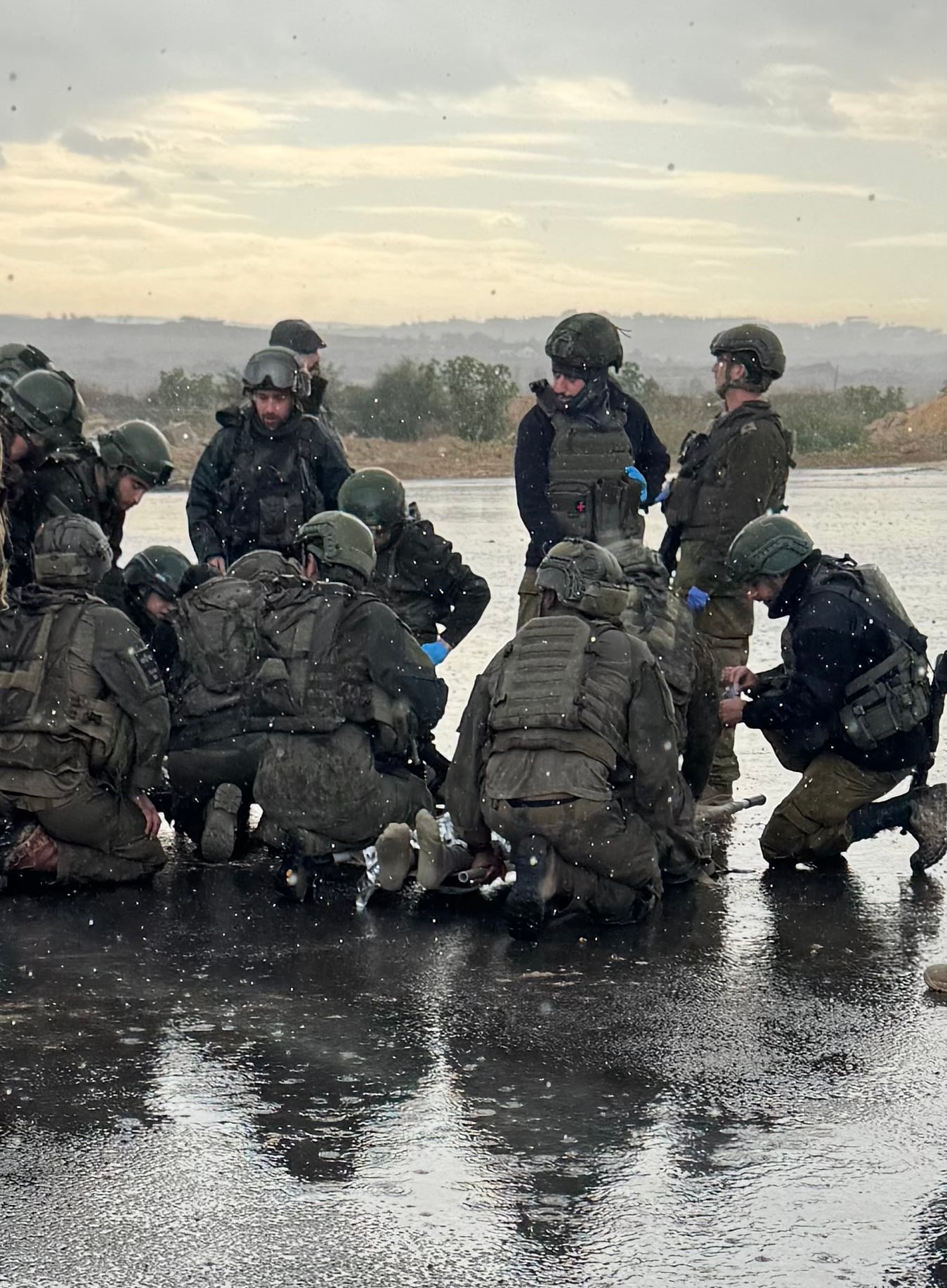
PALMAR rescue in the rain. (Photo ©️ Tuvia Book, 2026)
This week marks three years since the “hell on earth” of October 7. In those first weeks, I wrote three short pieces from inside the war. I have just reread them, and I barely recognize the man who wrote them. He was angry, grieving, and certain of very little except that he had to be in uniform.
Hell on earth
The first piece was actually a message from my friend Ralph Lewinsohn, a fellow tour guide who came to Israel from Namibia and raised his children and grandchildren on Kibbutz Kfar Aza, a few hundred meters from the Gaza border. (I spent my years as a “Lone Soldier” in Givati at the Kibbutz over the road, Kibbutz Sa’ad.) Thirty-six hours after the massacre began, he described what he had survived. Terrorists ran past his house, shooting without pause. His emergency response team was nearly wiped out. For hours he had no idea whether his daughter was alive. Soldiers finally broke in through his window, and in the seconds before they spoke, he did not know whether they were rescuers or killers. He then described the moment the IDF evacuated him from his house:
They collected us in small groups, and under heavy guard, led us to buses, which eventually evacuated us out of the war zone. There was constant heavy fire around us, and we had to take cover in a bunker for a while. On the way to the buses, we passed tens of burnt-out vehicles, bodies lying in the street, RPG launchers, AK47 rifles, grenades etc.
One detail has never left me. A friend’s grandchildren hid in a cupboard in a room with the bodies of their family, while a social worker stayed on the phone with them for hours until soldiers arrived. Ralph ended with a lesson from his African childhood: a wounded animal is the most dangerous of all.
Three years on, I still think about those children. They are older now, carrying a childhood that ended in a cupboard. When people talk about “the events of October 7” as if they were a political abstraction, I think of that telephone line and the person who refused to hang up.

In the City of Slaughter
A few days later, I walked through the ruins of Kibbutz Be’eri with soldiers from my unit. Standing among the burned homes, I thought of Bialik’s poem “In the City of Slaughter,” written after the 1903 Kishinev pogrom, in which he begged his readers to go and see with their own eyes what had been done to Jewish families, and to feel the horror on the walls. Bialik wrote about the “normality” of killing Jews and the world’s indifference:
For God called forth the spring and the slaughterer together:
The sun shone, the Acacia blossomed, and the slaughterer slaughtered.
Forty-nine Jews were killed in Kishinev, and it shook the Jewish world. On October 7, well over a thousand were murdered, and hundreds more were abducted amid atrocities on a vastly greater scale. Yet Bialik captured exactly what I felt in Be’eri: disbelief at human evil, the horror of innocents slaughtered, and the sense that the world was looking away.
But I also wrote then about one crucial difference, and I believe it more strongly now. The Jews of Kishinev had no army, no state, and no way to protect their children. We do. The Jewish people are not helpless, and “never again” is a promise we must keep with our own hands.

Good people
The third piece was about my unit, a PALMAR reserve medical extraction force of doctors, paramedics, combat medics, and fighters, stationed on the Gaza front. I thought then of a Naomi Shemer song about ‘good people’ that seemed to describe them exactly. People who know the way, and with whom you can keep walking.
Good people in the middle of the journey,
Very good people.
Good people know the way,
And we can continue walking with them.
I wrote about a lone soldier who came from Argentina to fight, a medic who cut short a trip to India after two weeks, a paramedic who had donated a kidney and aged out and who had three children serving in the army, and a doctor who flew in from London, leaving a sick wife and four small children. All of them came voluntarily, from every corner of Israeli society, with every religious and political view. We argued about nothing, because there was only one thing that mattered.
I quoted Shakespeare: “There is a tide in the affairs of men which, taken at the flood, leads on to fortune.” Reading it now, I would add that the tide also takes things from you. Those students, parents, and professionals gave years of their lives to this war. Some gave their lives.

Where we are today
What I did not know in those first weeks was that I would still be wearing the uniform three years later, in the same unit. I have spent more than two cumulative years on the Gaza front and just under one year on the Lebanon front. PALMAR units have carried out more than 3,000 evacuations, over 400 of them by helicopter. I wrote a book about it, Heroes of Palmar, because the stories deserved to be told.
What I got right then, I think, was the unity. I wrote that it took a war for us to find it, and I hoped it would last after victory. I will be honest: outside the army, it has frayed. In moments of respite, the noise of the world comes in, and the contrast with the camaraderie inside our ranks hurts. But I have also seen what holds when it counts. Religious and secular, left and right, new immigrants and sabras, Jewish and non-Jewish stand shoulder to shoulder, and no one asks how you vote when someone is bleeding.
What I did not understand then, perhaps, was that the fighting would not be the hardest part. The hardest part has been the waiting, the funerals, and the world’s hate and indifference, which has often been worse than I feared. In those first weeks, I was shocked that so many would excuse, justify or even side with the murderers. Three years on, I am no longer shocked, only sadder.
Yet Ralph’s wounded animal has not run away. We are still here. The Jewish people have a homeland and the strength to defend it. On October 6, 2023, I would not have believed how tested that strength would be, or how much of it there was.
Three years later, I carry the memory of Be’eri, the children in the cupboard, and the soldiers who volunteered from everywhere. I carry them the way we carry the wounded, to safety, and I will keep doing so.
Am Yisrael Chai!
Related Topics
Related Posts