
CFO | Empower Society for Good I Author
Tisha B’Av Reflection: The War Within, Then and Now
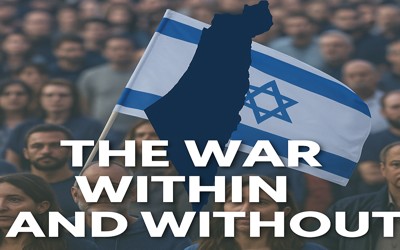
On Tisha B’Av, we sit low, read Eichah (Lamentations) and poems of what we have lost, and remember the burning of our Temples. But the tears we cry are not just for stone and fire. They are for the division within—the ancient spiritual fracture that broke us before Rome ever drew its sword.
Two thousand years ago, Jerusalem fell not simply because of foreign armies. It fell because of sinat chinam—baseless hatred among Jews. It fell because factions rose, each declaring the other treacherous. And while the enemy surrounded the walls, we tore ourselves apart from within.
Today, as the State of Israel stands under siege—militarily, politically, morally—we must ask: Have we healed that wound? Or is it bleeding again beneath the surface of our strength?
War Within: Then and Now
Today’s war is not only on the battlefield or in the court of global opinion. It is within our own people.
We are fractured:
- Haredim who refuse to serve in the IDF and see the state as a secular compromise.
- Secular Tel Aviv elites who see Torah as outdated and irrelevant.
- Former Prime Ministers openly calling for civil disobedience and political overthrow.
- Left-wing activists, sometimes funded by outside forces, who delegitimize the IDF and equate Israel with apartheid.
These aren’t just policy disagreements. They are wounds to the soul of the Jewish nation—each group holding its own version of “truth,” while forgetting the shared covenant that binds us all.
As we chant Eicha—“How?”—we must ask not only how Jerusalem was lost, but how we continue to risk losing it again.
A Letter to the Jew Who Sides Against Their Own
In this moment of deep moral confusion, some Jews—even with the best intentions—have begun to adopt the narratives of those who hate us most.
They repost headlines that accuse Israel of genocide.
They quote the Hamas-run health ministry as if it speaks with divine truth.
They call for boycotts of their own people, while excusing terror as “resistance.”
To those Jews, I say: your compassion is not the problem. Your misguided clarity is.
Yes, we are meant to care about every innocent life.
But we are also meant to remember who we are—a people with memory, covenant, and sacred duty.
When you accuse Israel of crimes while remaining silent about October 7, about rape, murder, and hatred, the problem is not your empathy. When you accuse Israel of crimes for the continuous suffering of the Gazans and don’t pin blame on Hamas for their actions, their refusal to a ceasefire (surrender would be better), and to release the hostages, you are siding with Evil. The problem is that your empathy has no anchor. No covenant. No loyalty. No memory.
And without those, your tears become weapons—not for healing, but for harm.
Time to Rebuild
Tisha B’Av is not just about what we lost. It is about what we still have:
- A Jewish people that still exists.
- A homeland that lives.
- A story still unfolding.
But if we want to rebuild, we must do more than weep. We must reclaim our covenant—the idea that we are one people, with one mission, rooted in one sacred history.
That doesn’t mean conformity. It means responsibility.
It means disagreement without destruction.
It means critique with commitment.
It means loving Jews more than we fear criticism.
It means loving Israel enough to wrestle with it—but never abandon it.
On Tisha B’Av, Let Us Mourn—and Return
Let us mourn the baseless hatred of the past.
Let us weep for the fractures we see today.
But let us also rise—with purpose—and say:
No more wars within. No more Jews tearing down Jews.
No more hiding behind false moralism while the Temple of our people burns again in spirit.
Tisha B’Av is the day we remember what division can destroy.
Let it also be the day we commit—as brothers and sisters—to rebuild, together
War Within and Without
A Tisha B’Av Reflection Series on Israel’s Battle for Its Soul
Introduction:
As we mark Tisha B’Av—the day our Temples fell, not only to foreign enemies but to internal division—I felt it was the right moment to share this 4-part blog series: “The War Within and Without.”
This is not just a reflection on war. It’s an exploration of identity, moral courage, and the future of the Jewish people. In a time of global hostility, internal fractures, and spiritual confusion, we are called to confront not only the enemies outside—but the chaos and loss of purpose within.
Each blog in this series tackles a different layer of the crisis we face—and offers a pathway back to unity, clarity, and Jewish destiny.
Blog 1: The War Within
Objective: To explore the growing internal fractures in Israeli society—between secular and religious, left and right, elites and soldiers—and how these divisions mirror the baseless hatred (sinat chinam) that destroyed us before. It asks: Can we still be one people in one land with one destiny?
Blog 2: The War from Outside
Objective: To expose how the West’s moral collapse—through media lies, ICC charges, and NGO propaganda—has weaponised humanitarianism against Israel. It highlights how antisemitic blood libels have returned in modern form and calls for moral clarity in the face of manipulation.
Blog 3: Why Israel? A Philosophical Answer
Objective: To answer the intelligent non-Jew or spiritual seeker who asks: Why is Israel always at the centre of world controversy? This piece offers a thoughtful, ethical, and spiritual explanation for Israel’s unique role as a moral compass and covenantal nation.
Blog 4: To My Jewish Brother or Sister Who Sides with the Palestinian Story
Objective: A heartfelt and challenging letter to fellow Jews who, out of pain or confusion, have embraced narratives that demonise Israel and empower its enemies. This blog calls them to return—not to silence or conformity but to loyalty, memory, and truth.
Closing Note:
On this Tisha B’Av, may these words stir introspection and restore a vision. The Temple was lost when we forgot who we were. May this year be different.
Let us rebuild—not only the land but our moral foundation.
Here is the first blog in this series:
The War Within – A Nation at War With Its Soul
Why is Israel so divided from within?
In times of war, bullets fly, and borders burn—but Israel today is engaged in something deeper and more existential: a war being fought not only on its physical frontiers but in its spiritual, ideological, and moral heart. This is the war within Israel—a profound and dangerous fracture between tribes, ideologies, and visions of Jewish destiny.
To understand this inner war is to understand the challenge of a nation built not merely on land and language, but on covenant, memory, and moral duty.
Between Army and Torah, Tel Aviv and Zion
- Haredi Draft Exemption
Many in the Haredi community claim that Torah study protects Israel. Yet others, even within religious Zionism, push back: “Torah must dwell in the land—but it must also defend the land.”
For decades, Israel has granted exemptions to Haredi (ultra-Orthodox) men from military service. But in a nation constantly at war, where every reservist counts, this exemption has bred resentment and rupture.
Can a society survive where one part prays while another part dies? Can Torah alone be defended, while the state that enables it is left to others to protect?
- Tel Aviv’s Secular Elites
At the other extreme are Tel Aviv’s progressive elites, many of whom threatened to withhold military service during the 2023–2024 judicial reform crisis.
These two poles—Torah without state, and state without Torah—mirror each other in their refusal to carry the full weight of covenant.
- The Role of Western-Funded NGOs and Former Israeli Leaders
Groups such as Breaking the Silence and B’Tselem receive foreign funding to critique the state from within. They claim to represent conscience—but often amplify distorted narratives abroad.
Former prime ministers Ehud Barak and Ehud Olmert have gone even further, appearing on international media to warn of Israel’s supposed descent into dictatorship and civil war.
Their agenda, cloaked in democratic rhetoric, appears to many as an effort to delegitimise a democratically elected government, using international allies and NGO infrastructure to achieve what they failed to do at the ballot box.
This alliance between external funders, leftist NGOs, and discredited political elites fractures Israeli unity when it is most needed.
Two Refusals, One Crisis
Despite their oppositional ideologies, both the Haredi draft resister and the Tel Aviv protestor share one trait: each refuses to carry the full burden of the state unless the state reflects their values.
Both have replaced covenantal responsibility with conditional participation.
Gol Kalev on the Inner Assault
“The assault on Judaism is not only anti-Semitism. It is a systemic attempt by the Western elite to replace Judaism’s moral clarity with postmodern ambiguity.”
This internal war is not simply political. It is a struggle over whether Israel will remain a covenantal nation—one rooted in ancient duty—or drift toward becoming just another Western liberal democracy.
The Way Forward: Covenant, Not Consensus
If there is hope, it lies not in winning every argument or silencing every critic. It lies in recovering what made Israel possible to begin with: Covenant.
A covenant is not consensus. It doesn’t mean we agree on everything. It means we are bound together, regardless of our differences.
- The secular Israeli must recognize that the Jewish mission is not a myth—it is the foundation.
- The religious Israeli must acknowledge that the state is not a distraction—it is the platform for redemption.
Israel’s war within must be healed through unity, humility, and a shared sense of calling.
Cover image – created by ChatGPT
Related Topics
Related Posts